Florida is living up to its tourist posters: bright, warm, and beautiful. And as I watch the northeast and Midwest descend into ice, snow, and wind chill chaos, Florida’s reputation as a winter refuge is solidified. Now that we’re near the southern end, it’s become hot and humid. The mosquitoes were apparently late coming back from the holidays, but some rain yesterday has them punching the clock again. We bought an anti-bug house to hide out in just in time!
To be honest, we haven’t done a lot so far this month, and that’s been lovely. Until two days ago, we hadn’t even done a lot of driving in Florida. Drive to get where we needed to be, sure, but not much beyond that.
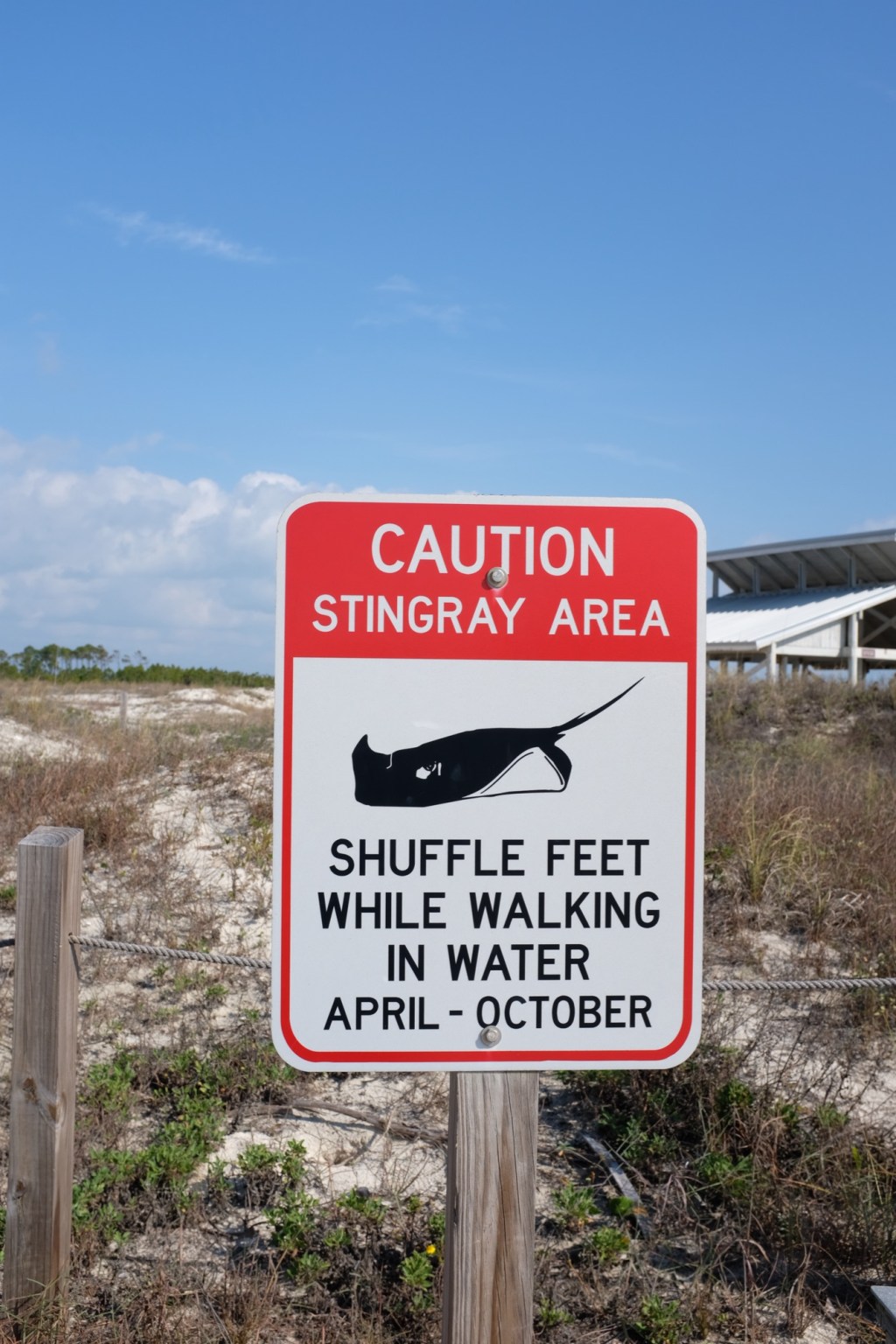
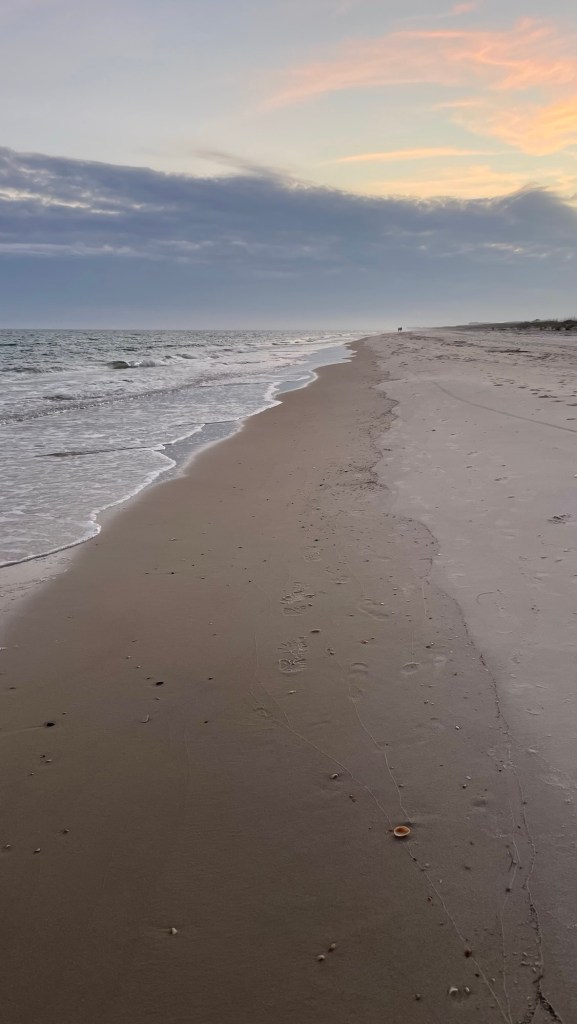
St. George Island, a barrier island along the Panhandle’s gulf coast, was the perfect first stop after so much time in Georgia. Crossing the long bridge to the island felt like the rest of the world had suddenly disappeared. Highly recommended.
We rode our bikes down the single state park road, spun our wheels when a cycling trail turned to sugar sand, and walked several miles through the wetland interpretive area.
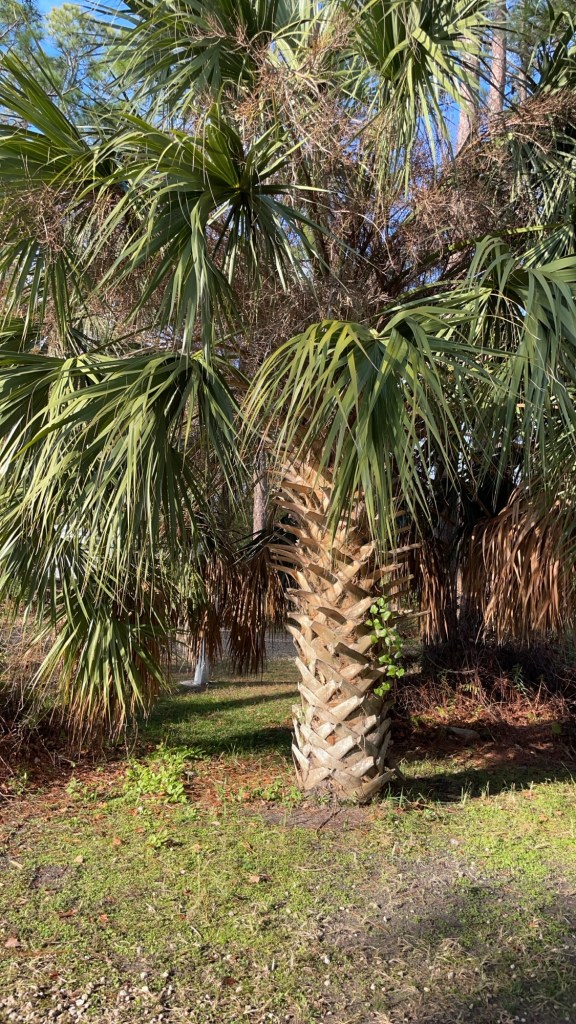
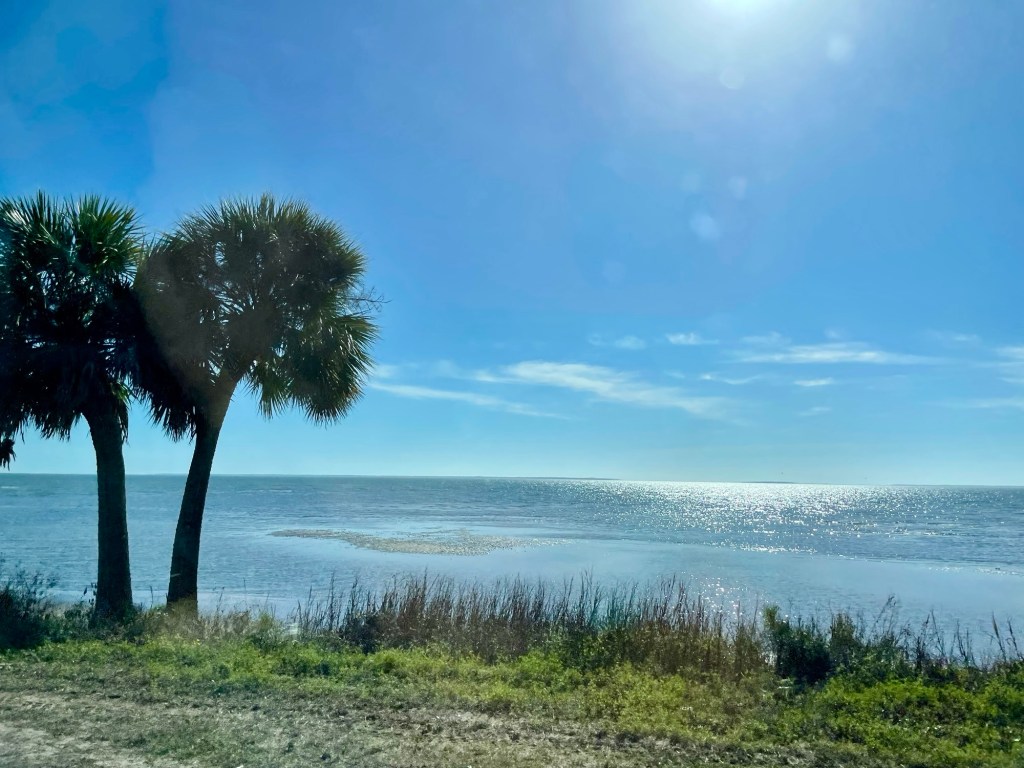
I started to appreciate the different palms
We kept our eyes peeled for alligators (no luck). I pulled my FujiFilm camera out and started to get a feel for its dials and settings again. On a deeply foggy morning when the propane grill didn’t want to light (our own fault), we had a delicious breakfast at The Beach Pit.
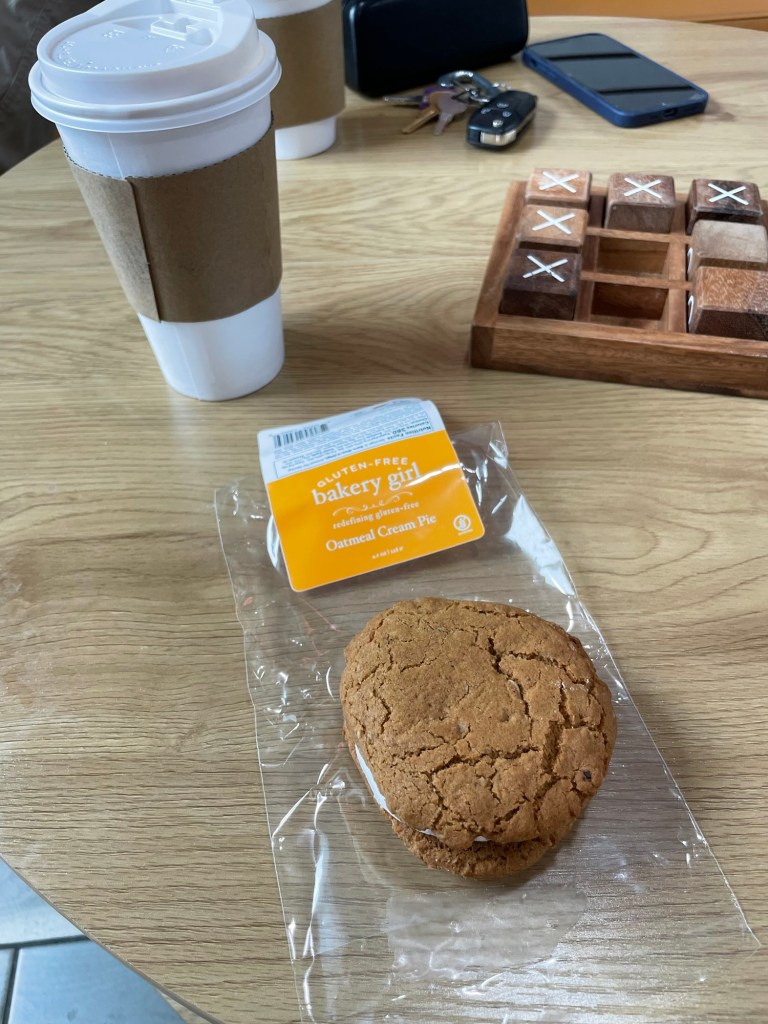
Afterward, we had a cozy cup of coffee at Island Espresso while we waited for the dense fog to lift. While ordering I saw that they carry a brand of gluten free snacks, Gluten Free Bakery Girl, that is easily the best I’ve ever eaten. I tried an Oatmeal Cream Pie as it’s also also dairy-free and I legit cried out with joy biting into it. It tasted just like the ones I remember from growing up. It’s a small thing, but it had a big impact.
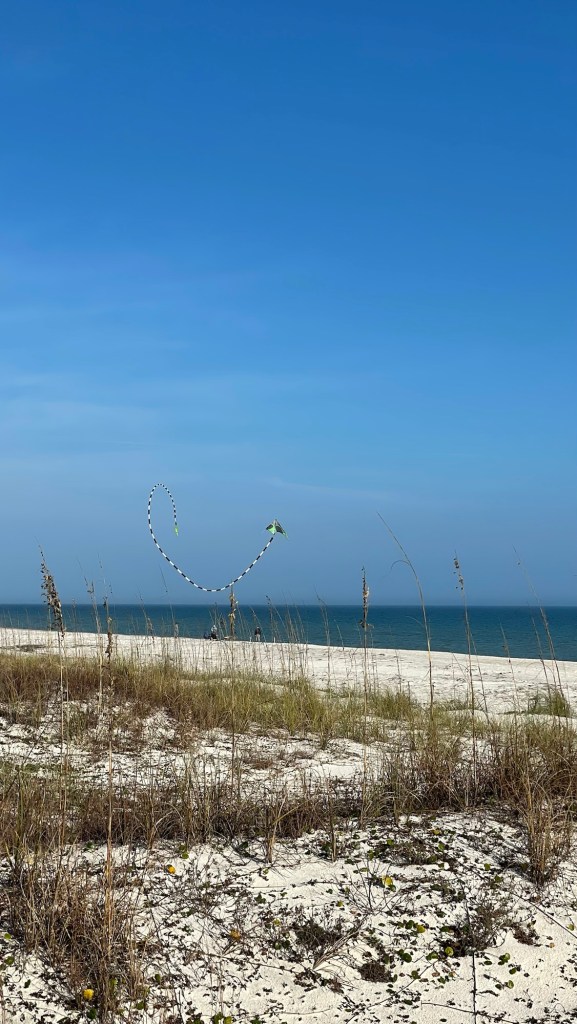
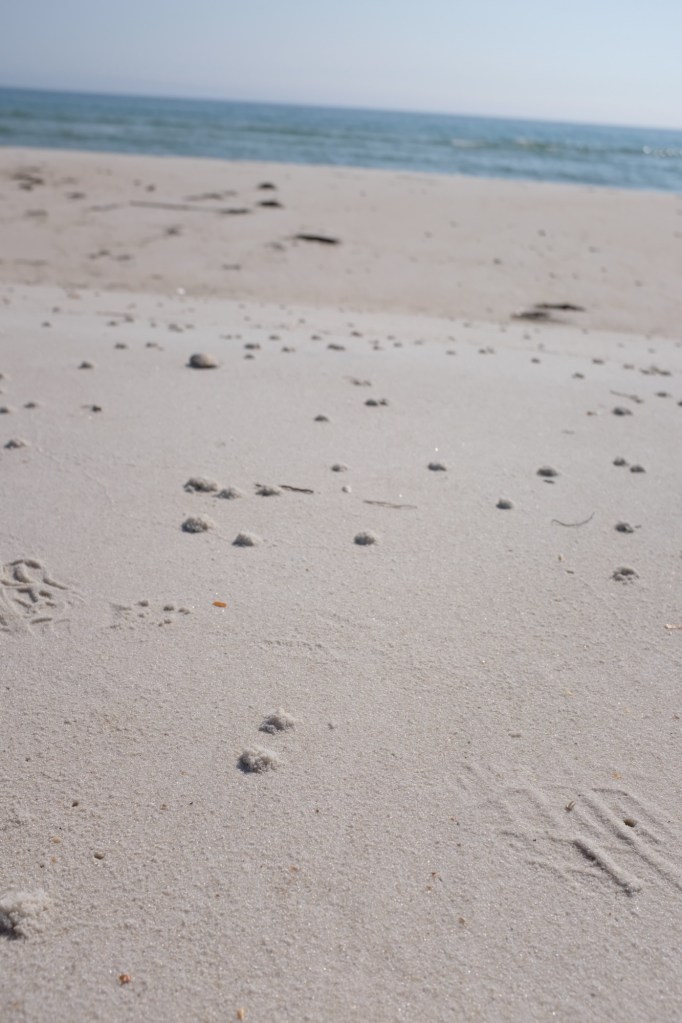
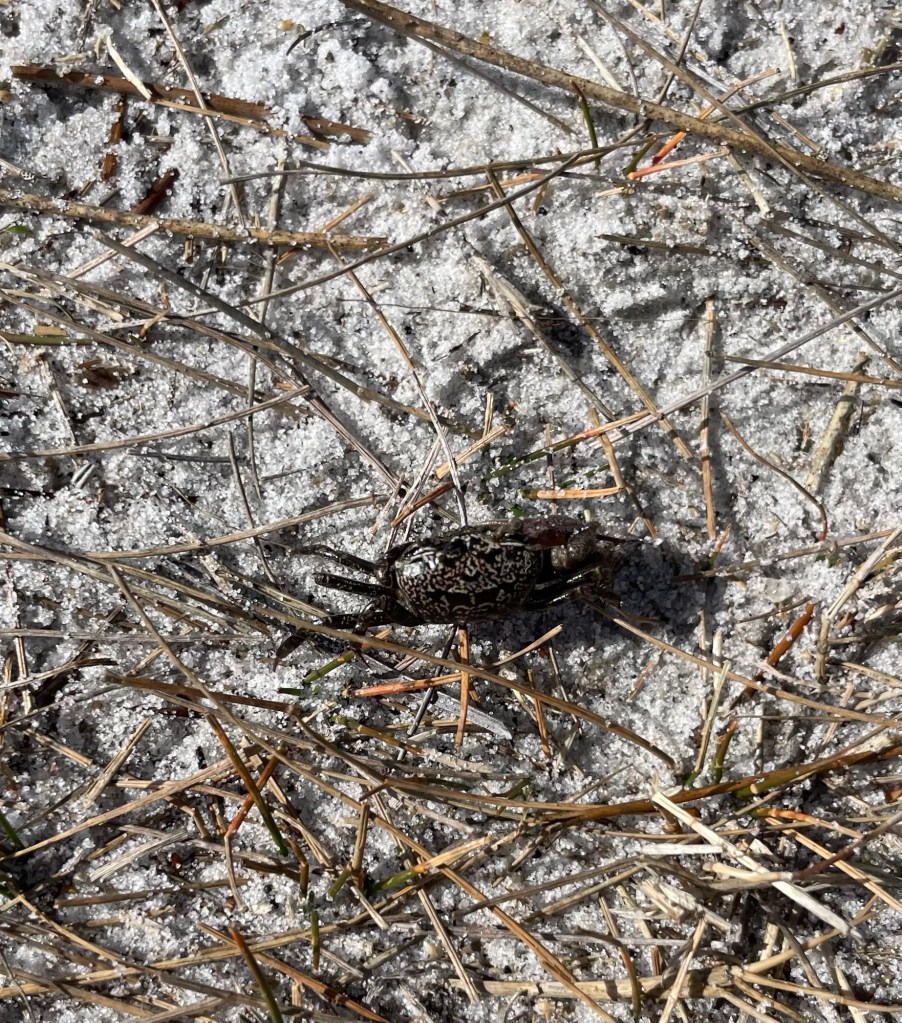
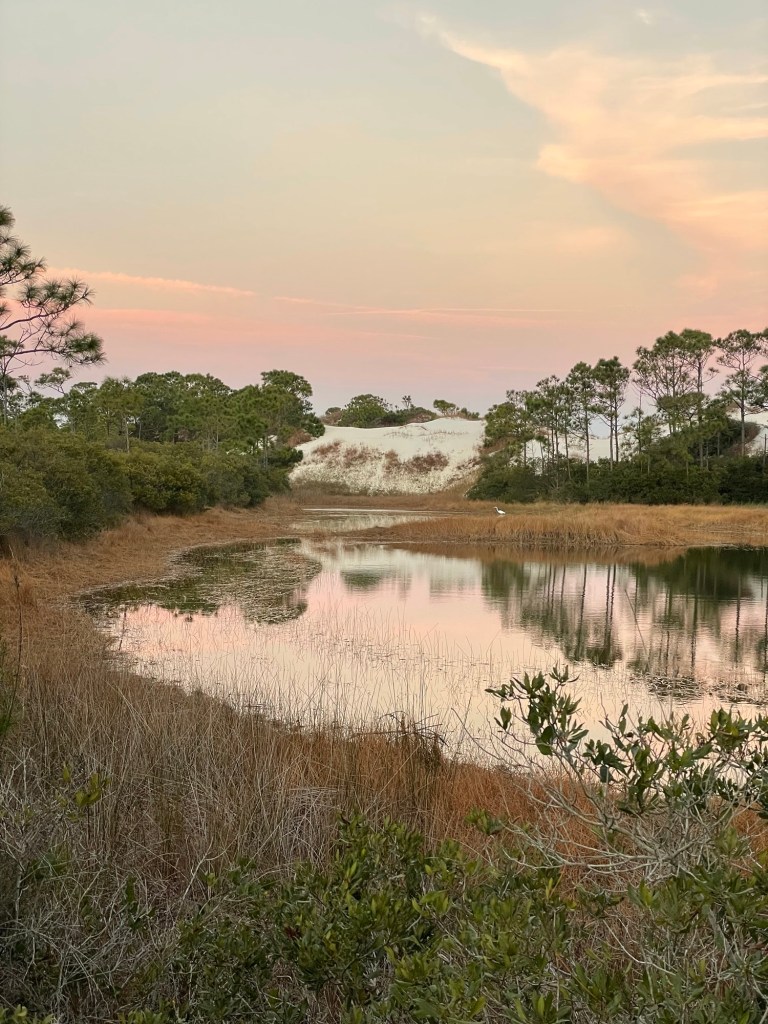
Later we watched a man taking a kite through leaps, curls, and dives. It made a zzz zzzz zzzzz sound as it cut its way through the air. I could have watched it for hours.We wondered what was making tiny little holes in all the sandy areas. Turns out, they’re little crabs of some sort. I never figured out which kind.Jeff learned about Great White Egrets while heading to the beach for sunset. (Zoom in to get a better look.)
I had several conversations with a tiny green tree frog that lives in one of the women’s shower houses. Jeff found a small cottonmouth snake near our truck. Thankfully the camp host moved it for us. That ticked it off and we got the whole curl and show your fangs show. Cool, but a little terrifying.
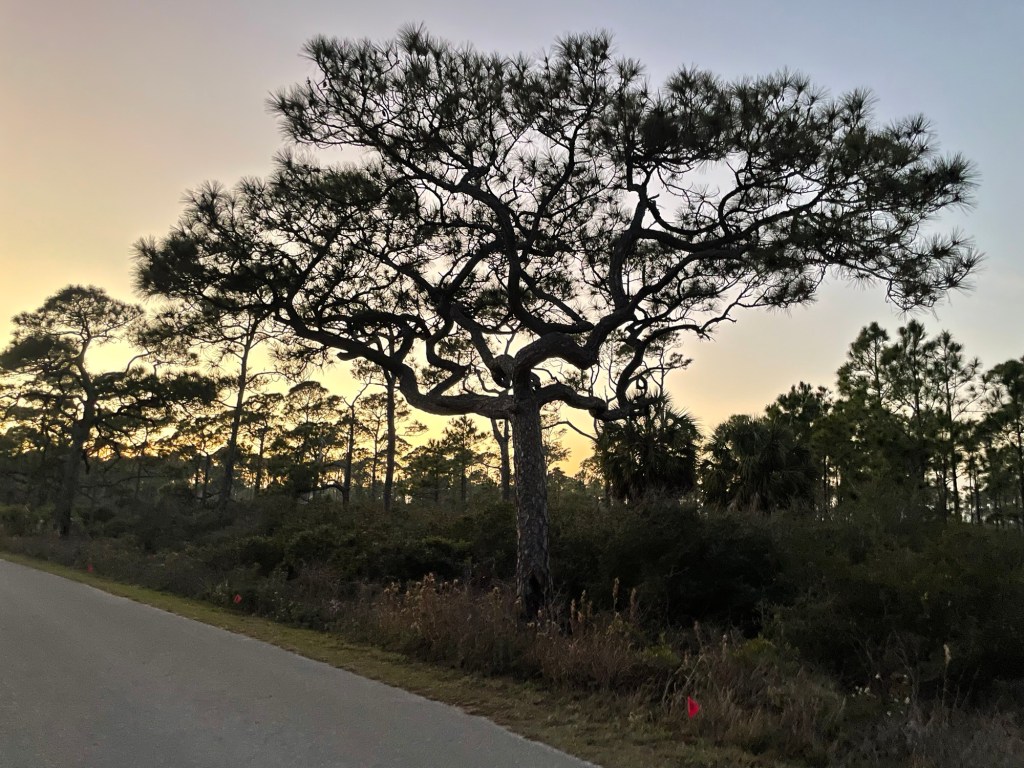
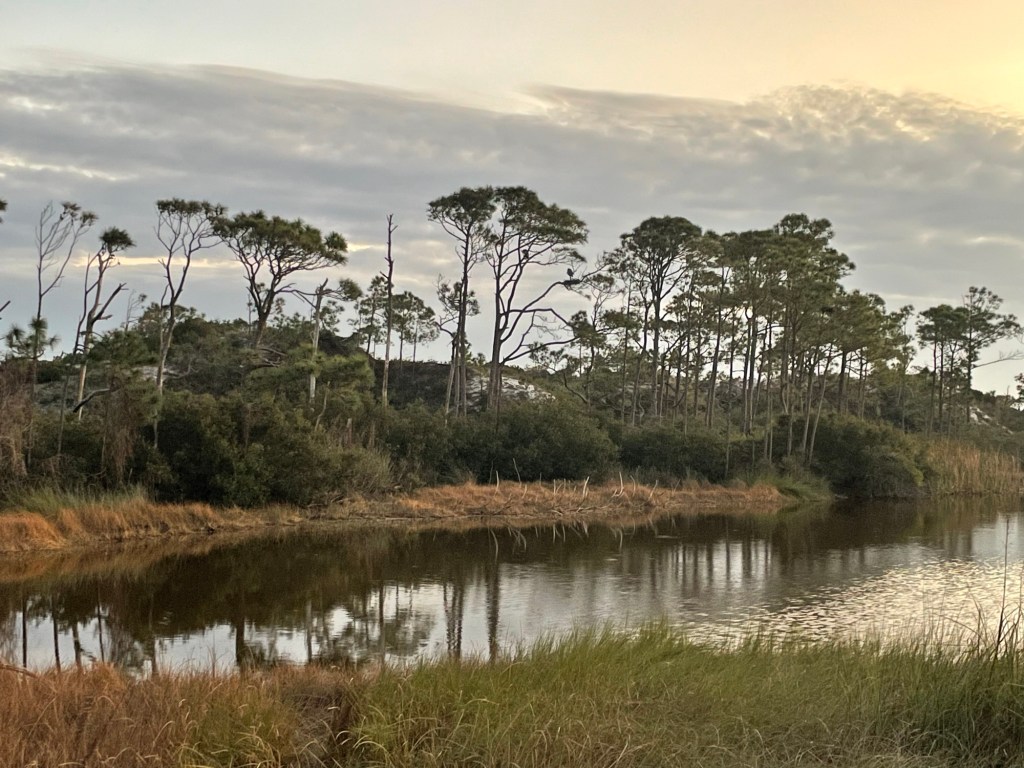
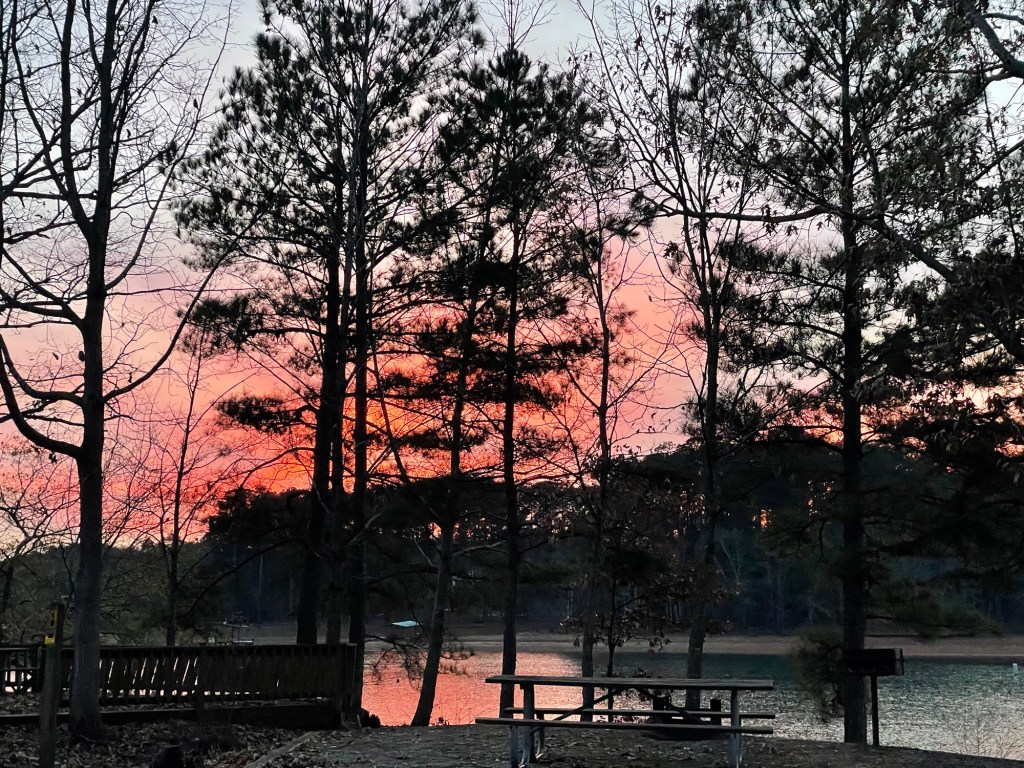
I fell in love with the silhouette of twisting pines against an orange sky.
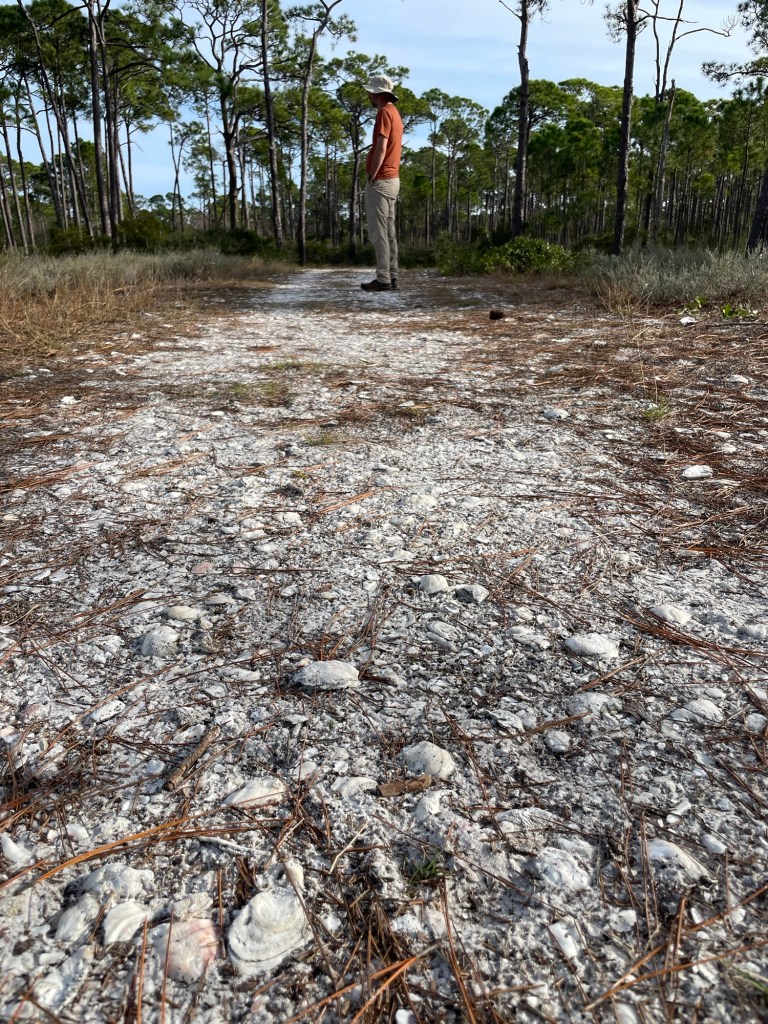
The island introduced us to the concept of using oyster shells as construction materials. It makes perfect sense as there are literally tons of them to be had, free for the taking, since local, raw oysters are a top menu item everywhere in these parts. (Thank you, no.)
Oyster shell path
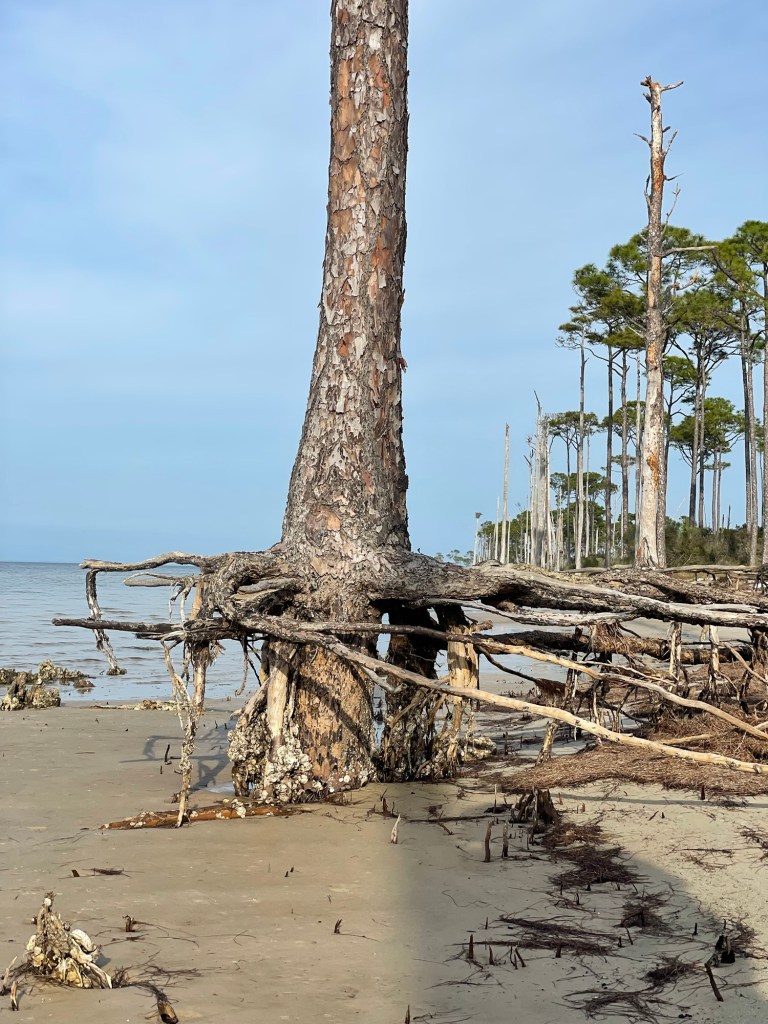
Tides are still something that I’m getting used to. The concept of water levels vastly changing from hour to hour is starting to make space in my brain, but the reality of what it does to the landscape is sometimes still beyond me. Toss in a few hurricanes scouring out the sand and it’s a whole different world.
I mean, seriously, this is wild.
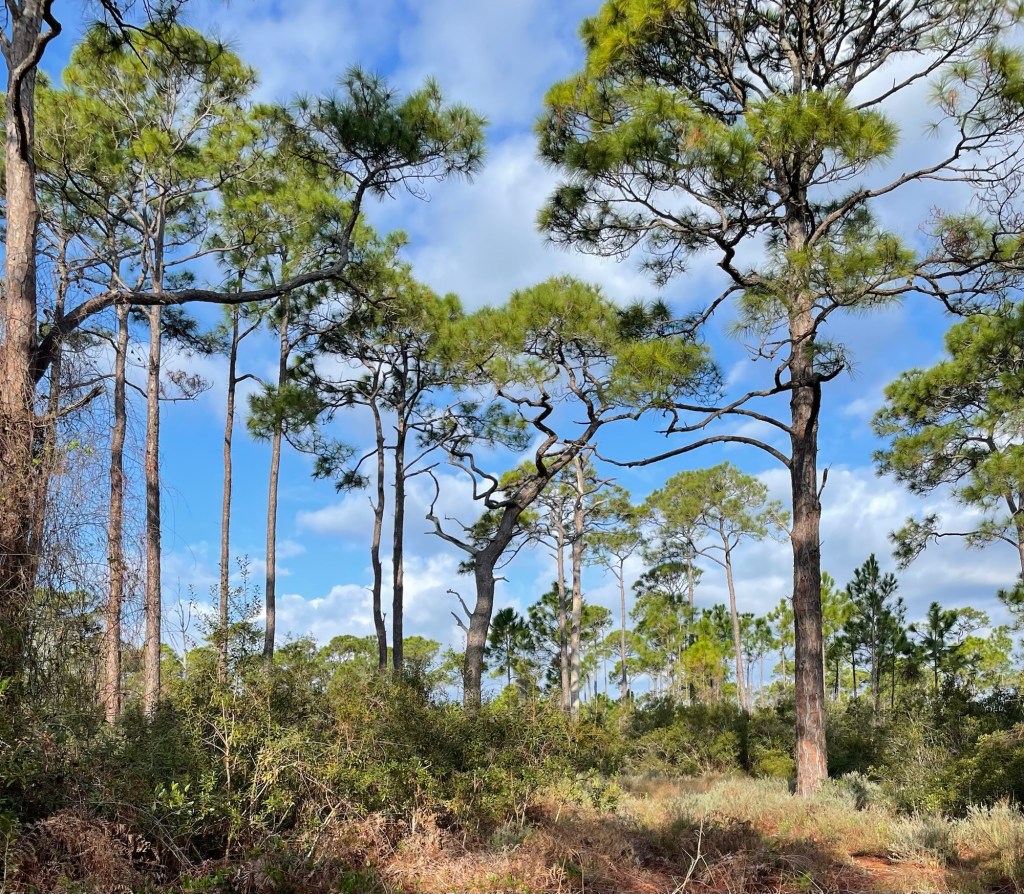
This poor long leaf pine has been through some rough days. The wind-twisted angles of the one below reminds me of trees out on the African savanna.
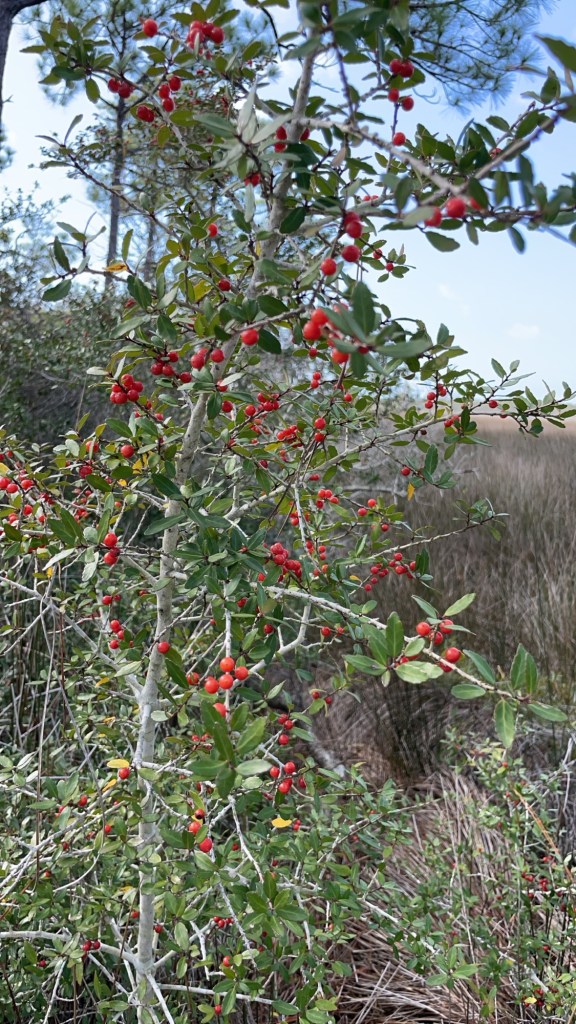
Ilex vomitoria (Yaupon Holly) is common across the park’s wilderness areas. Despite its name, tea made from this plant does not induce vomiting. It’s popular with many birds and mammals.The Panhandle is said to be what Old Florida was like. I can see the appeal. It was hard to leave. “The Forgotten Coast” (Don’t feel too bad, the locals like it that way.)
Florida drivers, we find, are at least as aggressive as Georgians and overly fond of playing on their phones while they drive. Jeff has had to lay on the horn to remind an oncoming car to stay on their own side of the road more than once. Despite all the proof to the contrary, a lot of people still seem to think that texting while driving isn’t a big deal. And there appears to be an inordinate amount of smarter than the average bear drivers down here. Locals love to complain about all the idiot snowbirds on the road, but it’s the Florida plates that terrify us!
We finally made it out of Georgia on Monday the 5th and are now sitting on a very lovely, very sandy barrier island on the Florida panhandle. It’s quiet and peaceful and the local cafe has delicious gluten-free & dairy-free goodies. The Oatmeal Cream Pie made me close my eyes in awe. Gluten-Free Bakery Girl (in Maryland) deserves all the good things in life.
Now, back to Georgia for a few minutes.
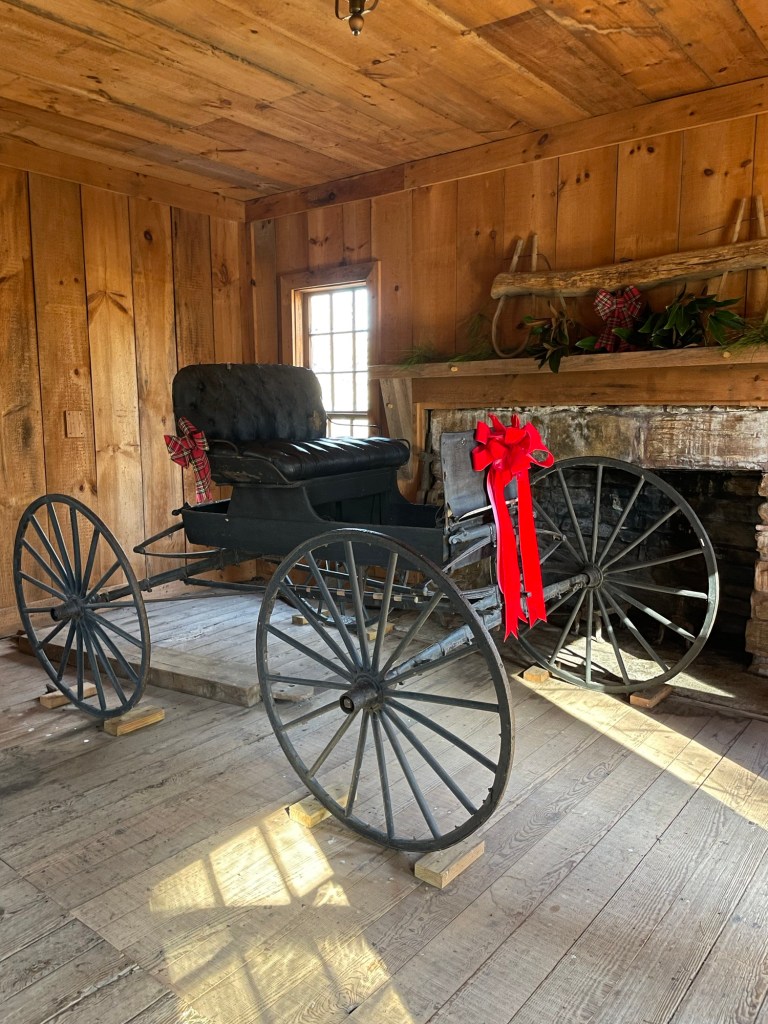
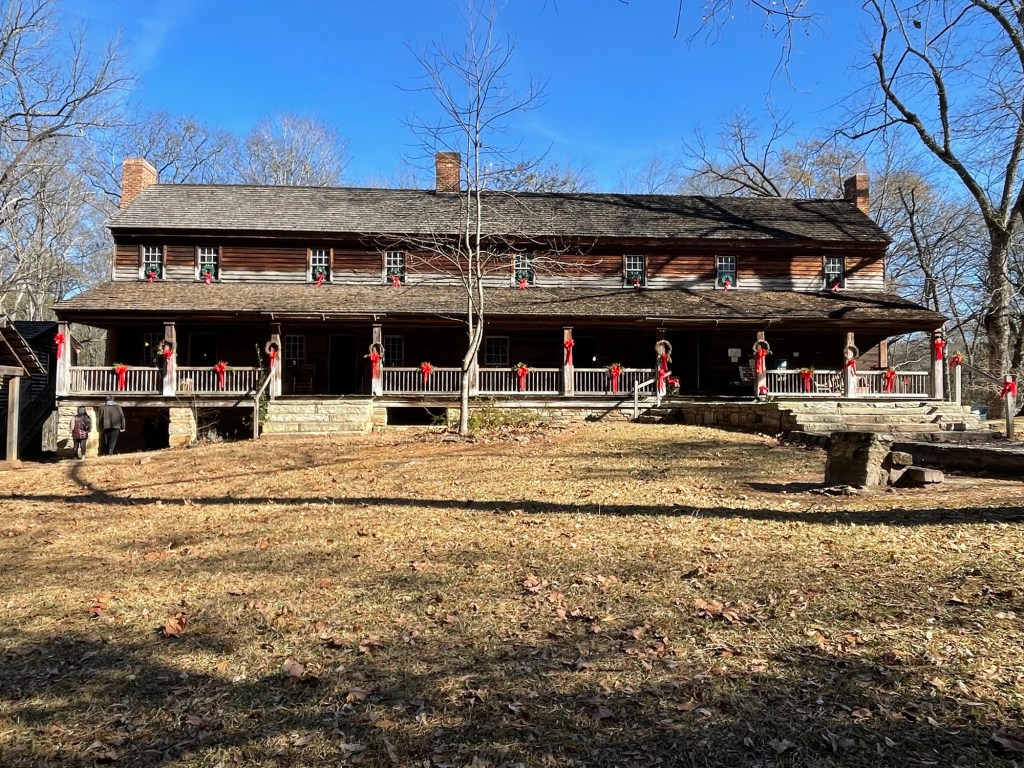
While Ashtabula (last post) started out as a coaching inn and then became a single family’s plantation home, Traveler’s Rest only ever operated as a stagecoach inn. Devereaux Jarrett built it near the intersection of Old King’s Highway and the Unicoi Turnpike. In business from 1815 until 1877, it was granted to the State of Georgia in 1955 by a descendant of his for use as a historical and educational site. The inn now acts as a time capsule and includes a surprising number of pieces of the original handcrafted furniture. According to the video we saw, coaching inns were found about every 20 miles on these long distance highways, as that was about as far as someone could reasonable expect to travel in the days of poorly maintained roads and literal horsepower.
The Jarrett family buggy. One horse power.
A few days before Christmas, the day after we found out that we were not getting the truck back as planned, we drove up to Toccoa and went to a little unassuming spot on the map that I’d been hoping to visit. But since it’s only open a few hours each week, we hadn’t gotten up there.
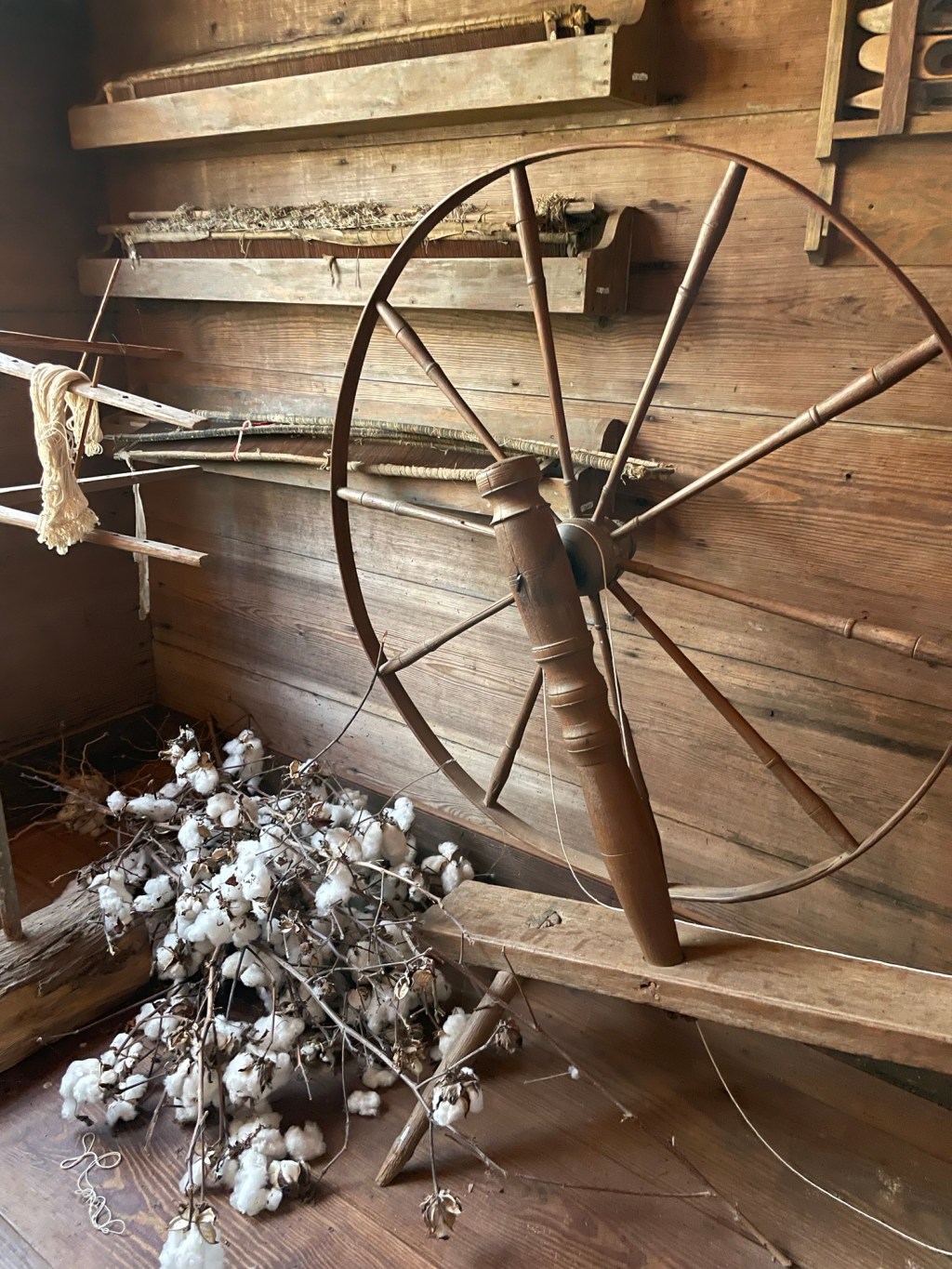
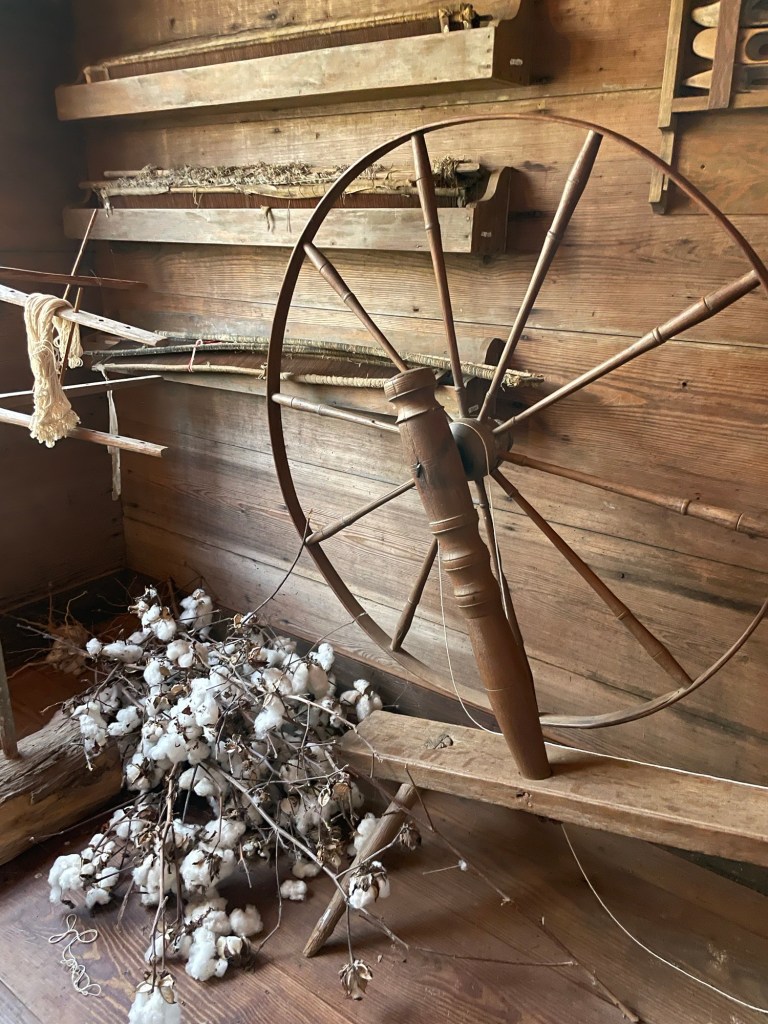
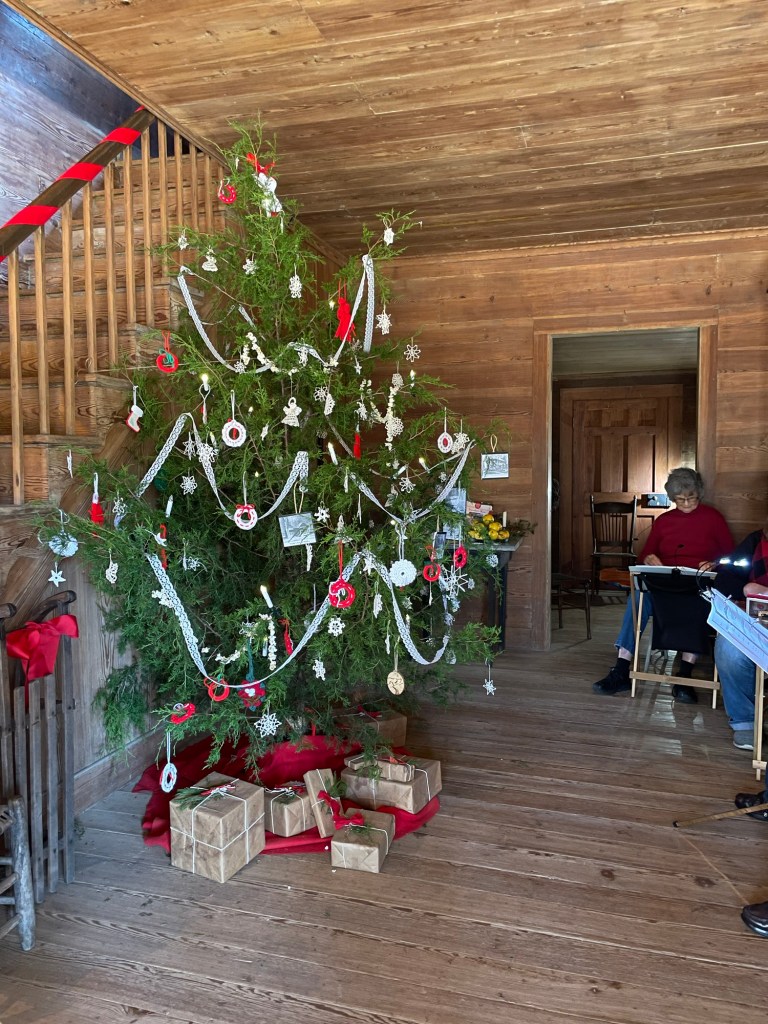
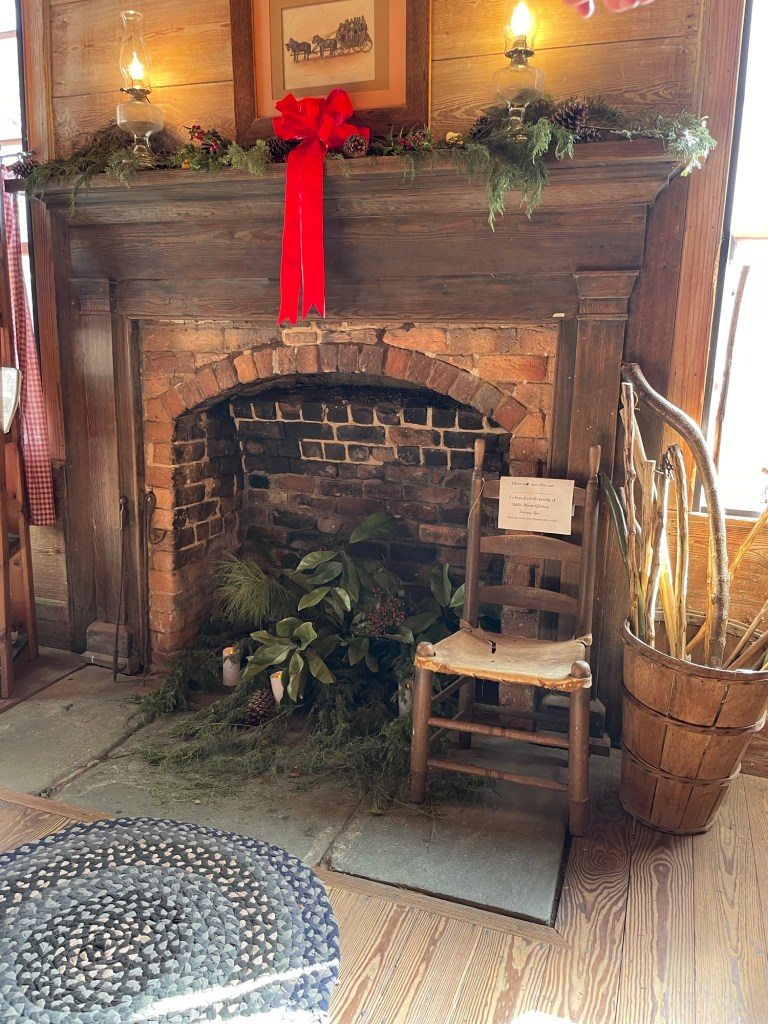
We sure got lucky with our timing. This coaching inn historical site was decked out in holiday decorations, a local dulcimer group was playing carols, volunteers were serving homemade refreshments in the cellar kitchen and in the upstairs pantry, and I got to learn about spinning wool and cotton thread from the most patient and enthusiastic spinner I could have asked for. I ask a lot of questions.
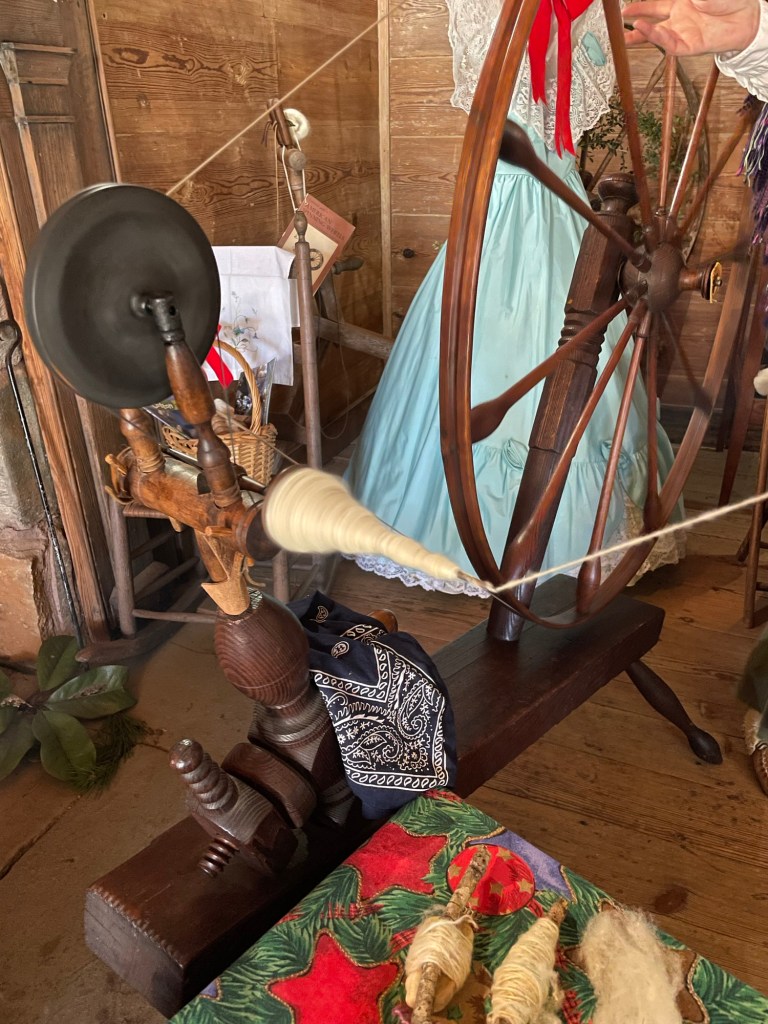
Spinning wheel and cotton on the stem
We lucked out on the weather, too. It was unseasonably warm and a soft breeze was blowing. They had all the doors thrown open which allowed guests to easily move in and out of the inn and around the property. No bunching up in hallways or following someone else’s pace while walking the same route.
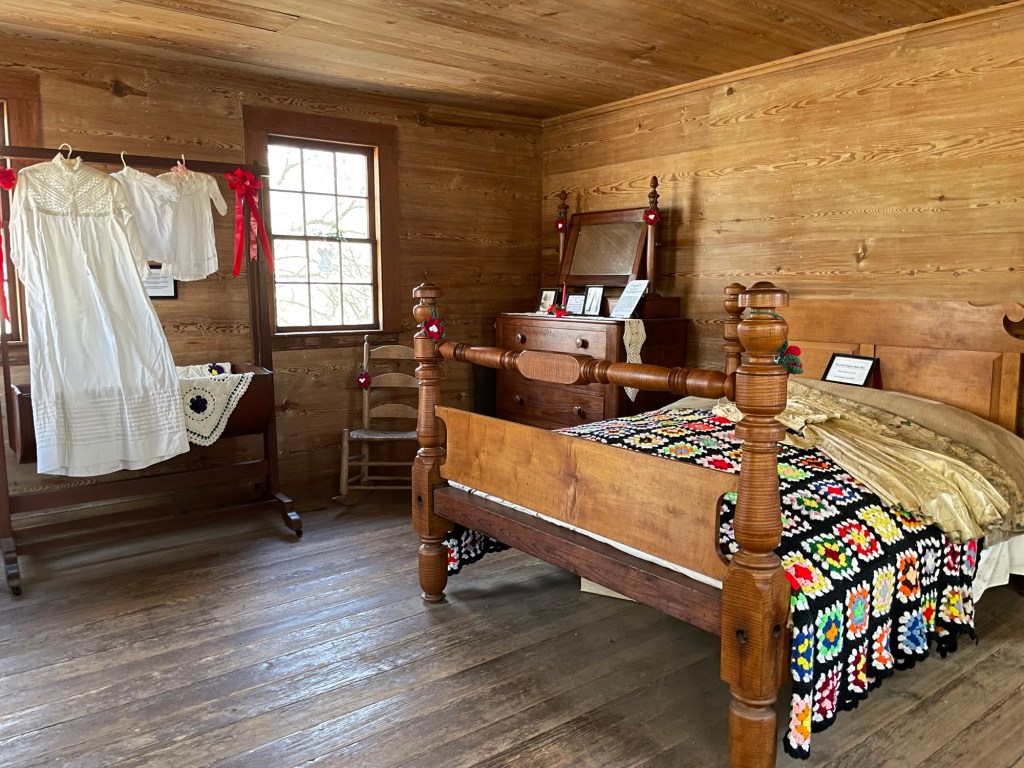
Antique bed frame, bassinet, and dresser. Not the modern crocheted squares coverlet, obviously.
You see that rail at the end of the bed? A quilt was rolled around it, storing it out of the way, and then, when you got cold in the middle of the night, you just pulled it towards you. Instant presto! Nice and toasty. It’s so practical; why don’t we have that on beds anymore?
Unheated bedroom with double bed
Travelers could pick from a private room and bed, heated $$$, a single room with two or more to the bed, unheated $$, or a group room with multiple beds of multiple people, unheated $ (to use the modern travel guide rating system). In this uninsulated hotel made of unfinished pine boards, a fireplace of your own would have made a big difference on a cold day.
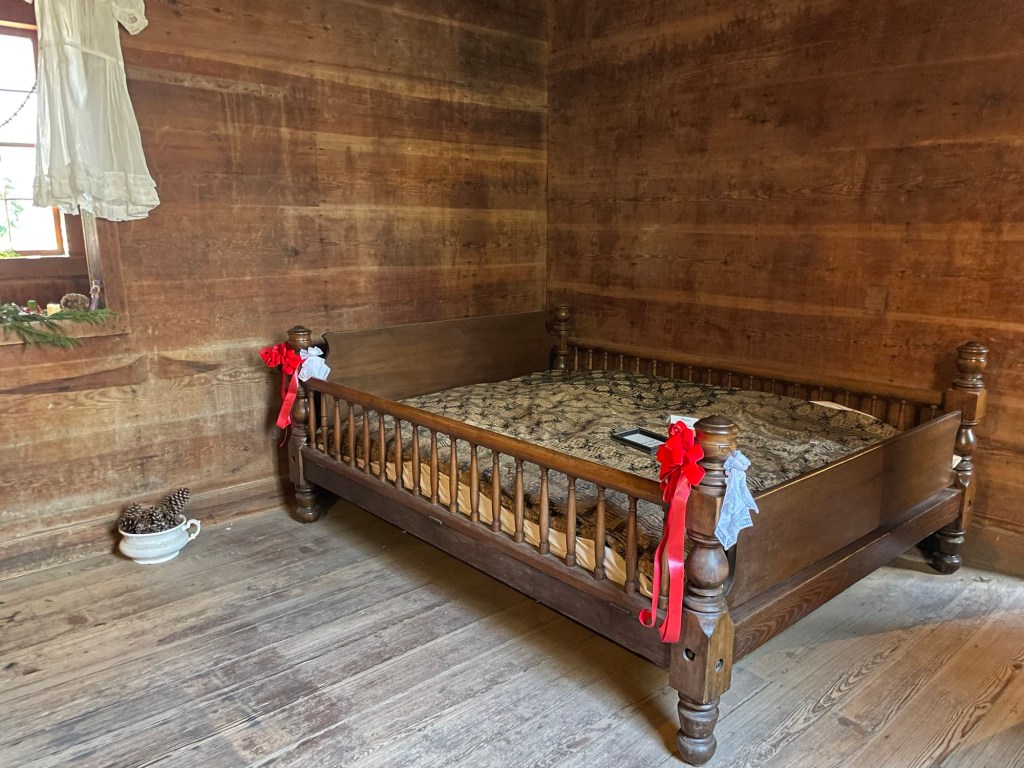
Bed with removable side rails
Can you guess why this bed looks so funny? If you imagine a long pillow going from one solid end to another, it makes more sense. This is where the children slept. Imagine just dumping your kid into the unheated communal kids’ bed and then heading off to sleep in another room. Modern parents would never.
I wonder how well our ideas of decorating for Christmas line up with the actuality of homes from this time period. Not that I think it matters, and I liked seeing everything so cheerful and bright during this rather brown time of year. It’s just a random thing I thought here and at Ashtabula.
Sherri’s wheel, working loose wool into yarn
Now spinning. This, I found fascinating. First, let me say that Sherri has the patience of a saint. Second, she refers to her wheel as ‘she’ and talks about it having preferences, as in, ‘She doesn’t like too much humidity,’ and ‘She doesn’t appreciate being moved.’ Third, the end of that spindle will snag your fingertip something good if you’re not paying attention. Poor Sleeping Beauty.
Since nearly all of a household’s day to day textiles were made in house, spinning was an essential part of nearly every woman and child’s life. Sherri said it took between eight to twelve spinners to keep one weaver at a loom. That’s a lot of thread/yarn! I recently read that all children were taught to spin as soon as they were coordinated enough. Women spun whenever they weren’t occupied with other tasks, and people who couldn’t contribute to heavier tasks (such as the elderly, injured, or disabled) spun to assist in the support of the household. Even the men spun in their free time when there was a dire need or if finances were especially tight.
Since spun fiber (wool and cotton) was always in high demand, it was also a way for women who did not marry or were suddenly widowed to financially maintain themselves and any children. Although spinster eventually became a derogatory term meaning a never married women of a certain age, it wasn’t used that way originally. Rather, being a good spinner/spinster was seen as having a highly valued skill and was treated as such.
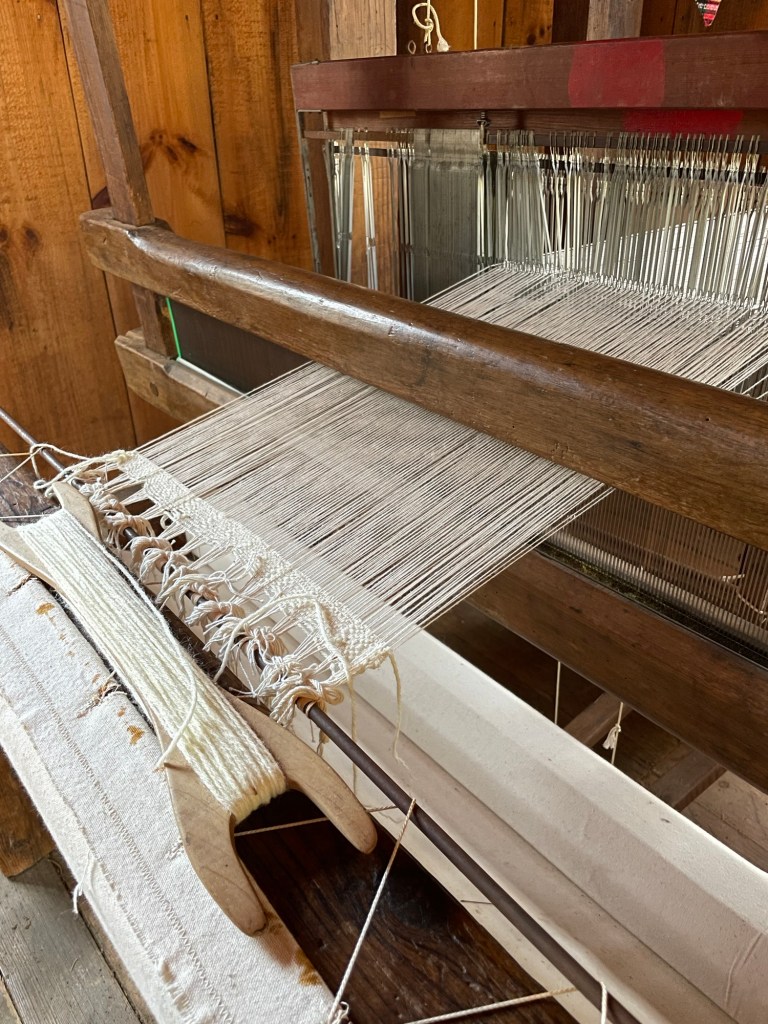
The family’s loom
Think about the number of cloth goods a typical house would have used. Think about how many things are in your home right now that wouldn’t be out of place in the 1800s. Napkins and shirts, blankets and upholstery. Sheets and aprons, towels and socks. Now imagine making each one by hand. Thread by thread. Stitch by stitch. We didn’t replace things so quickly when we had to make them by hand.
Screw trends and keeping up with the Jones, we repaired things until they were beyond repair and used their scraps after that. Rag rugs, quilts, and saddle blankets, to name a few. We lost something important to the human race, I argue, when that type of thinking stopped being the norm.
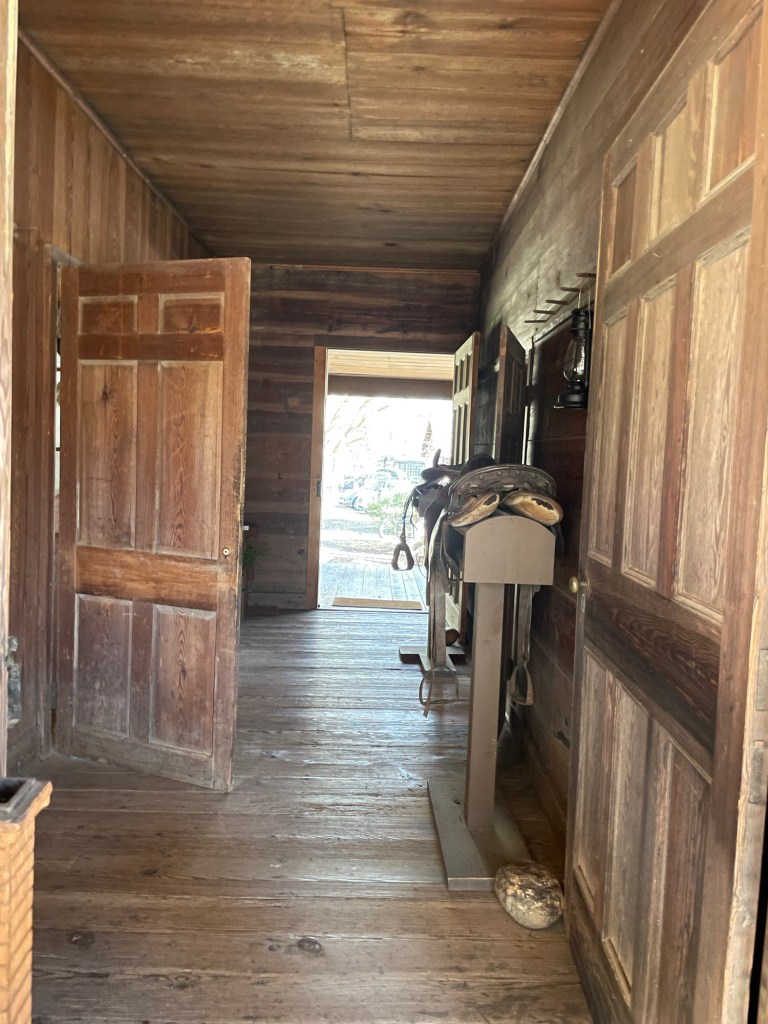
I imagine saddles were not actually kept in the breezeway, but the stable is long gone
I imagine these big breezeways would have felt like the lap of luxury on a gorgeous warm day when a light wind was blowing. The cross breeze from the attached, covered porches would turn the air over quickly and freshen the house, whisking away cooking and other unpleasant smells, and probably drop the interior temps by at least 10°F.
From here you can see how wide the building was when it stopped being an inn. The guest bedrooms are all upstairs, and the cellar kitchen is on the lower left, beneath the dining room. A small staircase connects the two, and the pantry is behind the dining room. The main staircase is sandwiched between the dining room and the left cross-hallway.
Office and reception area
The reception hall is on the far right, with the right cross-hallway behind it. Between the two cross-hallways, the guests’ parlor (front left) and the family’s parlor (front right) sandwich the center fireplace. The lower rooms at the rear were for storage and the family’s use. The loom was housed in its own building, a short distance from the pantry.
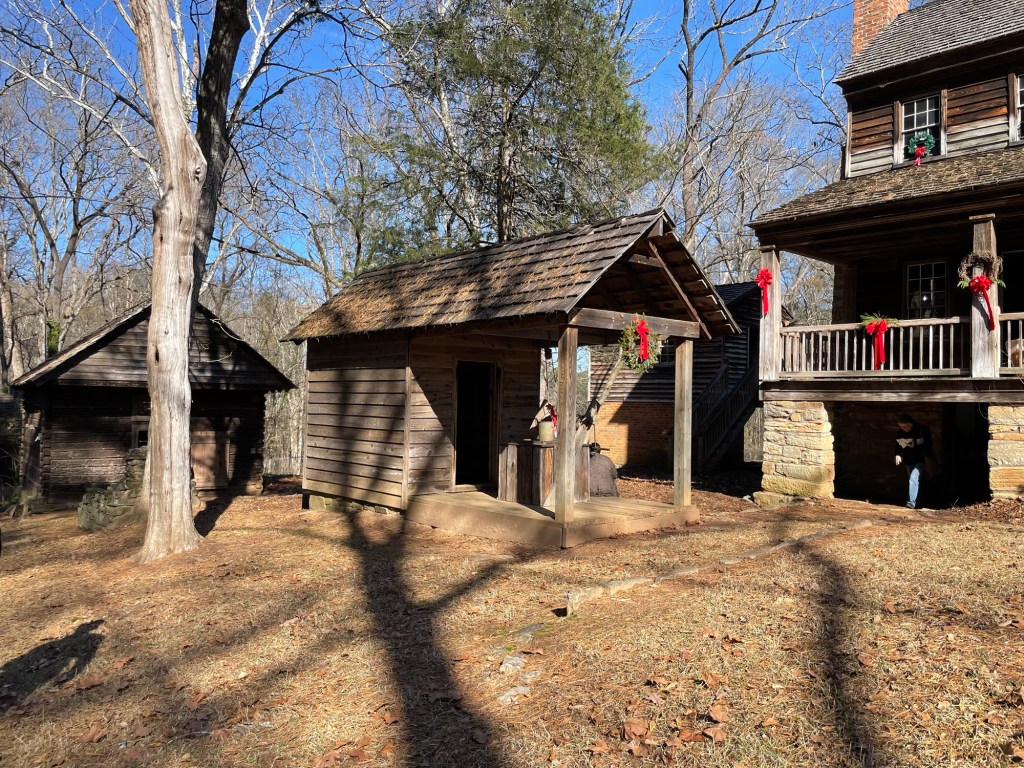
Ice house and covered well, meat house in rear
Outbuildings were all over the property. A well and ice house were must-haves. As were tool sheds, a simple forge with blacksmithing tools for repairs, a carriage house and stable, the necessities (aka outhouses), and cabins for enslaved labor.
Cast iron vat, probably 2 ft (0.6 m) edge to edge
The big vat above rocks back and forth and was used for boiling laundry and making lye soap. I’m not sure where the fire would have been built, maybe around it? Or perhaps under it, if the large slab isn’t original? Maybe in the brickwork behind it? I didn’t think about that until after we left.
The meat house, reproduction
If you zoom in, you can see the tool marks on the logs used to build this shed. It’s not original, but these tool marks are still impressive in my book.
On our way out of Georgia, we stopped at General Coffee State Park to break up the journey. It’s a nice campground with several different hiking trails, super friendly staff, and a cute demonstration farm. I spent some quality time getting to know this handsome bay.
Union troops robbed the home on their way north FROM the March to the Sea, not TO it. It was after his army had bypassed Charleston and went instead to Columbia (where ironically Charlestonians had moved their families, money, and household goods for safekeeping), on his way to North Carolina that small raiding parties pillaged the Uplands’ homes and businesses.
The things that wake me up in the middle of the night.
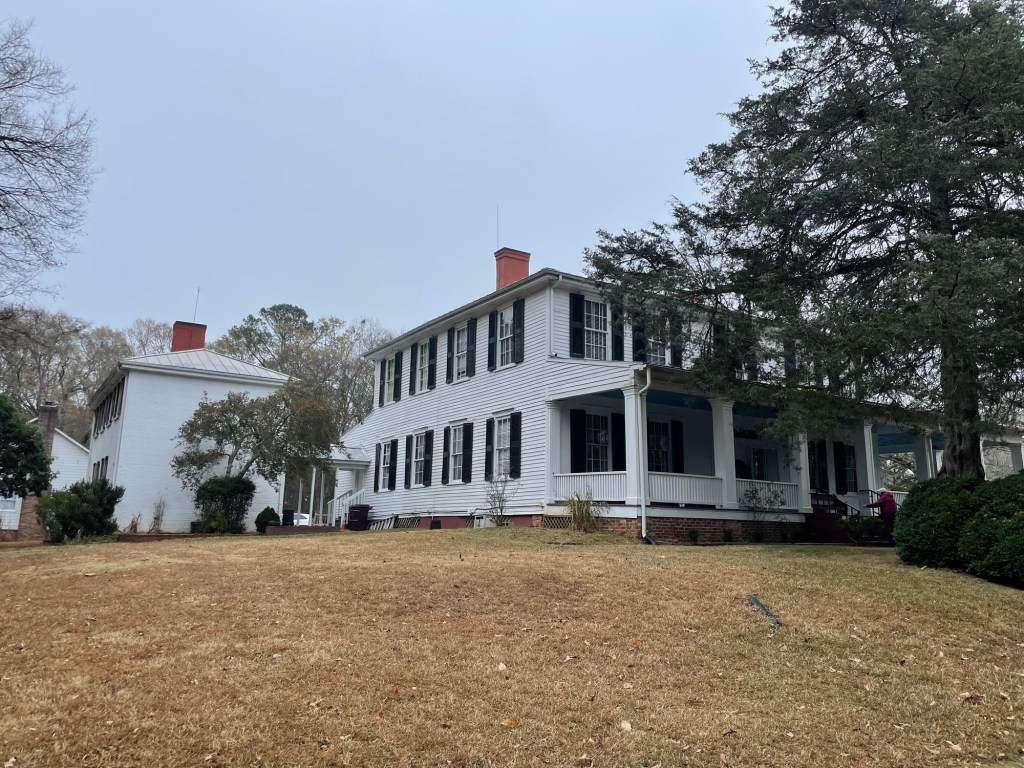
In Pendleton, South Carolina, two restored plantation homes are owned by a nonprofit organization tasked with researching, restoring, and educating the public about the area’s history through educational tours.
Educational tours, you say? Step aside, folks, step aside. I’m coming across that big veranda with its ceiling painted ‘haint’ blue to stop ghosts from crossing it and through those big double doors in 3-2-1.
We visited Ashtabula on a Thursday afternoon while everyone else was at school or work and had a wonderful tour guide all to ourselves. Following are some photos and snippets of its history. While the house has had many prominent owners, I found myself most interested in the original family.
Our guide told us about the research and restoration process (long, difficult, expensive), how and why the house was designed as it is, the different ways the house has been used over time, and about the many people who have called it home. She had a fun, dry sense of humor and didn’t fawn over the antebellum years, which we appreciated.
The family who built it, the Gibbes, were from Charleston, South Carolina, and brought the Lowcountry design ethos to the Uplands (the Northwestern-most part of SC) with them. Now why, you might ask, would someone from that cosmopolitan city want to move to the hinterlands? Well, first, Charleston in the summer was a humid, malaria-ridden nightmare. The higher elevation Uplands, along the edge of the Appalachian range, is cool in the summer and mosquito free. Second, a plantation needed a lot of land, and good cotton growing land was relatively cheap in the Uplands.
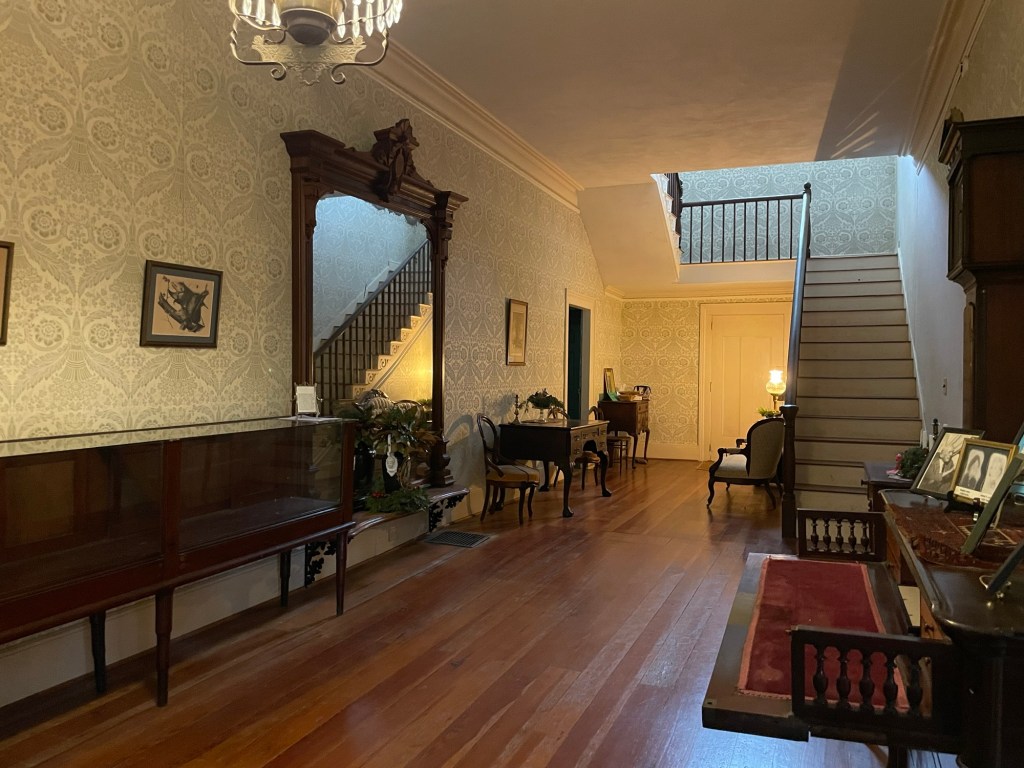
The main entrance and hallway
The first thing we noticed upon entering was that the house was cold — hats and coats and gloves cold. In fact, it felt colder in the house than outside it. That might be nice if it were summer, but in December it was a bit shocking.
It was noted that the wallpapers throughout the main floor and the upper hallway are reproductions based on the patterns found attached to the original muslin during restoration. Back then things were made to last.
Since its construction in 1828, the house has never had central heating. Each room’s fireplace kept the worst of the winter chill at bay, as well as blankets and body heat. More on that later.
The second thing I noticed was that massive entrance hall mirror. To give you an idea of how wide and tall that mirror is, the ceilings were about 12 feet tall (just under 4 meters). I stood before it and felt truly minuscule.
Guests would be received here
Mrs Gibbes had the windows above built in the Charleston manner, meaning that the bottom half of these very tall windows raise up and the lower, wooden sections swing open to effectively make two additional doors onto the 14 foot wide, three-sided wraparound porch. When visitors came — on that home’s designated calling day, of course — they could flow in and out of this area, getting some fresh air, gossiping, flirting, and socializing with the lady of the house and the town’s ‘Quality’ at their leisure.
Unfortunately, Mrs Gibbes died just before the home was completed (1826) and never lived a day under its roof.
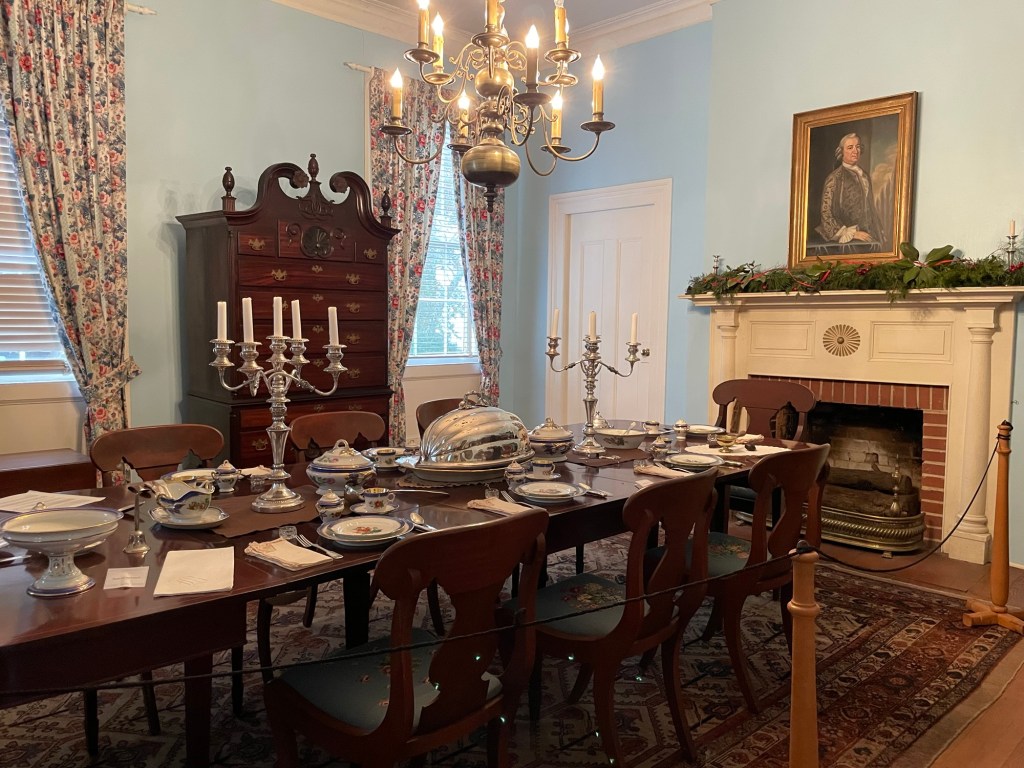
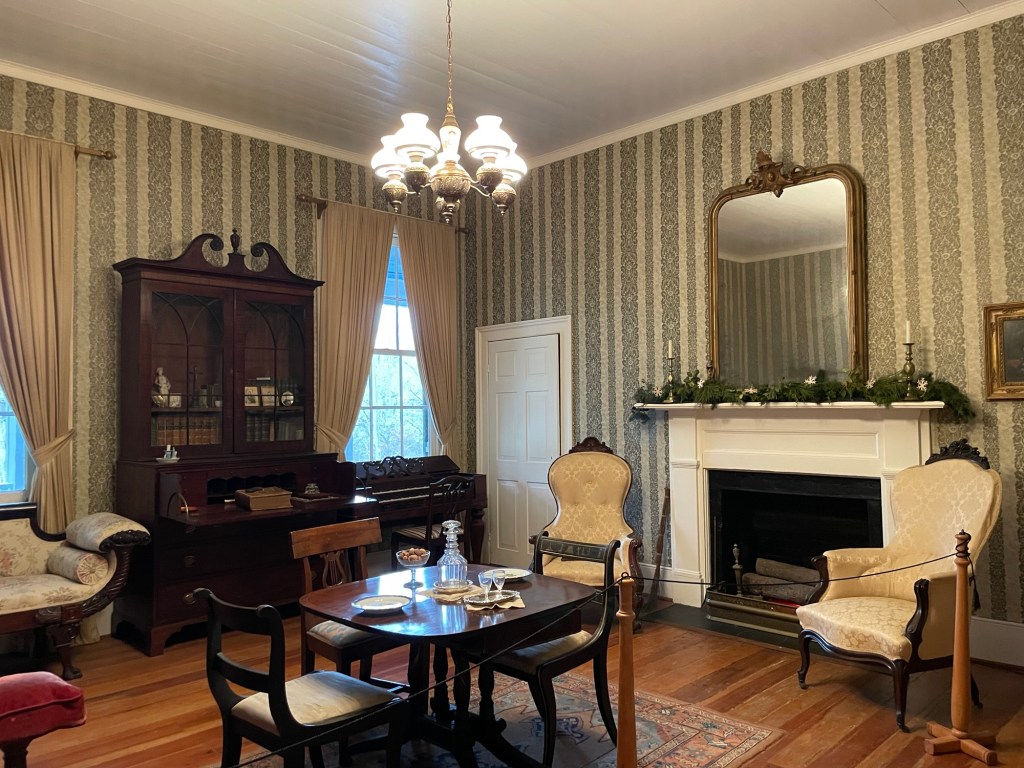
The dining room
The owner would be seated next to the fireplace in the dining room and his wife, or in this case eldest daughter or sister, would be seated at the opposite end nearest the window. While he was toasting his buns, she was shivering next to a drafty window. So much for chivalry. To help her and the other people dining combat the cold, a warming closet was built next to the fireplace where enslaved household staff would retrieve and distribute the blankets being kept toasty next to the chimney. The warming closet’s door is behind the white door to the left of the dining room’s fireplace (above).
When guests stayed over, the dining room acted as additional sleeping quarters. The table would be folded up as much as possible and pushed against a wall. Loose mattresses would be brought in to accommodate the overflow here and in rooms throughout the house.
(Side note: When Sherman’s soldiers were raiding the area during their march to the sea, the owner’s wife threw her silver flatware up into the top of the tall cabinet, very effectively hiding it out of sight.)
Pictured below is the family room, which is behind the dining room. The warming closet is to the right of the fireplace in this room. It’s the only warming closet in the entire home.
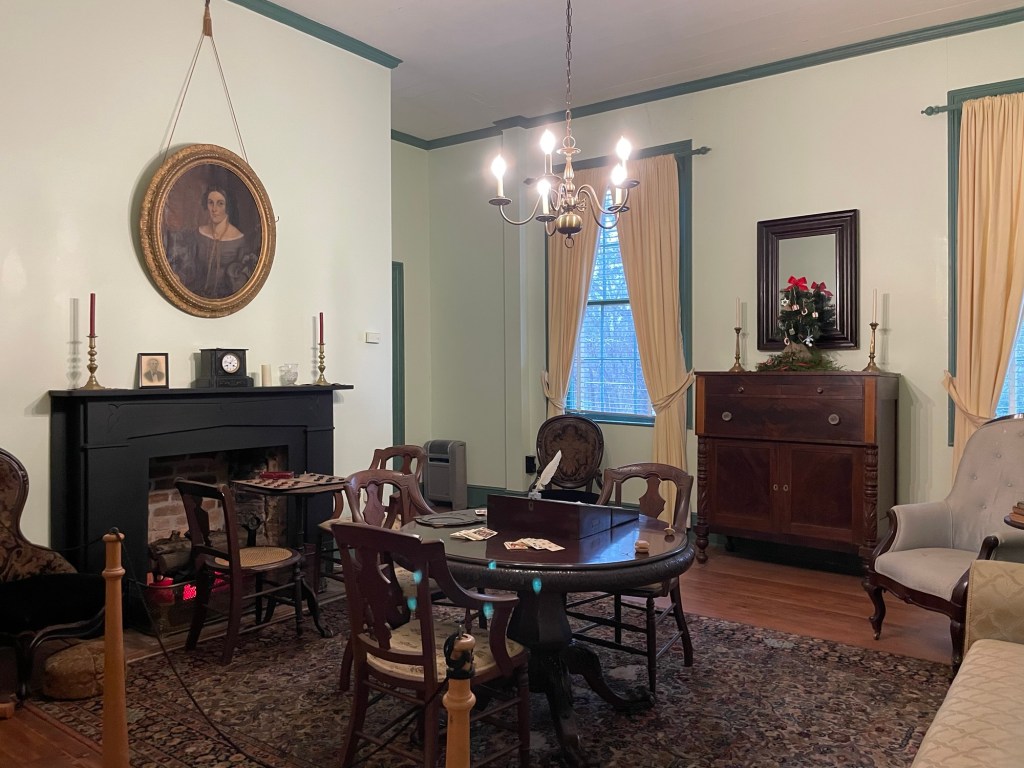
The family room
The family room had a few functions, but its primary one was for the immediate family to socialize, read, pray, and play games together when no visitors were present. Children ate all their meals in the family room, even when visitors weren’t present, because parents and children did not eat together, which makes me rather sad.
After dinner, men would gather in the room to smoke and drink before joining the women who had retired to the parlor.
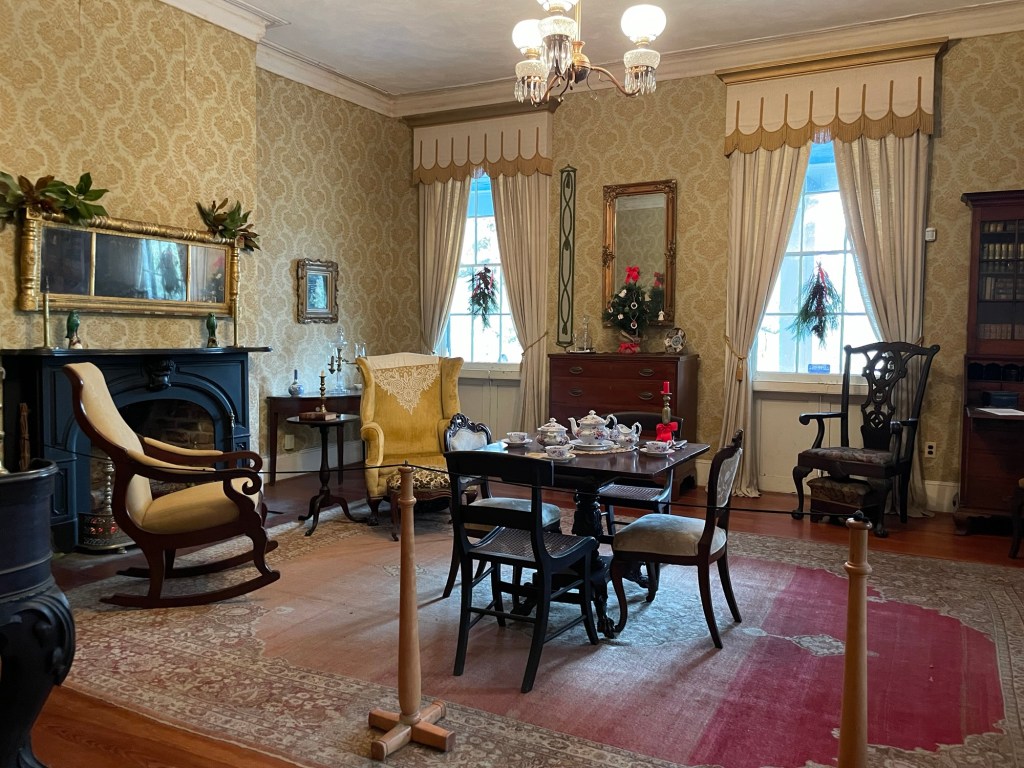
The parlor
Here the guests would gather for music, cards, a glass of sherry, and to talk politics. The larger chair to the right is a gentleman’s chair and the smaller one on the left is a lady’s chair. The lower armrests encouraged good posture while seated (no slouching!) and allowed a woman’s voluminous skirts to flow around her. The piano was an important part of this room’s decor and purpose.
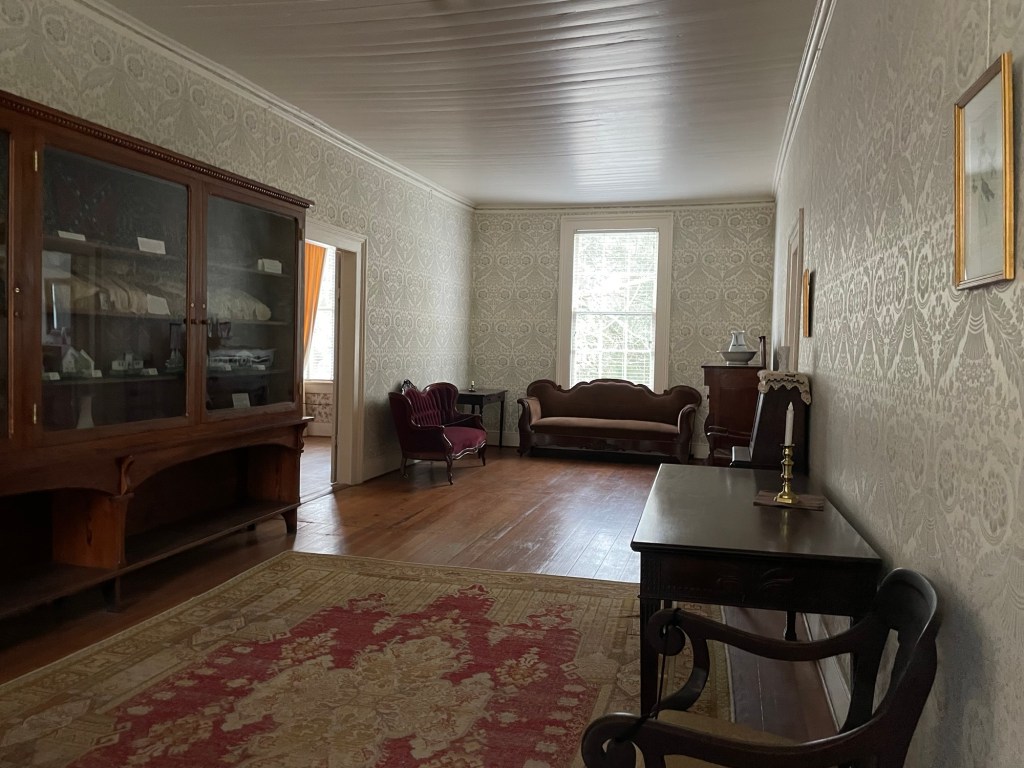
The upper hallway
This wallpaper design bounces sunlight so well.
The unmarried ladies’ bedroom
Unmarried ladies would retire together to this room, sleeping three or four to a bed as needed. Few people had the luxury of a bed to themselves in a busy house. When large numbers of guests were present, loose mattresses would be placed in here as well, thereby protecting each young lady’s honor throughout the night as well as harnessing their body heat to keep each other warm.
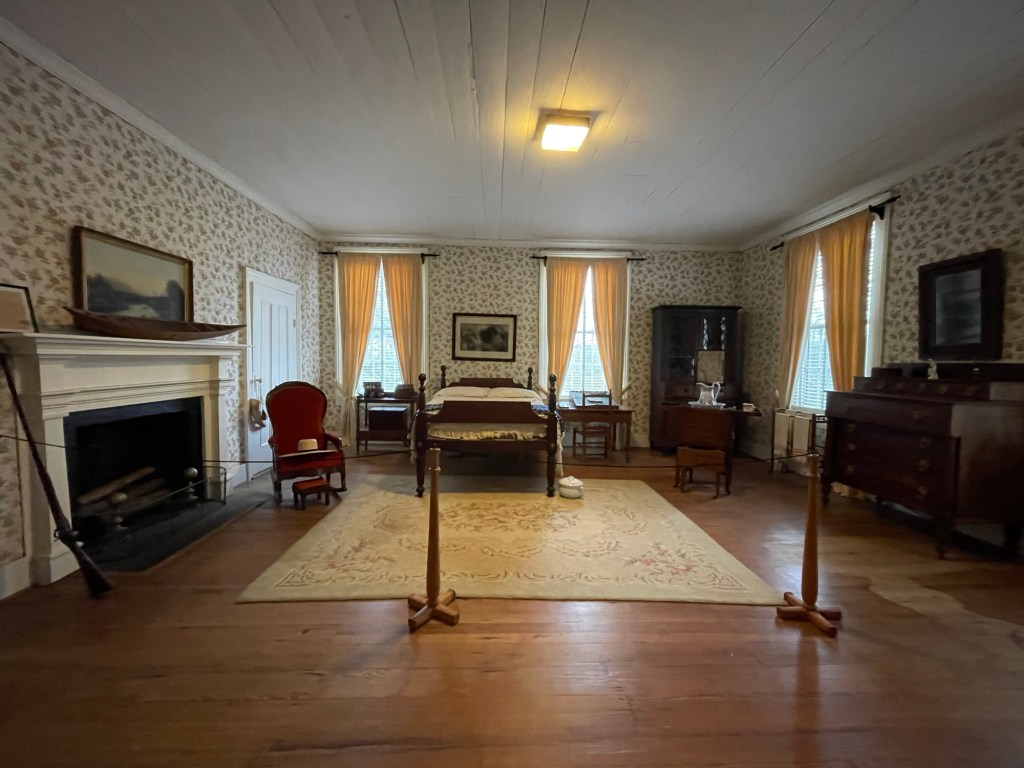
The Master’s bedroomCloseup of a mobile campaign chest
The master of the house had the biggest room. No shocker there. Closets on casters would be moved from home to home, like other pieces of furniture. A mobile writing desk like the one on the table here would have traveled with the owner wherever he went, carrying business papers, letters of introduction, and personal correspondence.
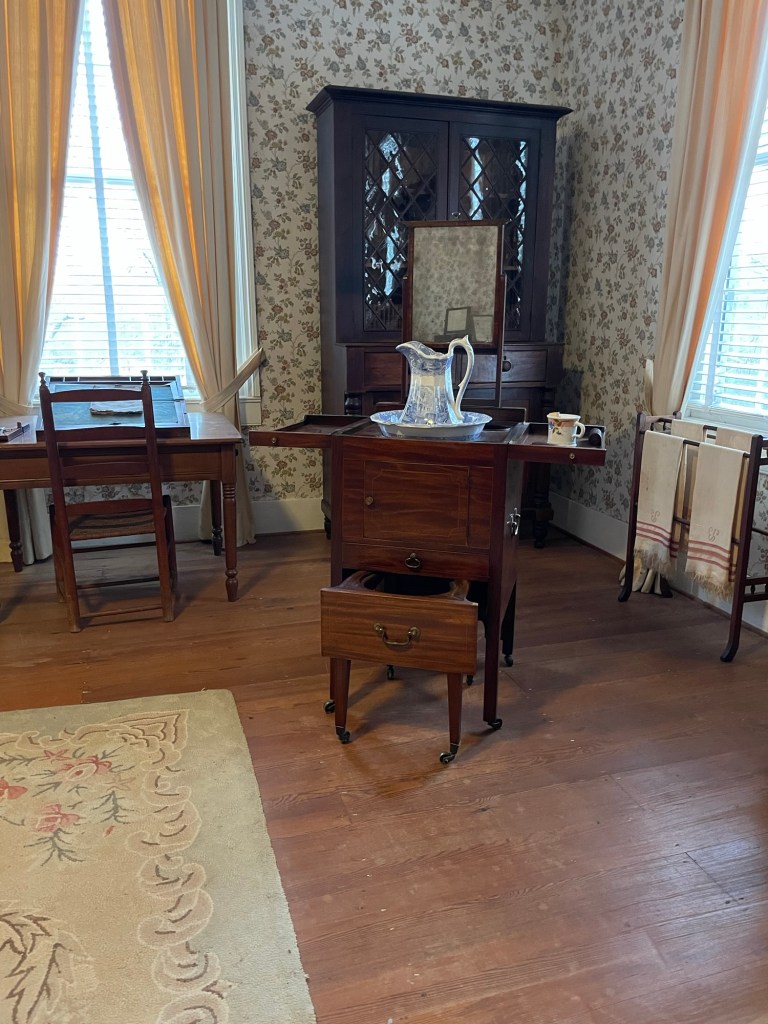
In this home, a wonderful old (military) campaign chest is on display. This type of box on wheels was used on both sides of a conflict and is a marvel of drawers and boxes, custom fitted for a chamber pot (lower pull out), wash basin and jug (middle door), shaving kit and dressing accouterments (top shelves) and mirror (drops into place at the back). It would have been carried by the owner’s personal servant from one military camp to the next.
Mr Gibbes, unfortunately, didn’t get much use out of this room as he died shortly after his wife (1828), but after the house was built, leaving his barely-an-adult oldest son and brood of younger children to try to carve a life out of the plantation on their own. At first an uncle came to help manage things, but the children ended up selling off land and several enslaved laborers to help pay the family’s debts and ongoing expenses, before selling the home and remaining land in 1837.
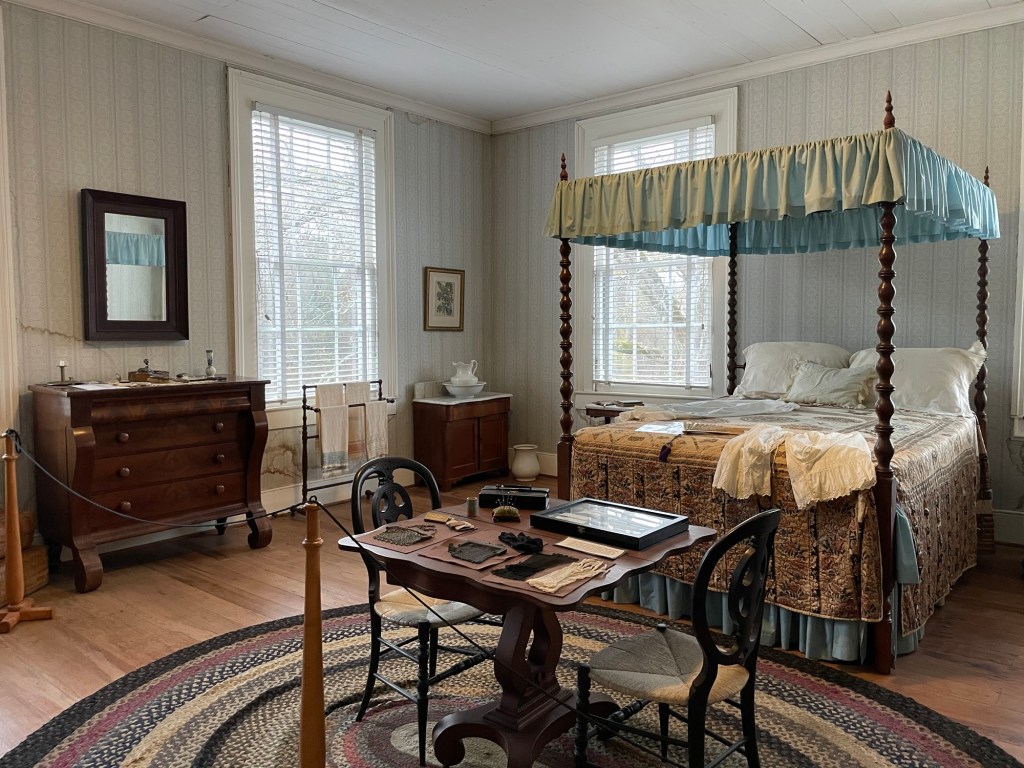
The lady’s bedroom
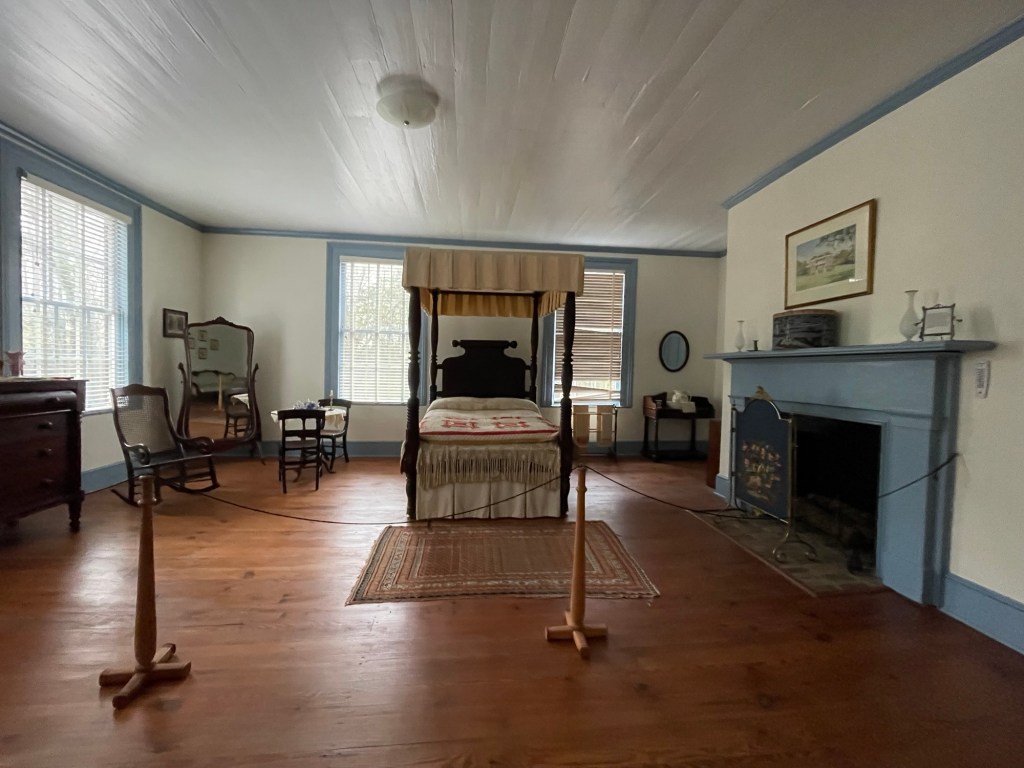
The wife of the a plantationnowner didn’t usually share a bedroom with her husband. In her room, she had her own space. For the most part. When guests stayed over, she was expected to share her bed and floor with other the married women.
Only as a very last resort, however, could the master of the house ever be expected to have other men (married and unmarried) camped out on loose mattresses on his floor. First, they would be accommodated in the downstairs rooms, then in some of the outbuildings or possibly in tents on the property if the weather allowed.
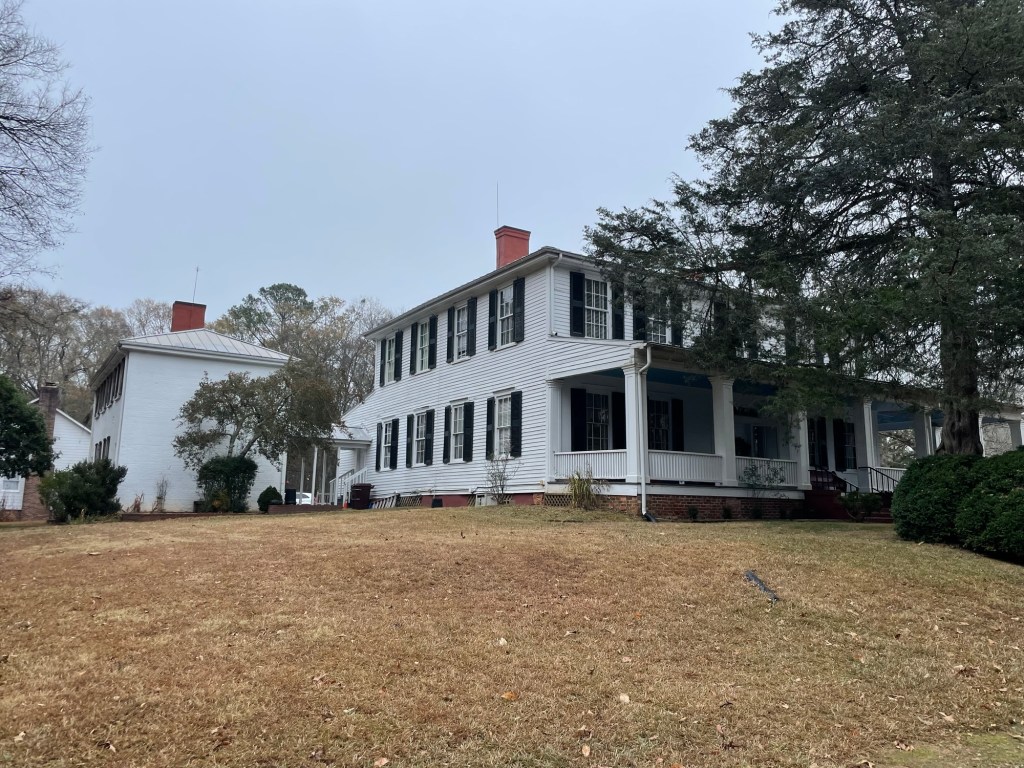
Rear of the house
The porch originally wrapped around the front and both sides of the house. But mid-last century, the house was split up into apartments and one side of the porch was enclosed as an office for a local doctor. The enclosure remains and is used as the volunteers’ break room. (It even has a small heater in it!)
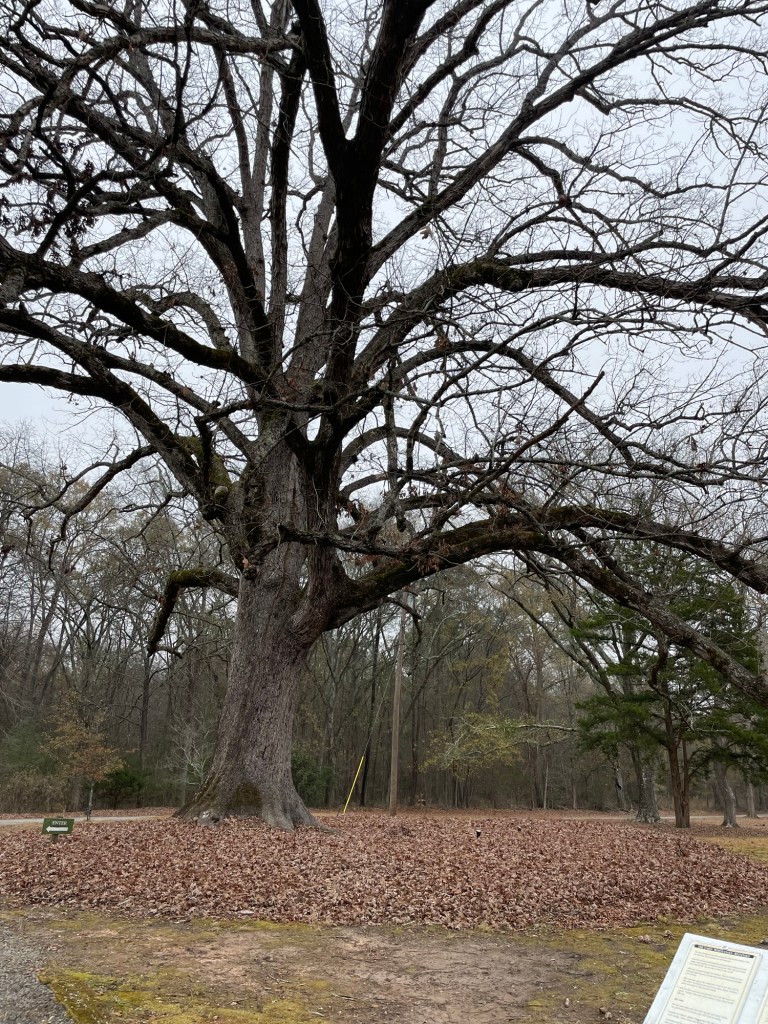
The old oak
This tree was already called the old oak when the house was being built. It’s estimated to be the same age as the USA itself. Sadly, it’s no longer very healthy. An arborist is doing what he can, but its days are probably numbered.
The right front side and enclosure
Our guide said that former tenants will occasionally tour the house and talk about what it was like to live there and how the house was configured at that time. Can you imagine calling this place home as a 20-something just starting out in the world?
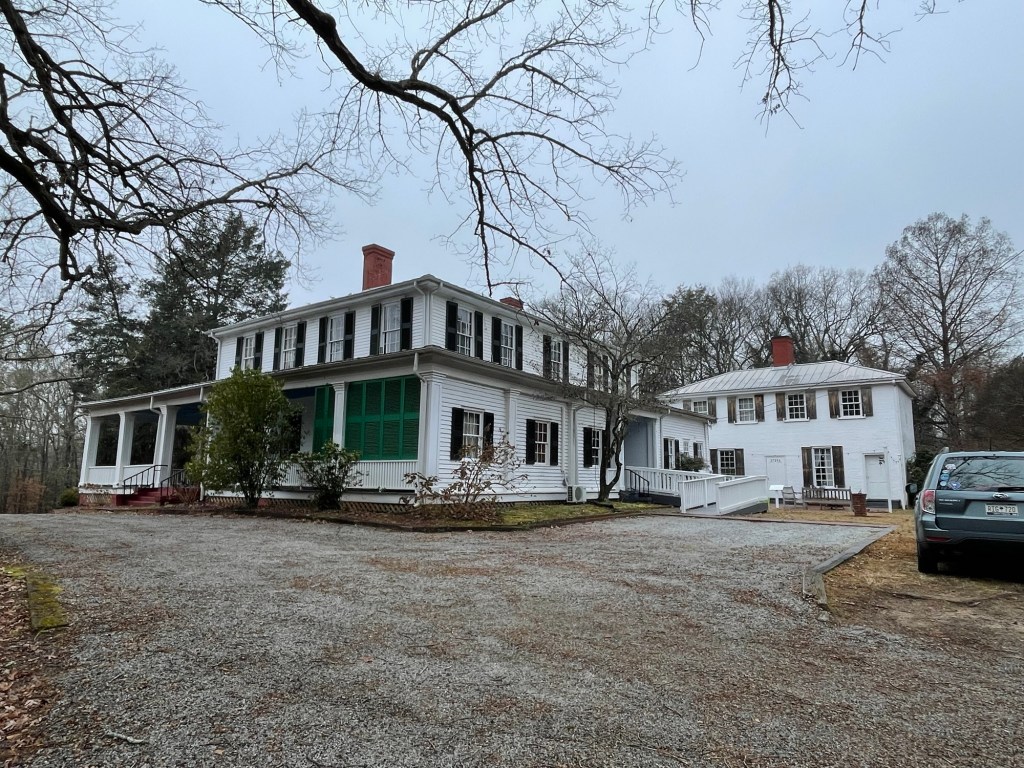
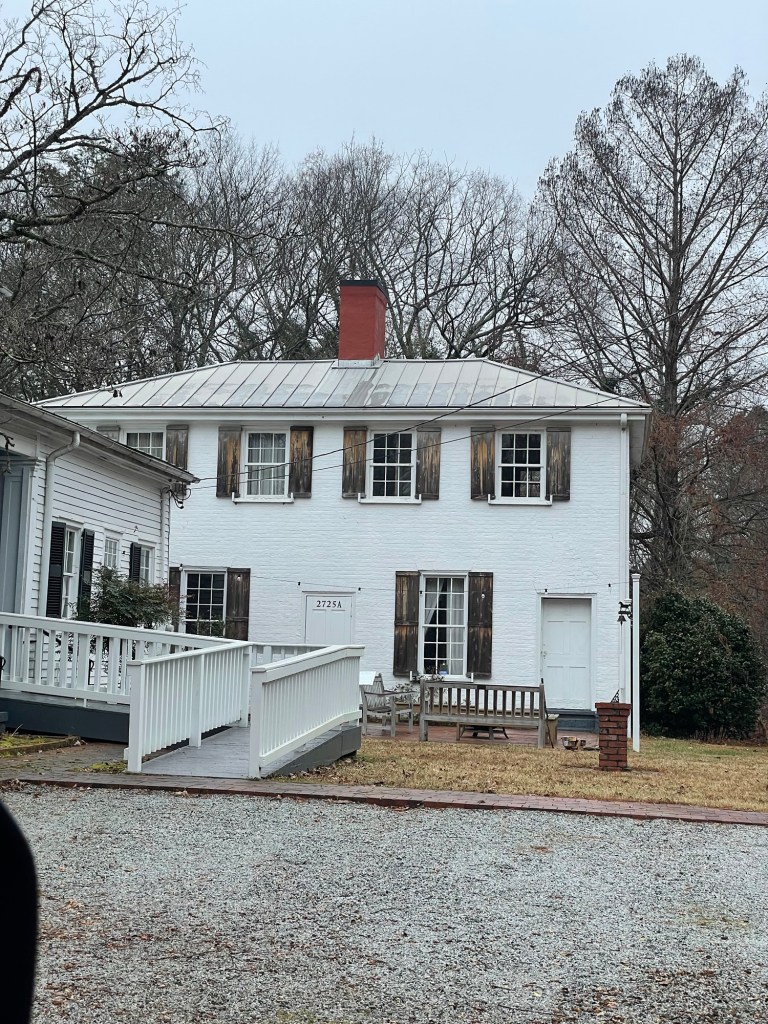
The lodging house
Although Ashtabula is one of the older homes in the area, the building you see behind it was built in 1790 as a tavern and coaching inn. Since the road out front is the old Greenville highway, this large rectangular building was no doubt a welcome sight after a long day on dirty roads.
The ground floor is divided into two sections, on either side of a fireplace wall. The right hand section acted as the entrance and dining area, and led to a bathing area in a small hut off the rear of the house. The left side area was the kitchen and had the ladder to the sleeping area on the upper floor.
The Gibbes lived in here while Ashtabula was being built.
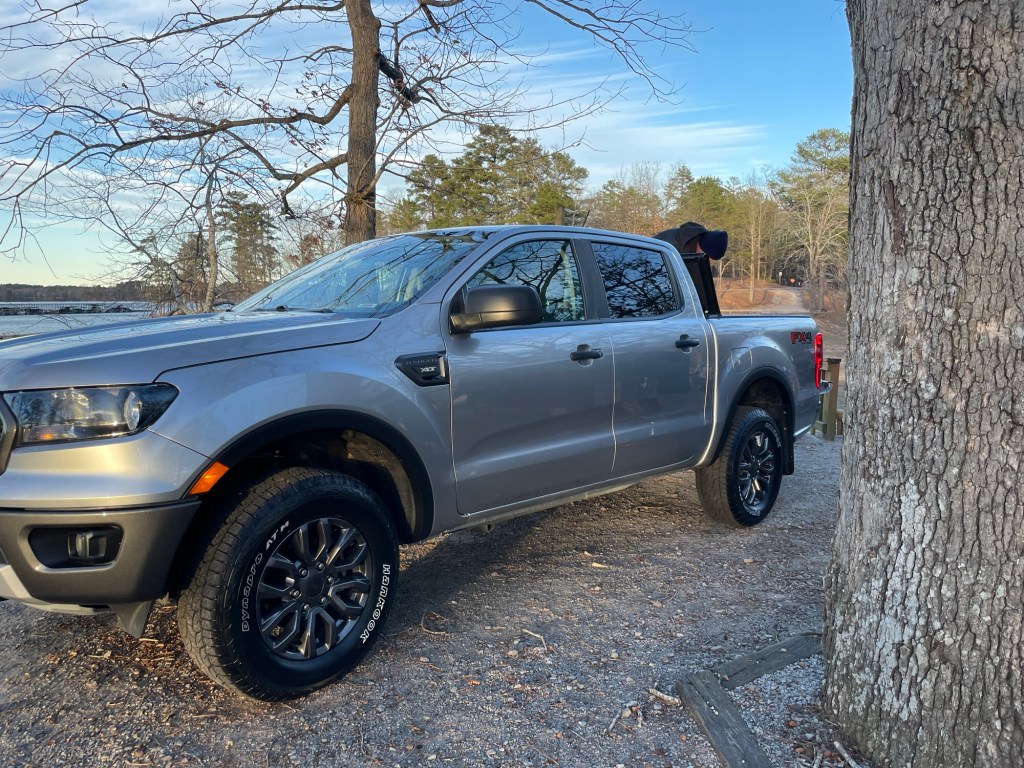
First things, first. The truck is repaired. We picked it up Monday late afternoon, packed everything back inside it, and drove out of the campground with happy hearts first thing Tuesday morning. We didn’t quite make it across the Georgia border, but we’re close. Georgia is a rather long state.
The title is a line from the song In the Aeroplane Over the Sea by Neutral Milk Hotel, and it’s my last reference to a band from Athens, Georgia, I swear. It just fit so well. What a curious life we have found here, indeed.
Happy New Year! I hope 2026 brings all of you much happiness and no auto accidents.
Merry Christmas to all who celebrate it. We spent the lead up to the Winter Solstice re-watching the Harry Potter series, like we do every year, like we did every year when Ian lived at home, and like the three of us did separately after he moved away. I still enjoy the movies and the books. I know there’s controversy. I know there are opinions. For us, we’re not taking any sides; it’s fun and tradition and we bought them all ages ago.
We’ve also been re-watching our annual lineup of unrelated Christmas movies. Last night was Elf. Christmas Day is reserved for A Christmas Story, we’ll watch that tonight. “Wow, that’s great!” One thing I’ve longed for today is a bar of Banket, that quintessentially West Michigan Dutch dessert of sugar-infused almond paste covered by several overlapping layers of flaky, butter-loaded pastry shaped into a long tube. The ultimate Yule log, in my book.
Just to keep everyone up to date, we are still, yes still, at the same campground because one of the three parts needed to repair the truck’s alignment was delayed in shipping. It will hopefully be here on Monday. Then we could, and hopefully we will, be out of here by New Year’s Eve. Fingers crossed everyone. Fingers. Crossed.
On a delightful twist, the weather yesterday turned perfect. Blue skies with just a touch of clouds, warm breezes, and sitting right at 75º Fahrenheit. It’s the same today and looks like tomorrow will be too. As such, and since everything is closed for the holiday anyways, we’re enjoying some camp chair time in the sun. We’re reading, relaxing, and now and then watching the locals cruise the campground in their golf carts. Apparently this the local excitement (and clearly everyone knows the gate code). We picked up a couple of steaks for our fancy holiday dinner. They’re marinading as I type this.
Two weekends back when the overnight temps drop to 20º, we headed to Athens, GA for two nights to check out the University of Georgia campus and see the musical home of a few of our favorite alternative bands from our own Uni days. The B-52’s (previous post) were one band, but the big draw for me was knowing that R.E.M. started in the town as well. (Eventually I will learn to play the mandolin part of Losing My Religion, but it’s going to take a while.) Classes weren’t in session the weekend we were there, so all the students were gone and a few things were closed, but we also enjoyed the chance to roam around without dodging a pile of exam stressed co-eds. We always got a seat at what is now our restaurant there too, The Globe. Great food, interesting drinks, and pleasant staff.
If you ever go, “Give them my name at the door, and they will attend to you.” If you get the reference, we’re probably friends.
One of the first things we saw on campus was this great ‘pointer tree’. Do you see how two branches were trained at a very early stage into right angles? We learned from a very helpful docent at The Cherokee Museum of South Carolina that the Cherokee used to do this as a way-finding measure. Trails would have pointer trees to help them find their way through the forests on important routes. Now that we know to look for them, we see them more often than we would have expected to. The fact that this pointer tree stands there, in the main square of the oldest state-chartered land-grant school in the nation (1785), is a good reminder of a good many things.
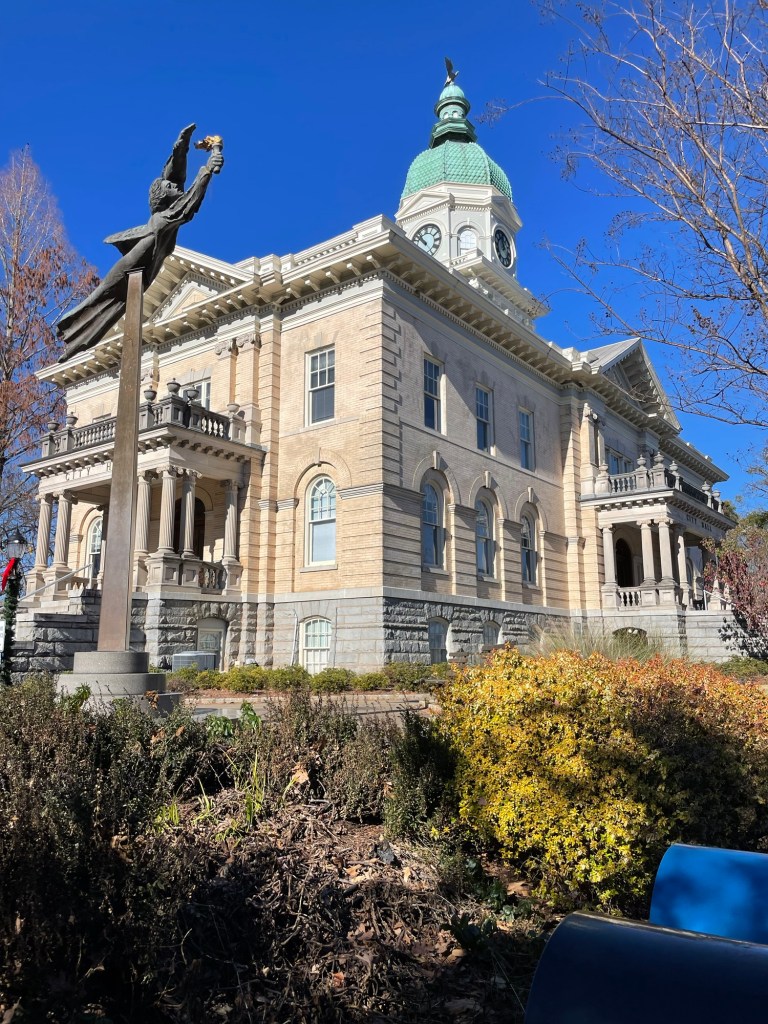
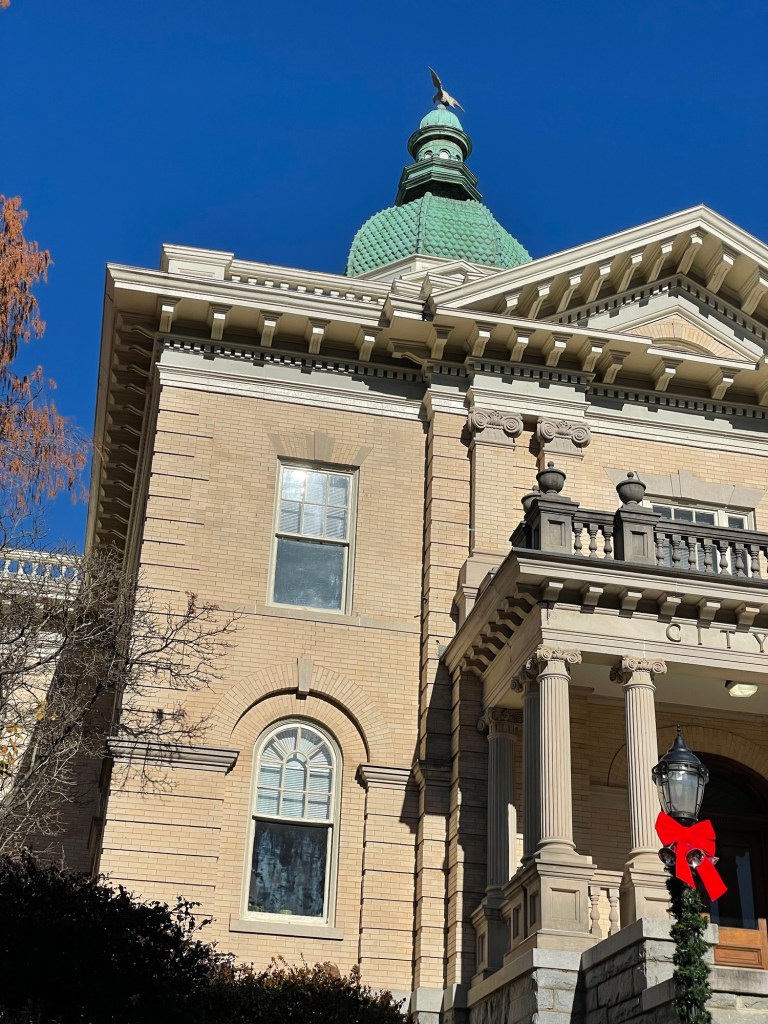
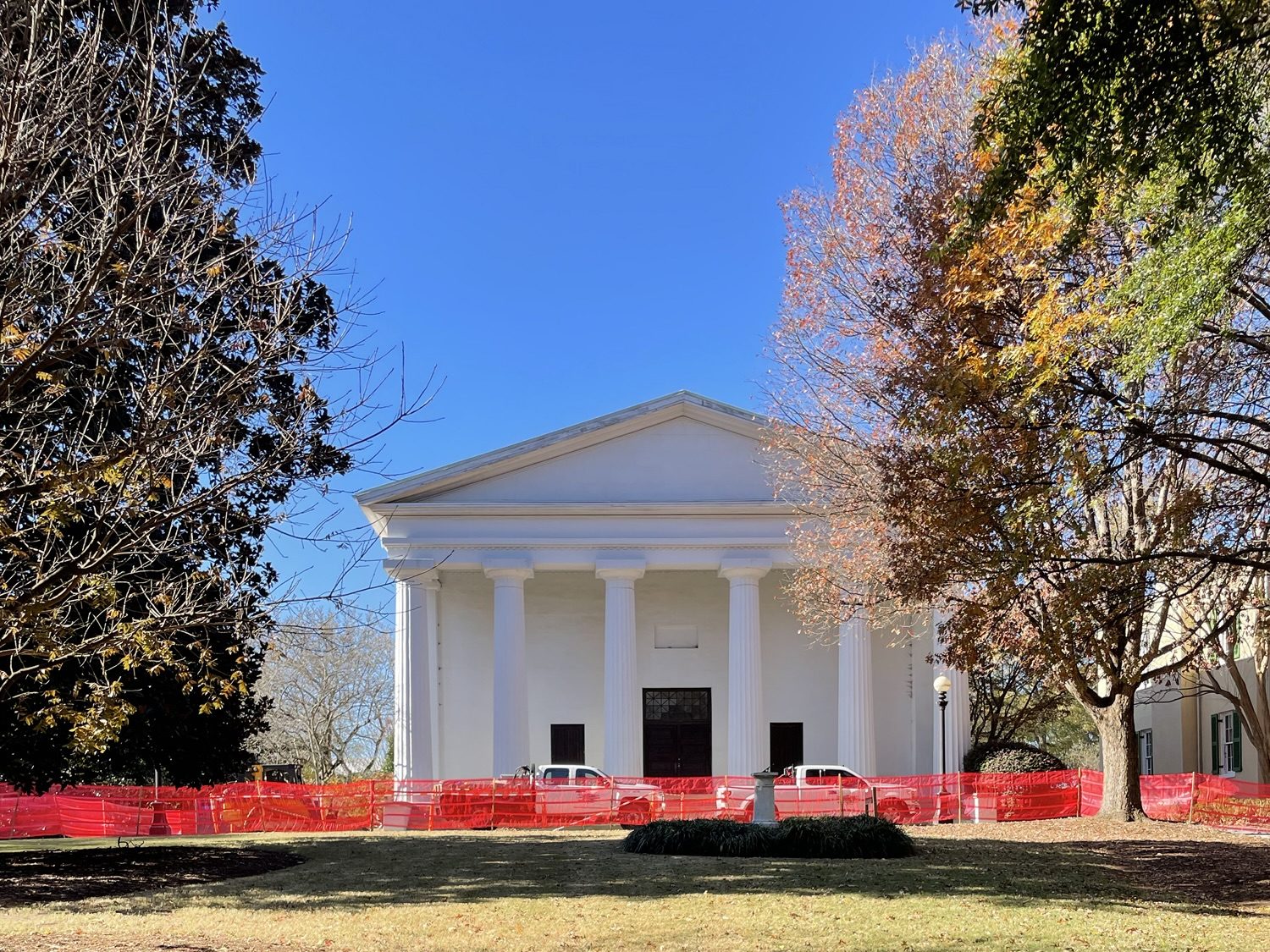
City Hall in Athens is a classically pretty building. I especially like the patina of the dome’s copper roof.
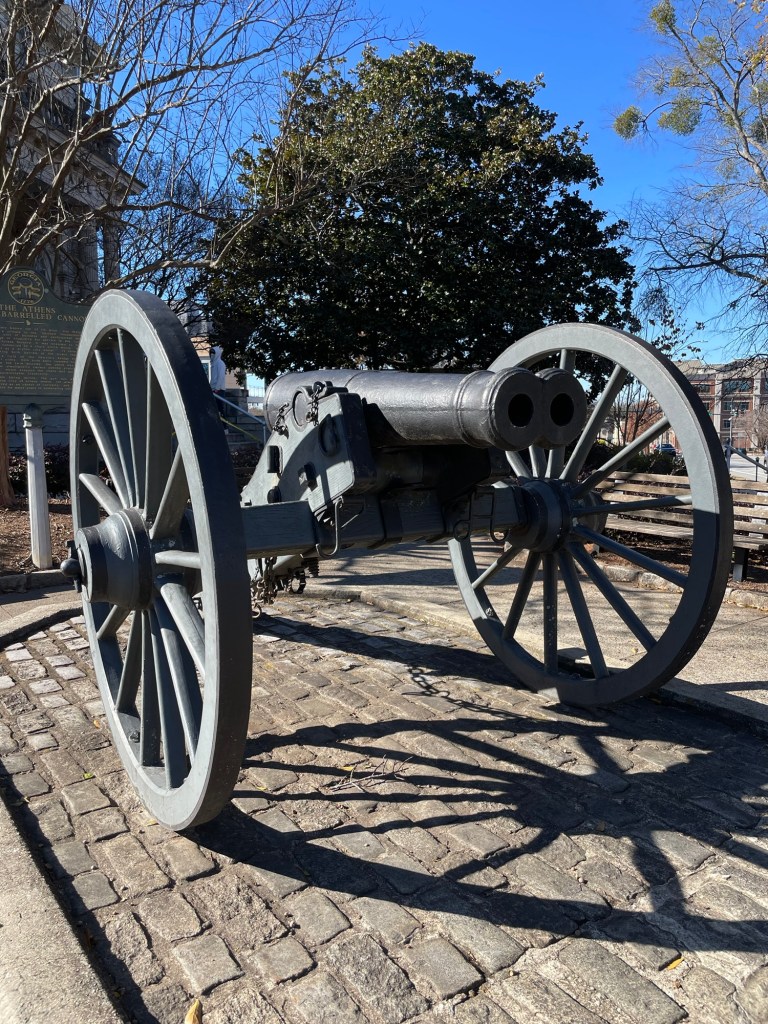
A fun fact about this double barreled cannon is that it’s the only one known to still be in existence. It was a prototype designed to shoot two cannonballs connected, by a chain, into a regiment of oncoming soldiers, “to mow them down like a scythe through wheat.” That did not happen. Unable to find a way to light both charges simultaneously, its only contribution to the Civil War was to become an addition in the Nope Files and a quick lesson in how wildly cannonballs can fly. As safe as loosing two cats tied together at the tail into a wading pool full of toddlers.
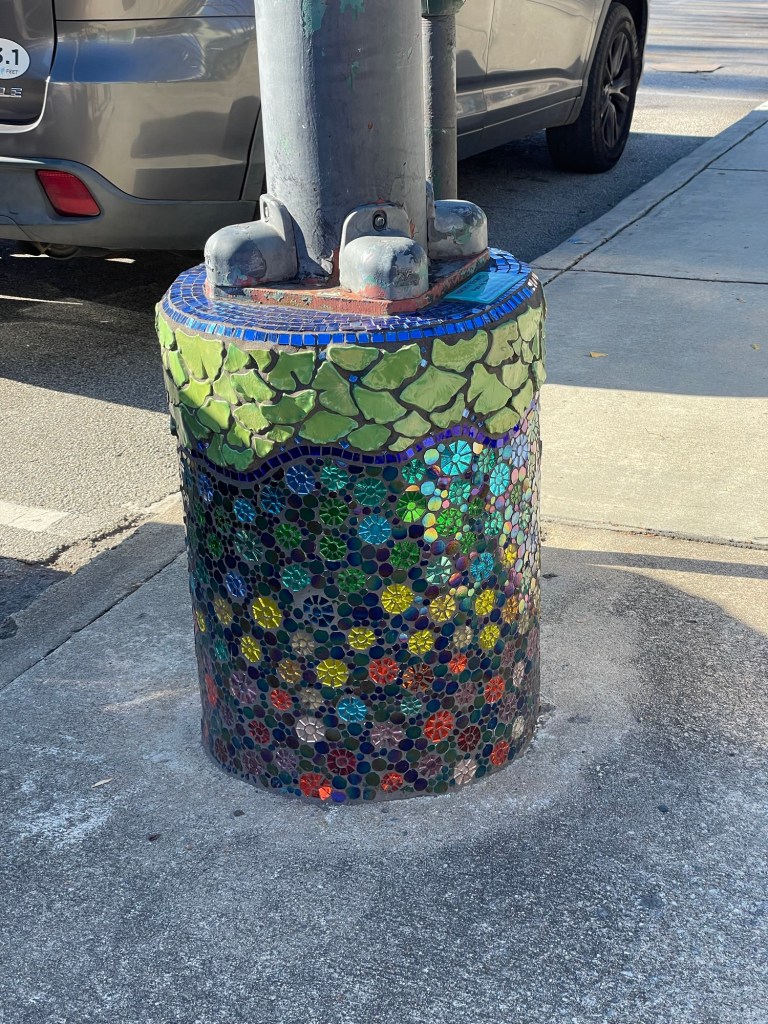
Athens has a few interesting art-related bits around town. I especially liked the mosaic light pole foundations I saw near the music hall of fame sidewalk inserts, along the music venue corridor. There must be over two dozen places to listen to live music, right near campus alone. No wonder it’s a kind of musician incubator.
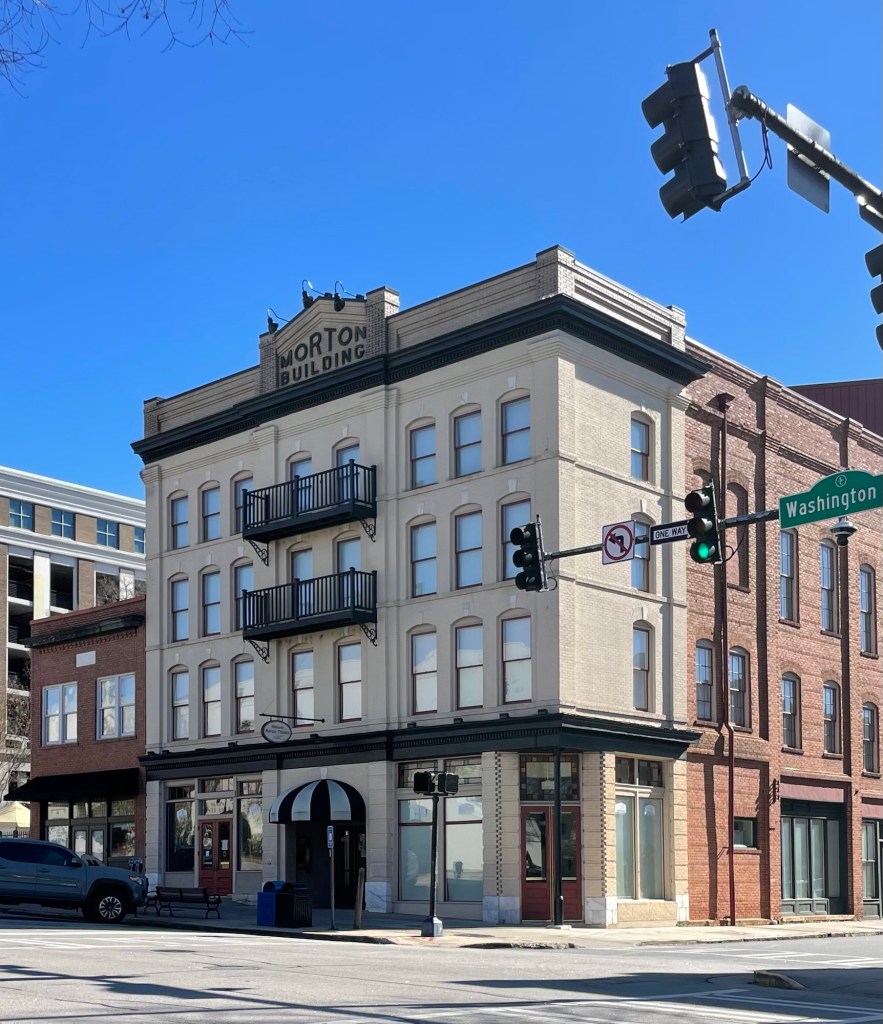
A lot of the town has the mid- to late-1800s brick and stone architecture that we’ve been seeing. I liked this one because it immediately brought to mind Morton’s Salt. I don’t know why that made me smile, but it did, so here you go. When it rains, it pours.
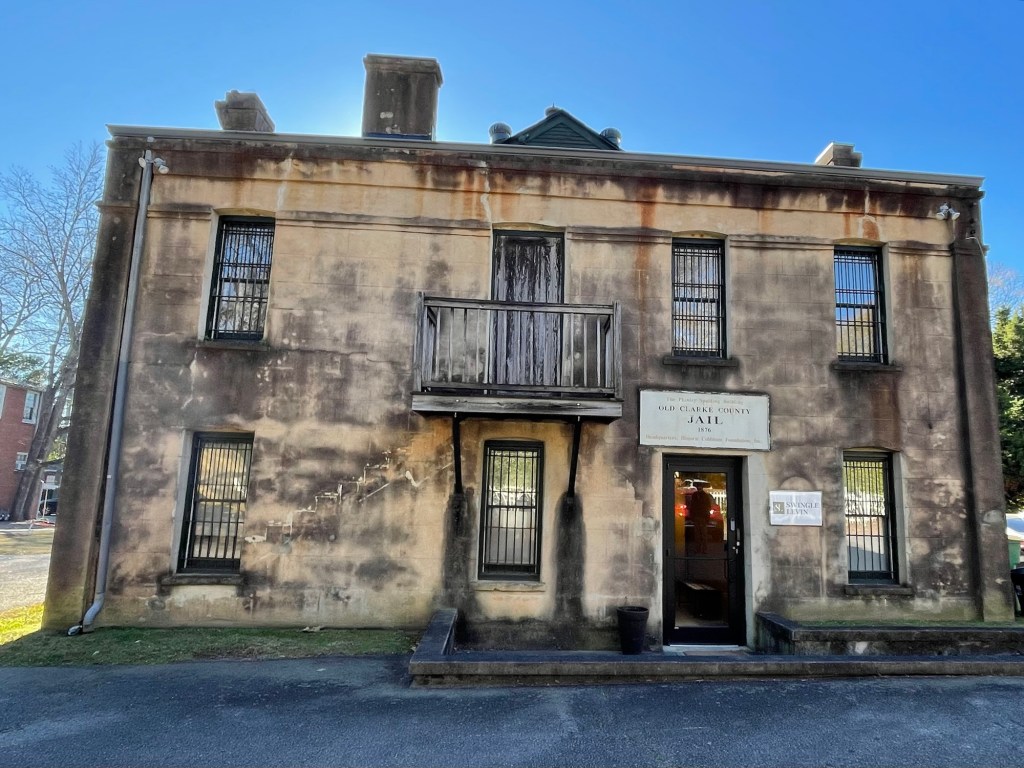
We found the Old Jail, of course, when we walked to tour a local mansion, only to find that the mansion was closed and we needed to make a reservation to tour it in the off-season. Oh well, live and learn. We didn’t have time to do that, so we just roamed around and looked at a few more historic buildings.
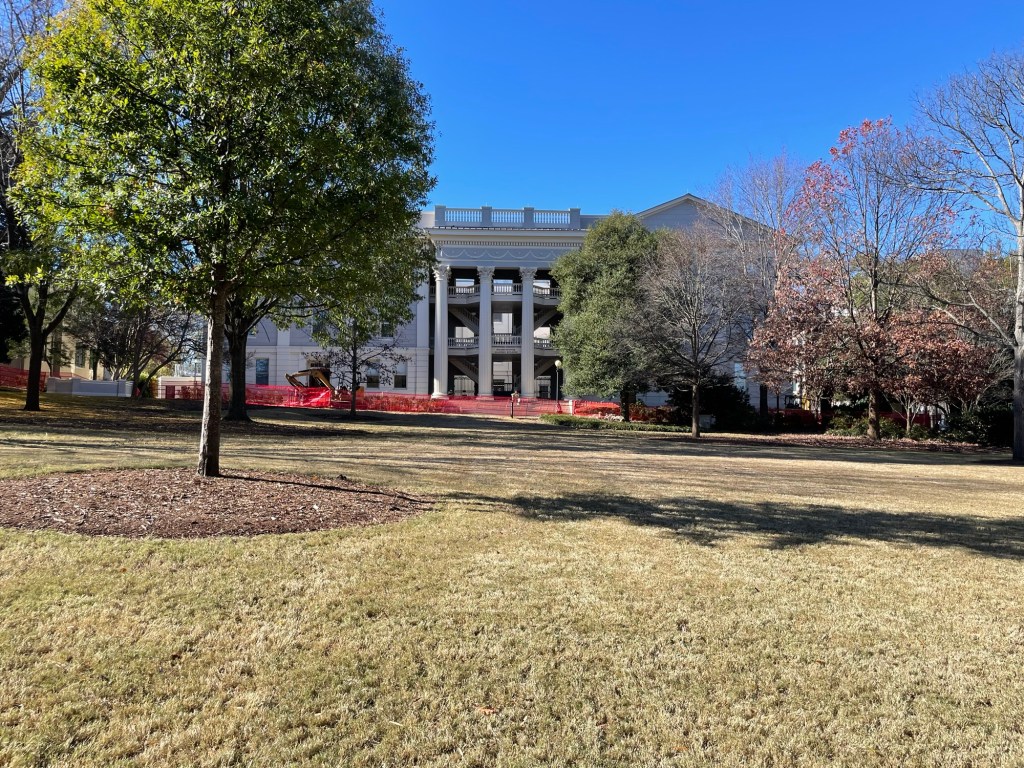
Dear parents of U of G students, this is the school-provided home for the University’s president. Remember that the next time you wonder how tuition has gotten so high? Also, I clearly miscalculated when choosing careers. That upper porch? Those verandas? I can almost taste the sweet tea and hot, buttered biscuits. Summer heat would have no power against that architecture.
I’m a sucker for an old cemetery, and this is the oldest one in Athens, but it was closed. Locked behind a chained gate. Alas.
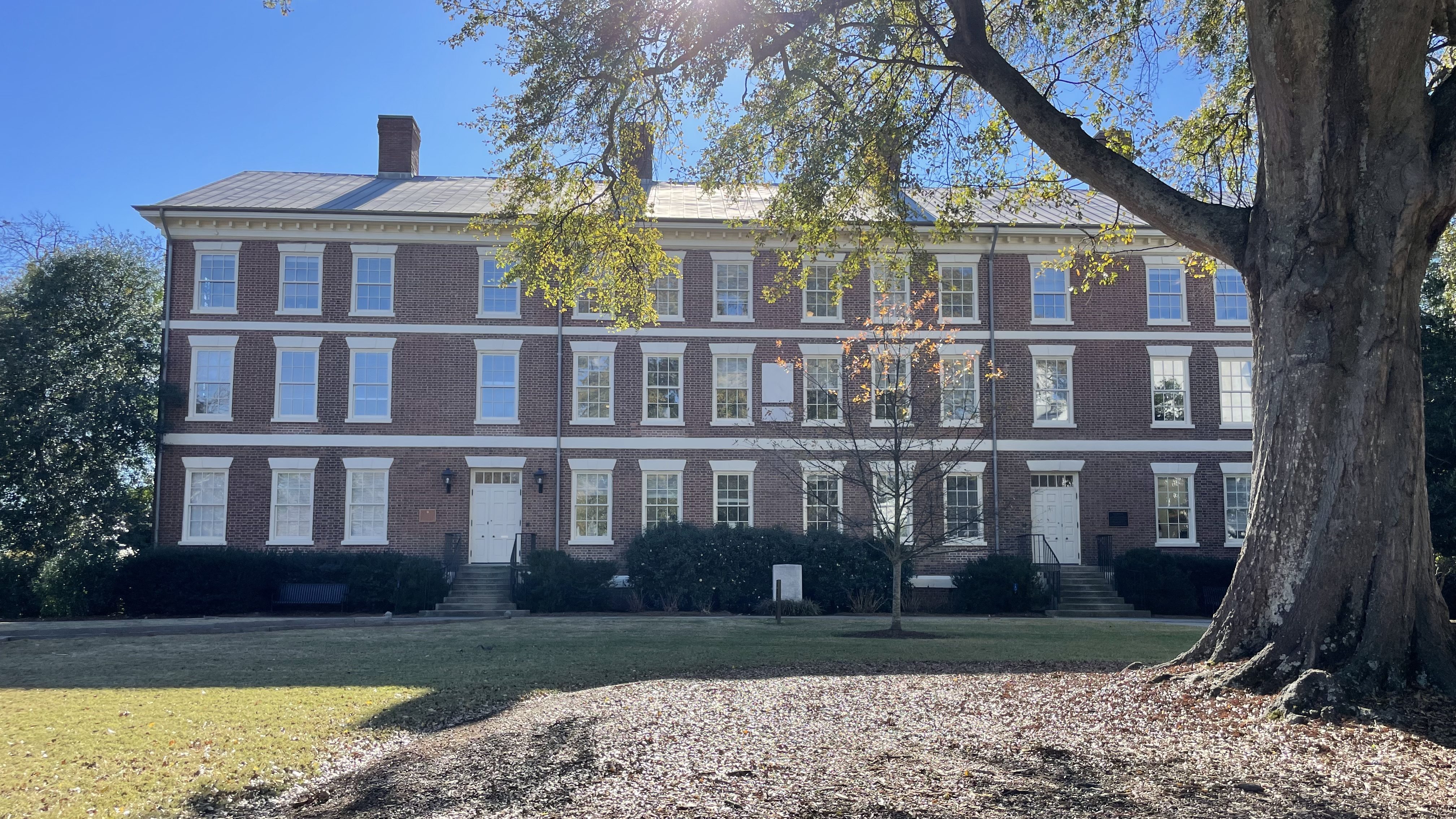
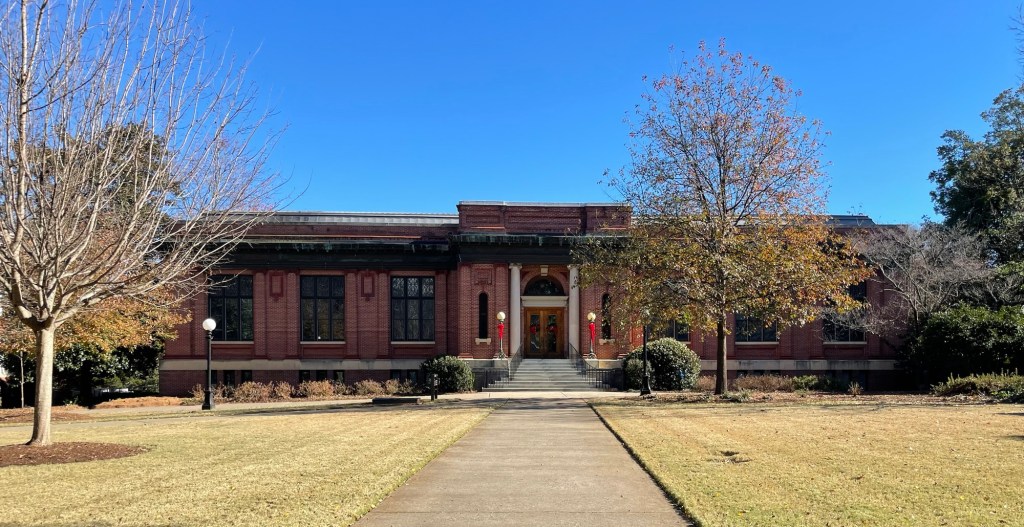
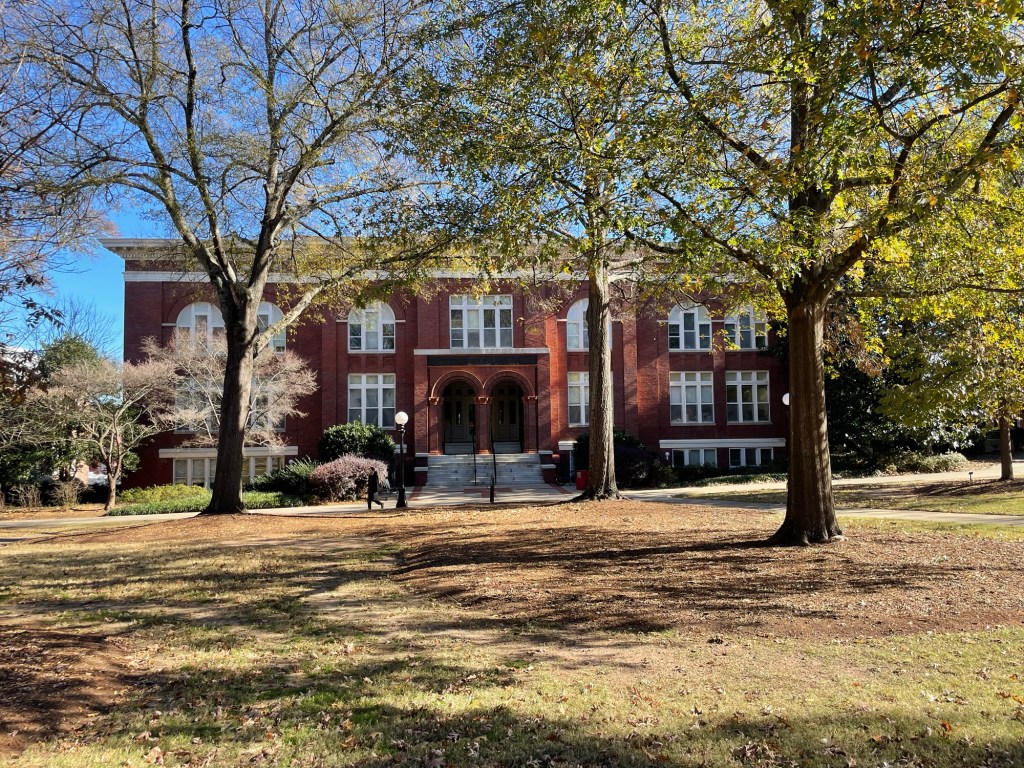
Following are a few of the U of G buildings on the square. Pretty, pretty, pretty.
The original college building from 1806
It’s a very pretty campus, and I can only imagine how good it must SMELL when the blooms are in full swing and the weather starts to get sultry. There are so many flowering trees and bushes and what seems like acres and acres of flower beds.
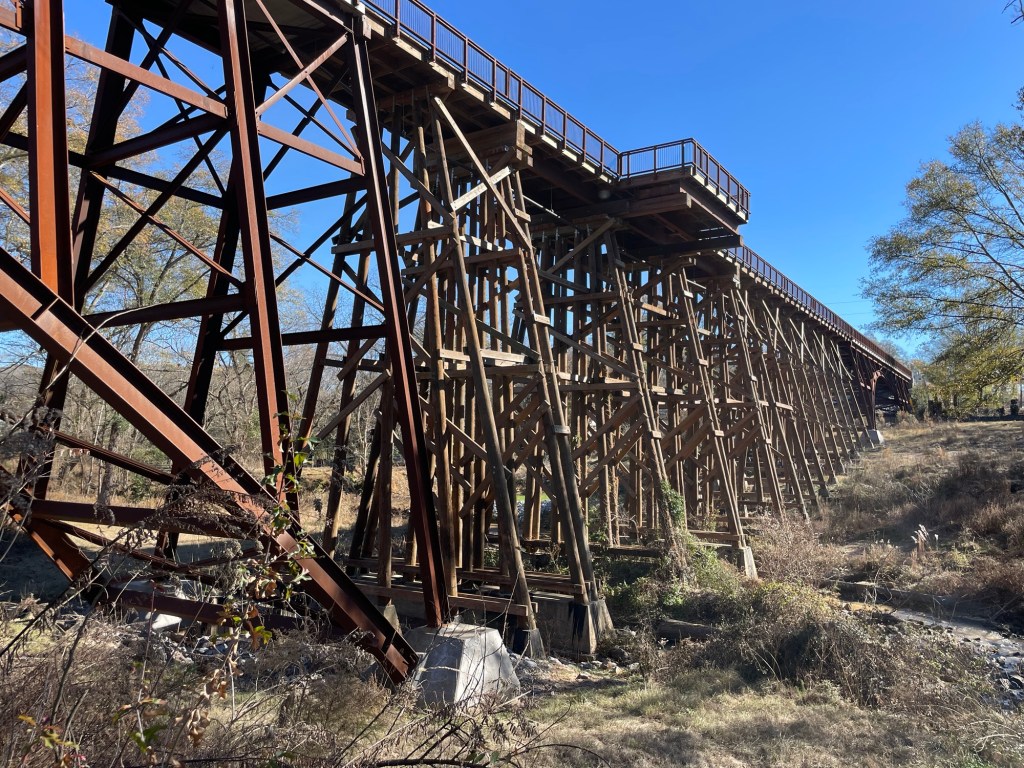
OK, now back to R.E.M. The back of the Murmurs LP cover shows a partial bridge, long dilapidated, and hence forth referred to as the Murmurs bridge. It’s since been reconnected (see below) to the opposite side of the creek as part of the multi-use Firefly Trail. Eventually, the trail will be thirty-some odd miles long. On our way to see it, being the fans that we are, I noticed that we were passing Weaver D’s restaurant where the owner reportedly has always responded, “Automatic,” to people when they place their orders. That little quirk became the reason for the band’s Automatic for the People LP title. I think it’s fair to say that R.E.M.’s affection for Athens, Georgia ran deep.
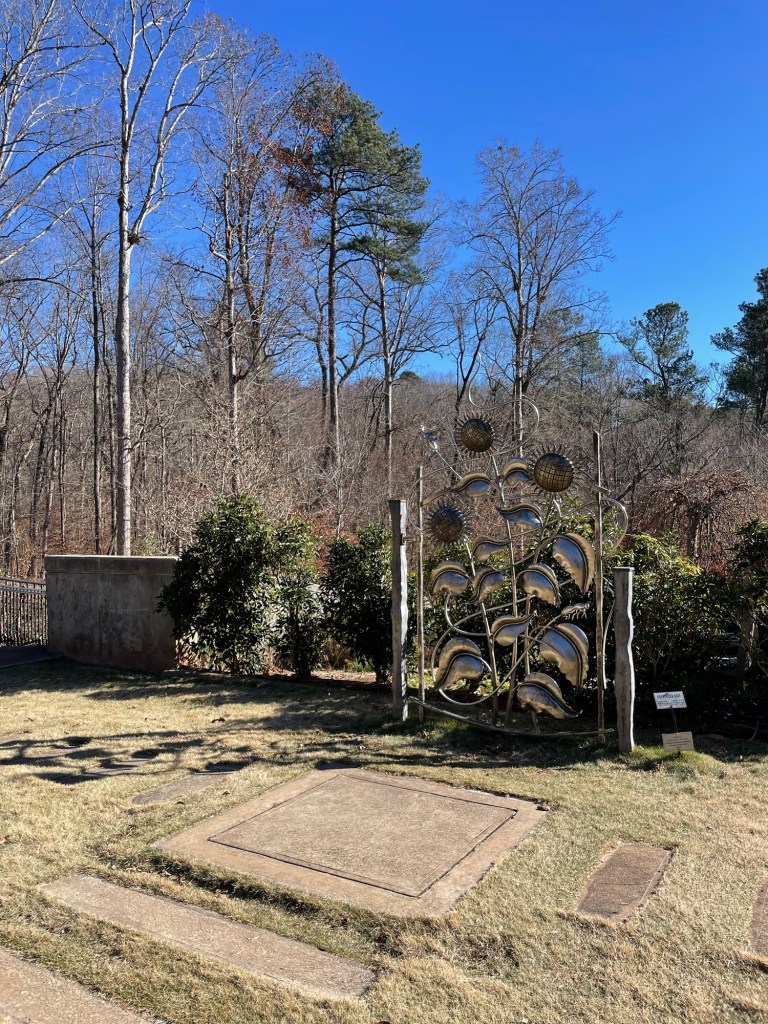
On our way out of town, we stopped by the Botanical Gardens of Georgia, south of Athens, since the weather was growing warmer and we always enjoy a trip through a botanical garden, even when the plants are slumbering.
The conservatory was decorated for the holidays and the Garden itself was full of whimsy. A good trip, all around.
As we sat enjoying the sunshine today, we noticed how point specific wind can be. Fifty yards across the inlet from us, a tree’s dead leaves were rattling away in the wind while the tree right next to us, in a similar state of dead leaf coverage was barely moving. We tend to think of wind as a single thing, a kind of giant box fan that blows across everything and everywhere at the same time, but being outside a lot has made us much more aware of the nuances of nature.
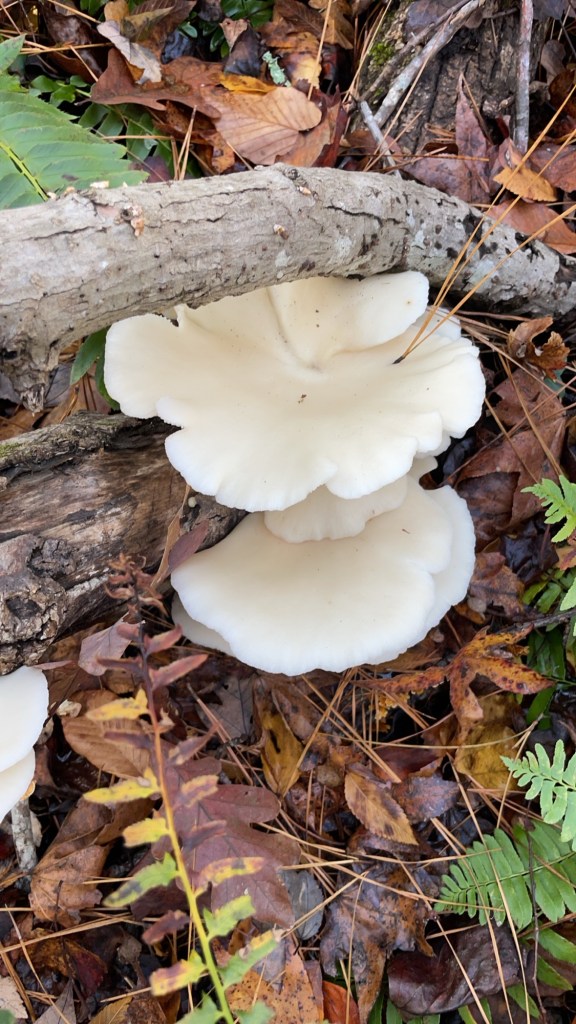
The weather hasn’t been too friendly here in east central Georgia these four weeks, but occasionally it’s been pleasant and we’ve tried to take advantage of those days. A few beautiful mushrooms have crossed our paths, although I think this one is my favorite. It looks almost silky, doesn’t it? Still not eating it.
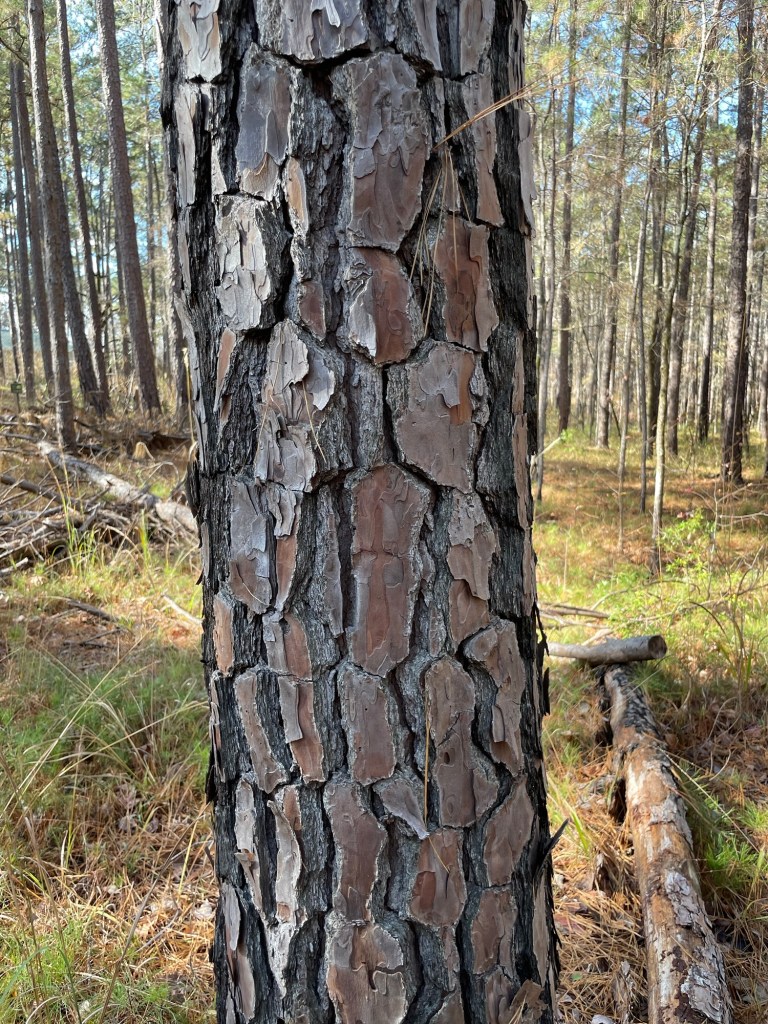
The almost squared off bark tiles of the Pinus echinata (Shortleaf Pine) at Mistletoe State Park captured my fancy. I saw one today too, right at the campsite. Talk about situational blindness. The trees themselves are very tall, but the branches don’t start until quite far up the trunk. It creates a canopy not unlike a series of umbrellas, allowing you to see deep into the forest, despite so many tree trunks all around. They do indeed let you see the forest for the trees.
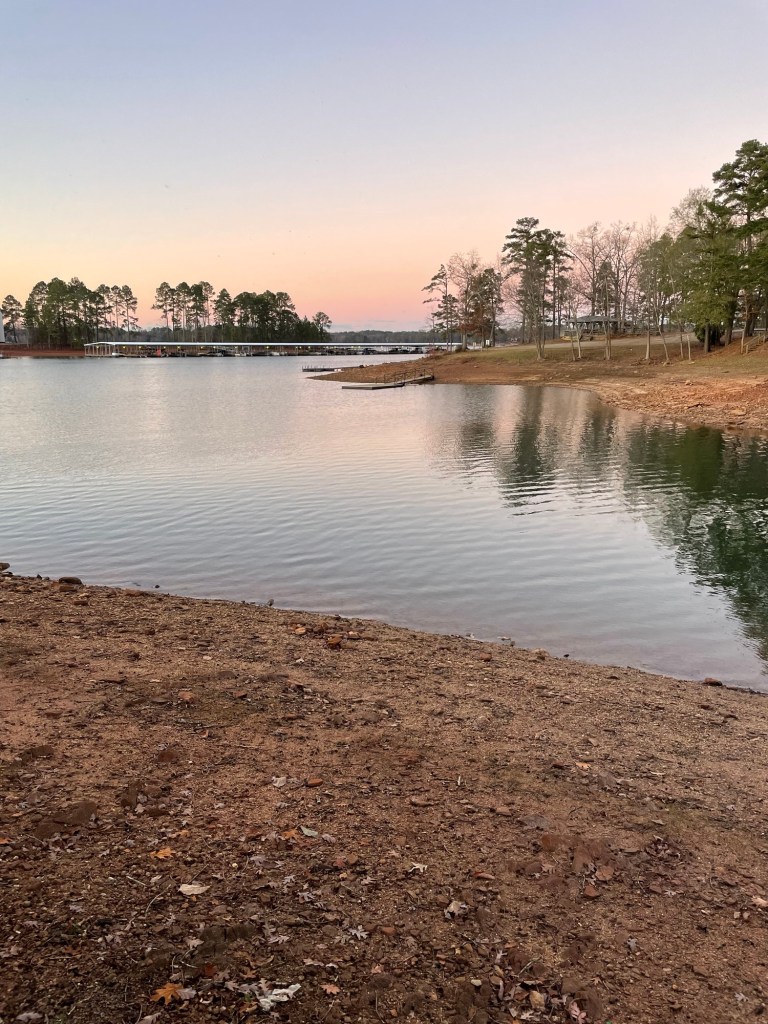
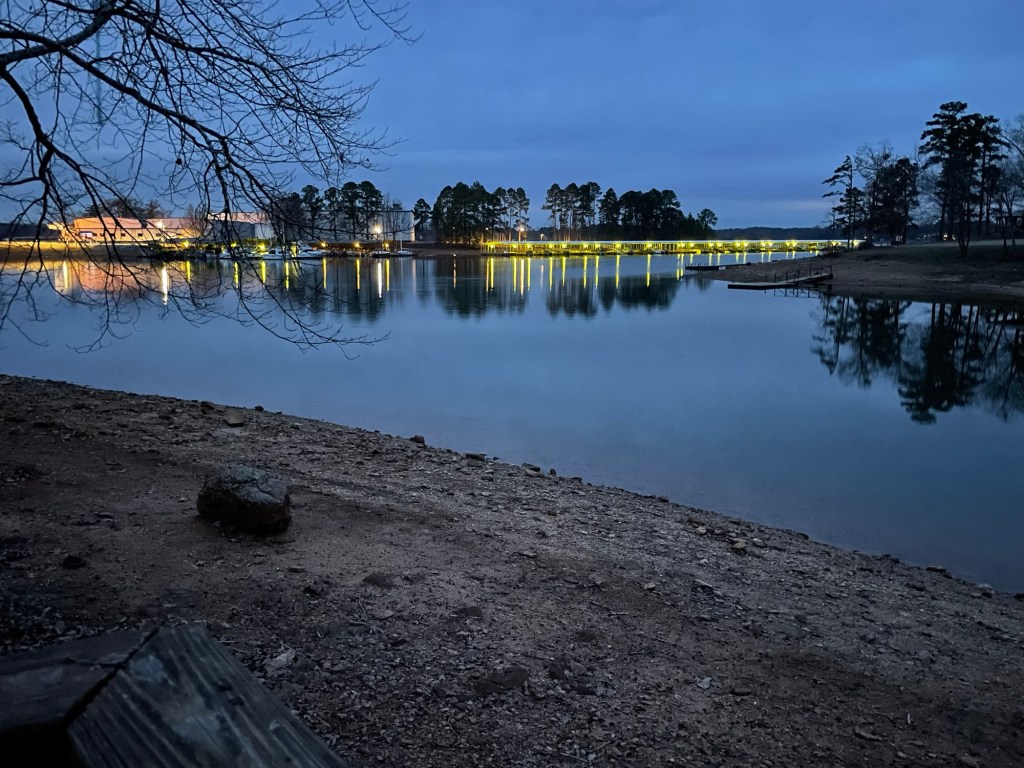
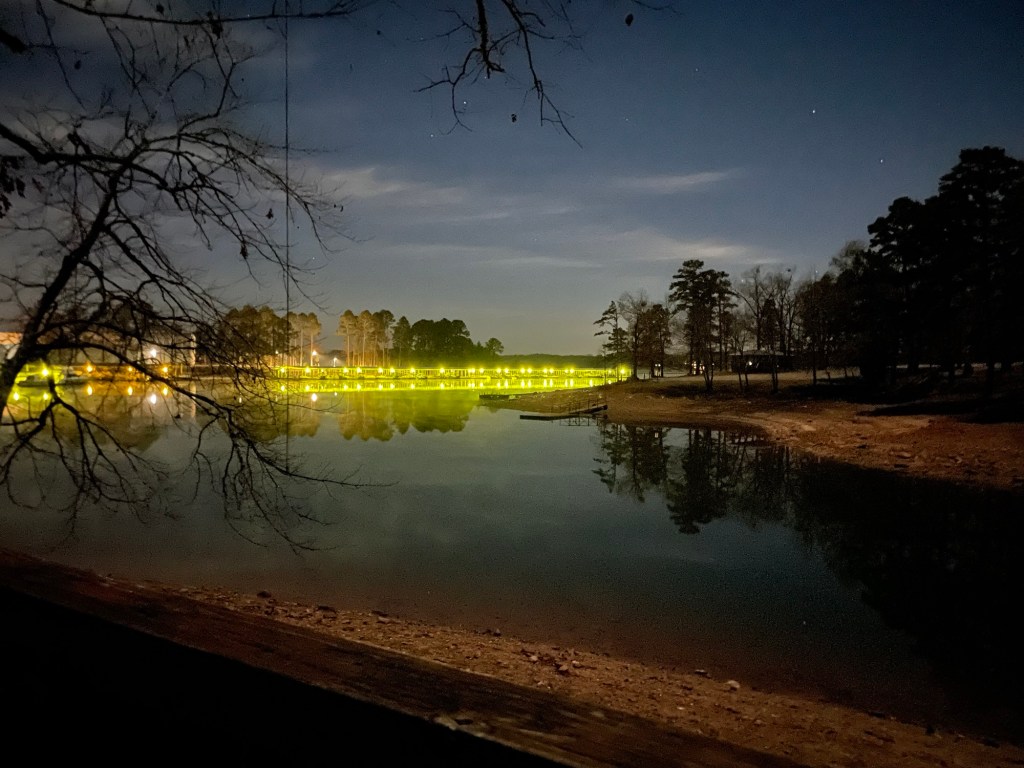
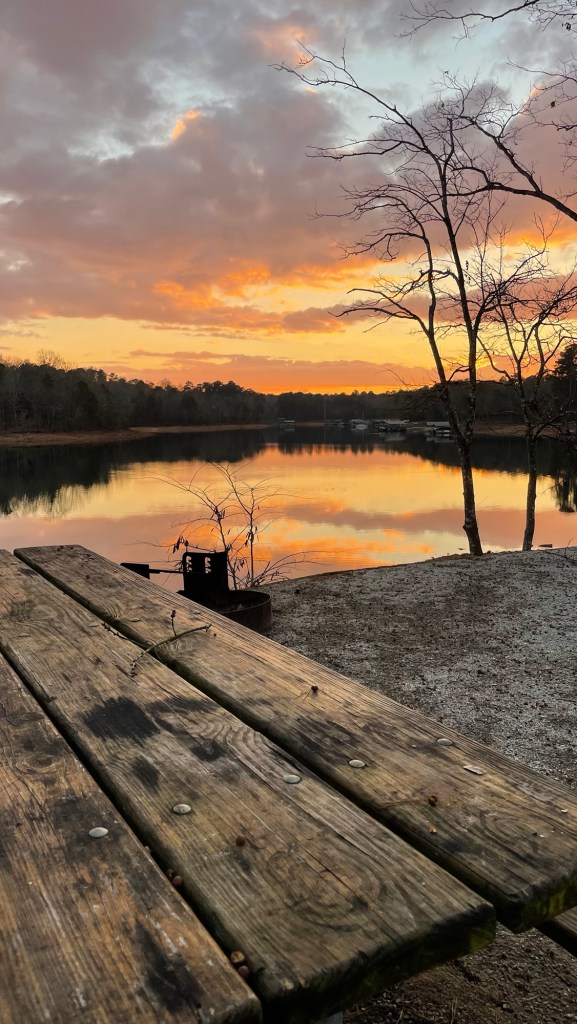
The most ongoing natural beauty, however, has been from our campsite. The sunrises and sunsets are beautiful on a nearly daily basis, but the lights from the boat shelters are my favorite sight as they cast their shimmering green reflections onto the water as dusk drops into night and dawn breaks into day.
Right here, it reminds me of Nick Carraway reminiscing, “So we beat on, boats against the current, borne back ceaselessly into the past.” Gatsby would have had a hard time picking out Daisy’s dock from this line up.
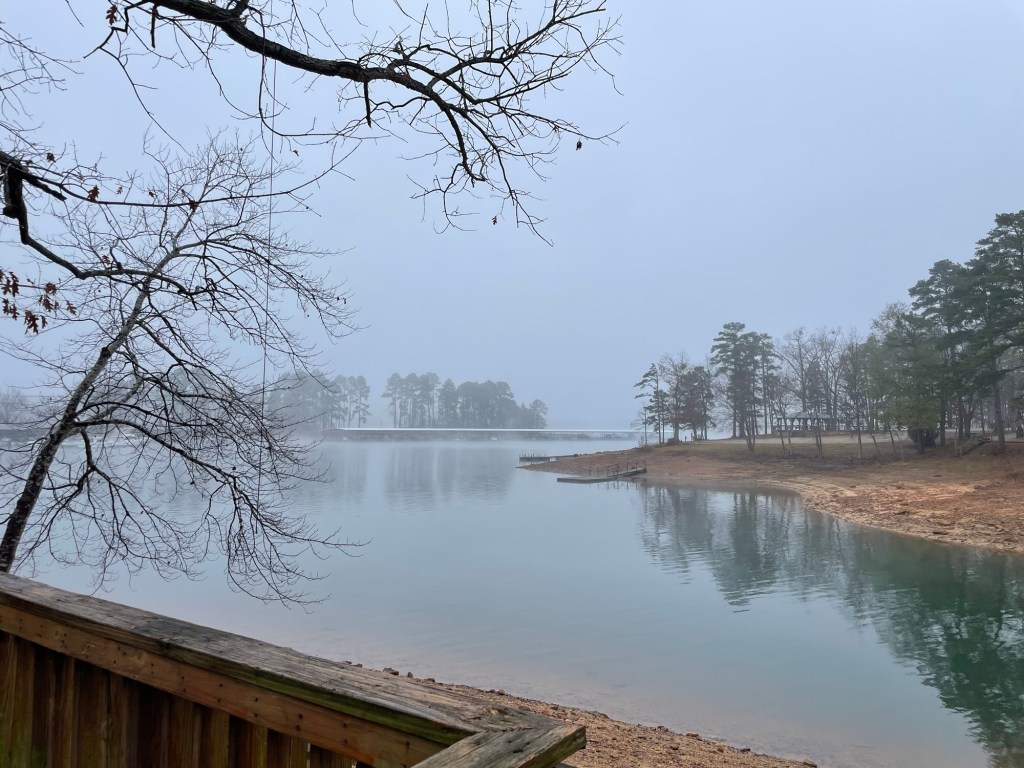
In the fog
Below is the other side of our peninsula. Georgia takes sunsets seriously.
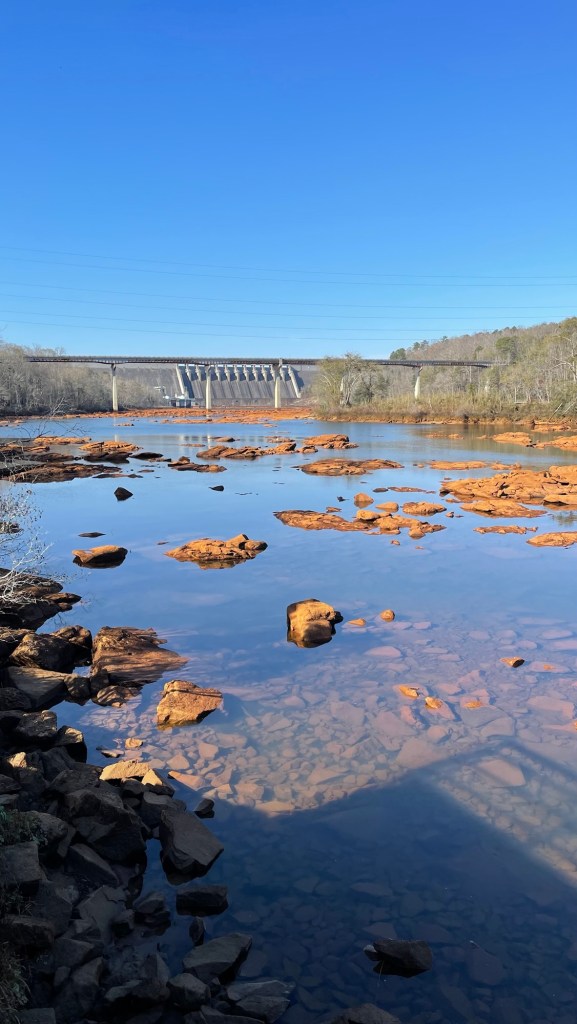
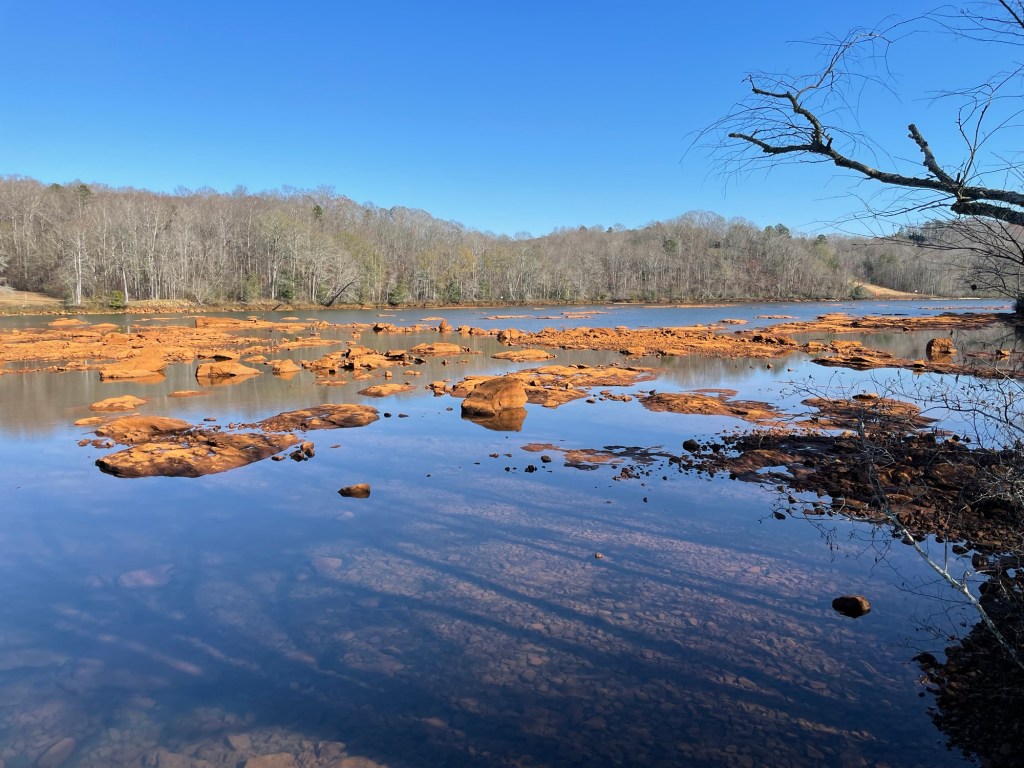
We’ve passed by the dam, below, on many of our drives between Georgia and South Carolina. It’s holding back that big wild oak leaf that is Lake Hartwell. The dam itself is rather uninteresting, seen one and you’ve seen them all, but the downstream area has striking red rocks peaking out of the crystal waters of the Savannah River.
If you’ve ever hear about the red clay of eastern Georgia (and western South Carolina), know that they weren’t exaggerating. It is red red deep brick red in color. And next to green grass, it feels like a Christmas display available year round. Every construction site churns up the brightest red clay we’ve ever seen.
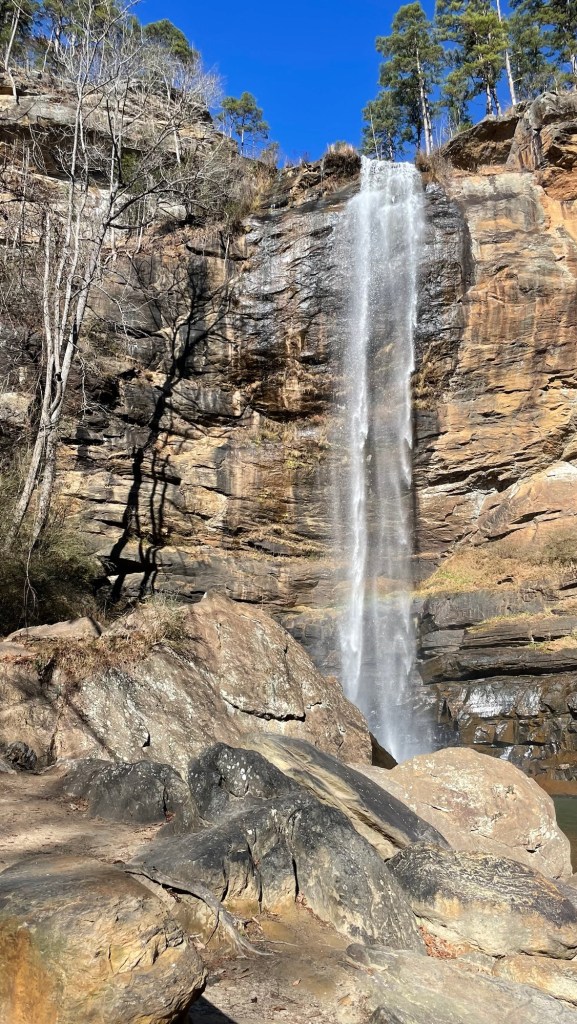
Ever heard of Tallulah Falls? No? Neither had we. It’s a small religious college with a waterfall at the back of it.
For $2 you can take a 3 minute stroll to stand at the base of it. It was pretty and quiet and we had it all to ourselves. Four bucks well spent.
We were saddened to read the plaque there about the flood of 1977 which wiped out a large part of the campus, killing over 20 people and injuring nearly 70. The dam behind this waterfall had failed. You exit through the gift shop. Yes, seriously.
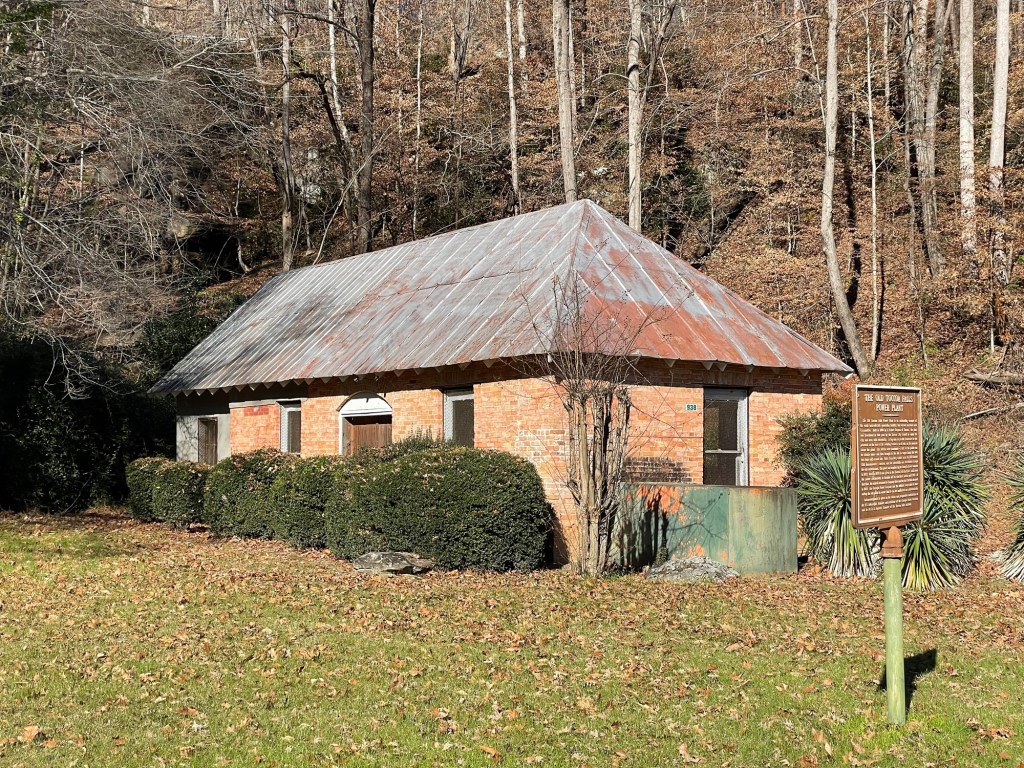
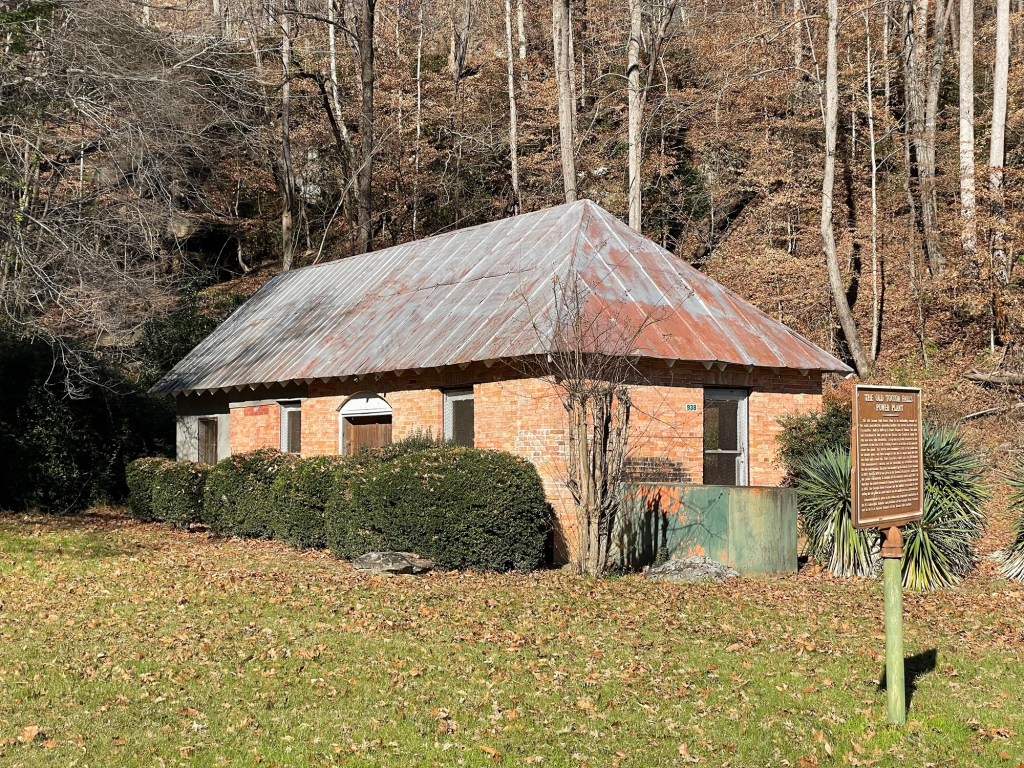
This ancient hydroelectric power station used to power the campus, but has since been decommissioned. If you risk the venomous cottonmouth snakes, like I did, you can still see some of the old machinery inside.
If not, like Jeff, you can enjoy its old tin roof. Ever wonder why Cindy Wilson of the B-52’s, ends that old bar favorite, Love Shack, with the phrase, ‘Tinnnnn roof. Rusted.’ ? Having been in the backyard of Athens for some time now (Go Bulldogs!), we can easily see why. Tin roofs are ev.ery.where down here. New and old, big and small, they are and appear to always been the default roofing option. You can almost age a building by the amount of rust on its roof.
Oh, Phil Connors, it’s like you’re right here with us. It isn’t Groundhog’s Day, but it sure feels like it.
Today we were mere minutes from arriving at the repair shop to pick up the truck when they realized there is a problem, a good-sized problem, with the front end. They can’t get the front wheel to line up because there appears to be “a bend in something, somewhere.” They’re going to tear the drivetrain apart to figure out what’s going on.
Tomorrow marks the four week point of the truck getting smashed into. The repair shop hopes to get the truck back to us before Christmas — Monday at the earliest, but probably more like Tuesday or Wednesday. Not feeling too festive down here at the moment.
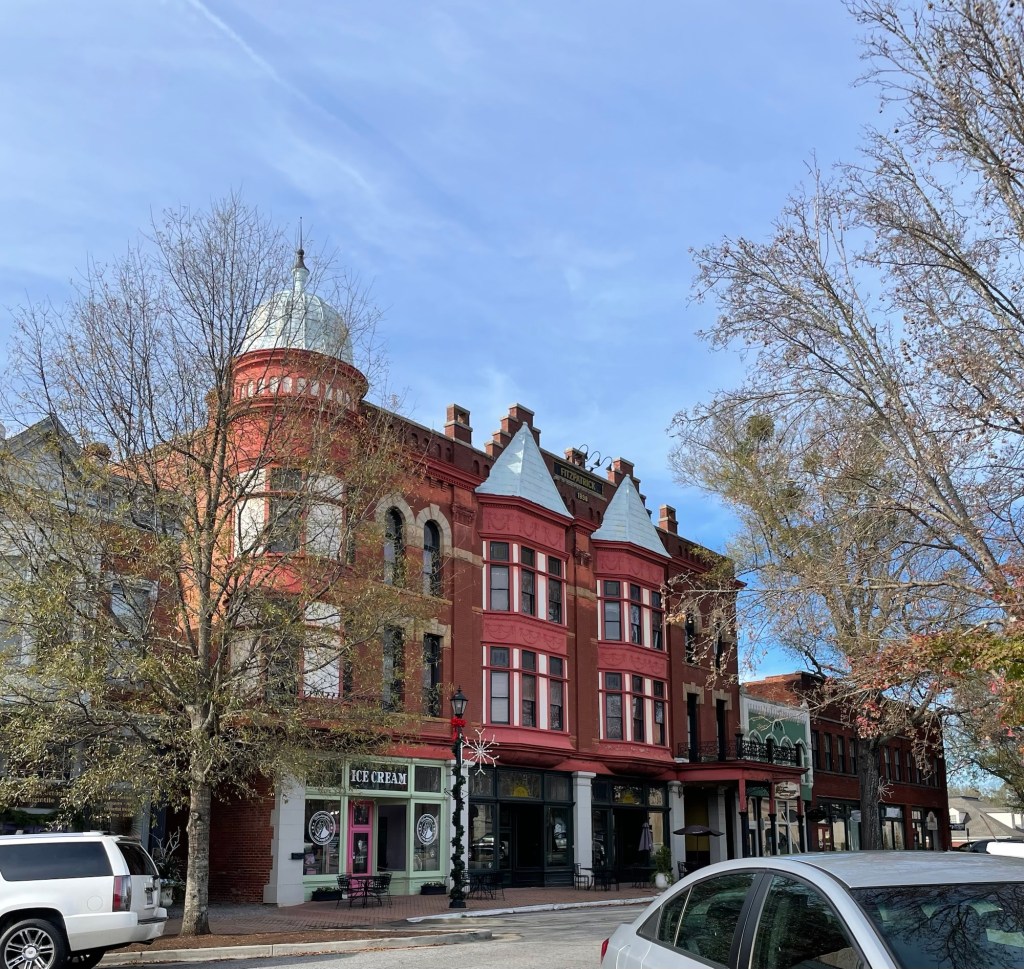
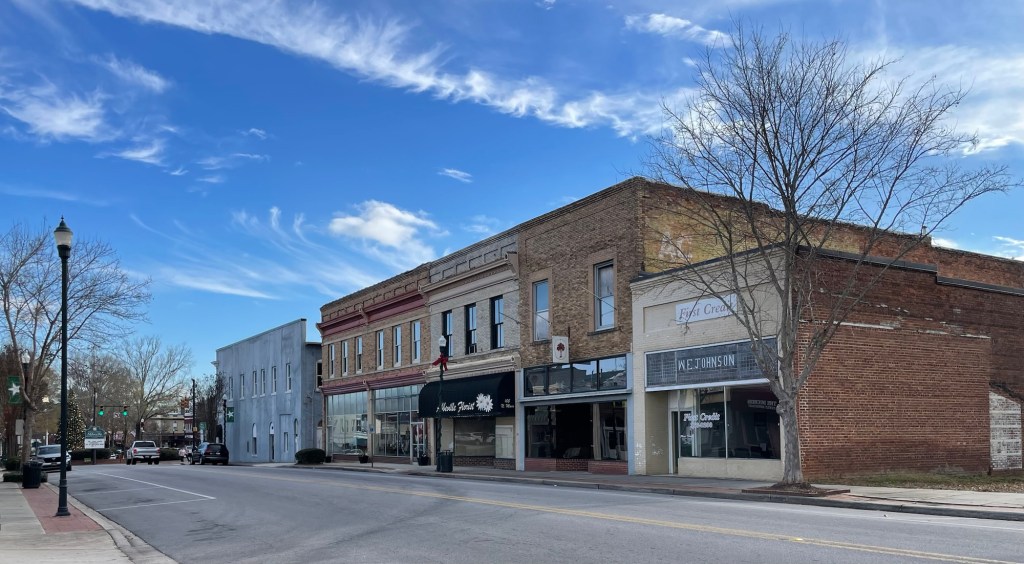
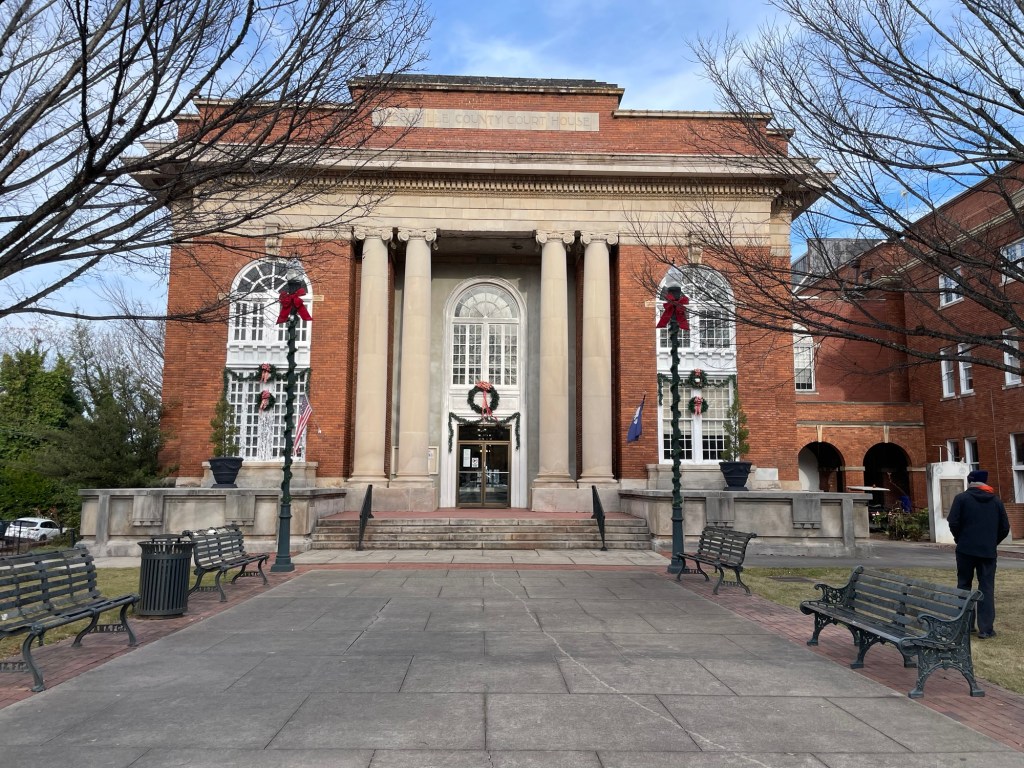
We enjoy walking around the traditional business districts in the rural areas that we’ve been visiting. Happily there are frequently clear signs that efforts were or are being made to salvage the more architecturally and historically interesting buildings. Unfortunately, I haven’t been taking too many photos the last couple weeks, being a bit down after the truck’s accident, so bear with me.
A turreted former bank — Washington, Georgia
One inevitable sight is a former bank building, like above, often found on one of the corners. There are also the deep merchandising windows of early department, general and hardware stores. And strangely enough, the frontier jail site (usually long since moldered into dust) is likely to still noted somewhere around the town. The buildings square are almost exclusively made of brick.
While walking around, we’ll inevitably see a brass plaque commemorating the great fire (or fires) that ripped though the village and destroyed much (if not all) of the original wood-fronted businesses. Since eastern Georgia and western South Carolina, the area we’re in now, was colonized well before the American Revolution, those towns (full of fireplaces, blacksmith shops, open cooking hearths, and the like) inevitably had at least one massive conflagration in their several hundred years of existence.
Among the retail buildings, flat fronts with large plate glass windows and wrought iron or carved wooden window/door frames are common at ground level, with varying degrees of stone and brick window ornamentation on the upper floors. Upper floors were frequently added on as time and profits allowed. Bay windows on upper floors and false rooflines are commonly seen, with each little detail adding another delicious bit of visual interest. I’m especially found of the fact that these older buildings have a bit of individuality, even among various “types,” versus the homogeneous nature of modern business architecture. We’ve noticed that during the 1930s, builders still seemed to be adding decorative details to windows, door frames, and the cornices of commercial and residential buildings.
Although some buildings, like the livery stable below, served the most basic (and dirty) of a town’s needs, builders still seemed to understand that the eye deserves a bit of beauty.
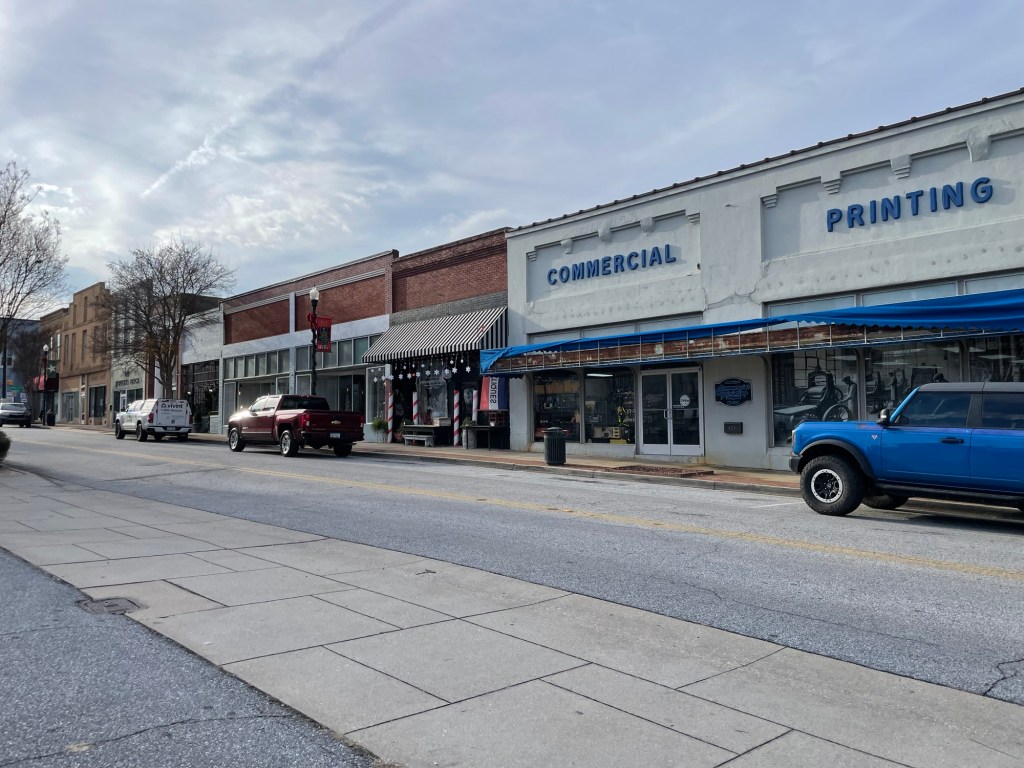
Around 1940, the level of ornamentation dropped significantly, and by the 1950s and 1960s, buildings were becoming plain and utilitarian at best (see the two on the right hand side, below). John Calvin would have been so proud. But wait, pride is a sin. (Bit of a catch-22 there). Don’t even get me started on the “renovations” that happened to some of the more elaborate buildings during the 60s and 70s. It was like taking a razor blade to Venus or Aphrodite.
Abbeville, South Carolina
What’s most noticeable about these little business districts, however, is how many of the buildings are now sitting empty. I’d estimate that about 30-50% of the store fronts we come across are empty. In the six above, for example, only one building is occupied. Some have active for sale or for rent signs. Some signs are so old they can barely be read anymore. Some businesses were clearly abandoned mid-renovation quite a while ago, if the thick layer of dust on saw horses and tools are any indicator.
How does a town come back from this? Must we really accept the Dollar General, Amazon, and WalMart -ification of America? What will become of our small towns and rural hamlets? Can they keep more than a Mexican restaurant (almost always excellent), a musty antique/junk store, a hair salon or barbershop, and a liquor store with bars on its windows, in business again? I dearly hope so, but I have my fears. It’s a bit circular, isn’t it?
People frequently claim they want unique products, locally grown fresh foods, and a thriving local shopping district, but they shop at big box stores or one of the online behemoths for a smaller price or one stop convenience. Small stores go out of business and the village center becomes a ghost town. Heads shake. “Someone should do something,” is said. A brave entrepreneur goes out on a limb and carries unique items or local perishables. They charge a bit more to cover their costs and can’t carry everything imaginable. Shoppers go back to the big names. The village core erodes.
Abbeville
Don’t get me wrong, I see some encouraging things, too. Local chambers of commerce are trying so hard to keep a sense of community alive.
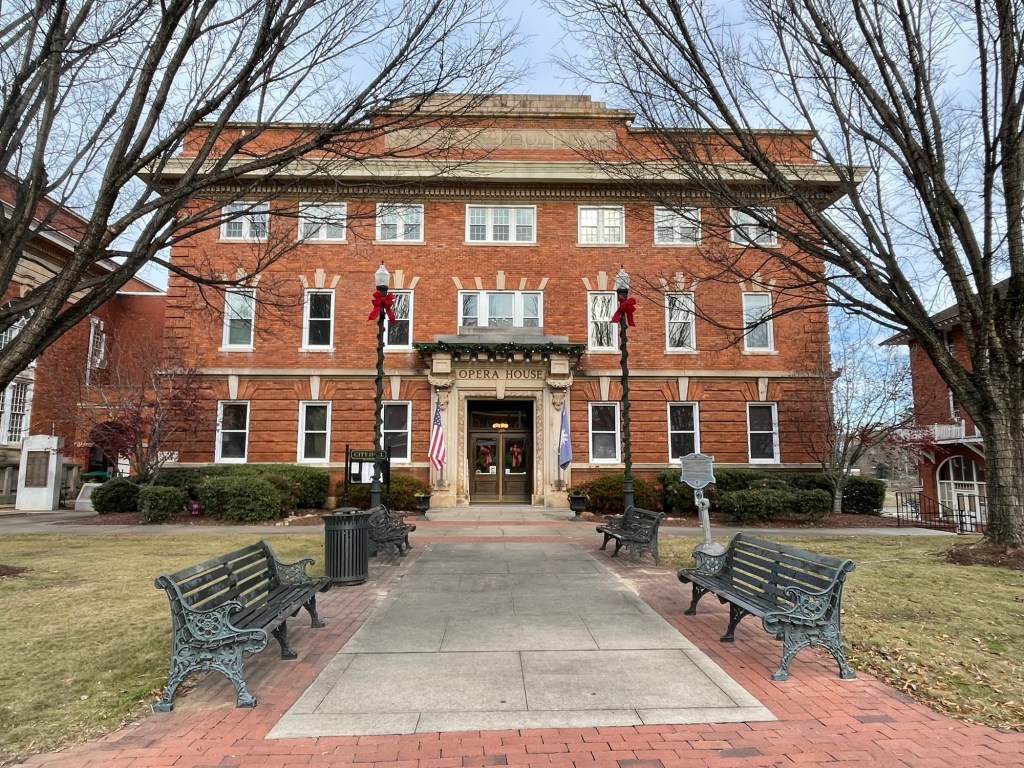
For example, the holiday decorations and Christmas tree in Abbeville, South Carolina, below, must have taken a team of volunteers days to put up. They also had signs for a musical public event, to give people a fun reason to come back to the business district this holiday season.
Abbeville’s charming brick streetsAbbeville
Another business district that is still doing rather well, Hartwell, Georgia, had a variety of public events listed this month — a tree lighting event, a holiday-themed theatre production, a local home tour, and a Christmas parade. But even they’re struggling to pull people into town due to the economy. We were often the only people in the shops when we visited them. And their annual home tour usually sells out almost immediately we were told, despite its $25 per person price tag, but this year there were still a lot of tickets left only a week before the event.
Walhalla, South Carolina — amazing museum telling the story of the Cherokee population that lived and continues to live in the area. Washington, Georgia — home of firsts: first county in GA, first library in GA, first cotton mill in the South, first gold stamping mill in the world. Anderson, South Carolina — ‘the electric city’ that early on powered its community with a hydroelectric dam.
Royston, Georgia. Seneca, South Carolina. Toccoa, Georgia. Westminster, South Carolina. I could go on and on. All of them are worth visiting and filled with interesting history, but for the most part that hasn’t been enough to keep the businesses open and the employees paid.
I don’t have the answers needed, and I certainly don’t want to knock these communities. They’re lovely. I hope they can find a way to thrive in the coming years.
Abbeville police stationAbbeville Opera House
In honor of these sweet little towns, may I suggest that you buy less, if you must, but definitely buy better when you can? Find your next must-read at a local bookstore. Buy from farmers markets, crafts stalls, and roadside stands. Meet the people who grew/raised/made the things you purchase whenever you can. Eat at family run restaurants. Stuff your stockings with things an individual made. (Such as some fun stationary, pretty pottery, or even a lump of coal.)
We spoke with the repair shop on Monday and drove up there today. The truck’s one-piece ‘cage’ was damaged along the driver’s side bottom, so they’re going to shave a portion of the entire driver’s side off (an inch, two, three? I have no idea) and weld a new edge back on. Apparently that is a thing. Who knew.
They’ll pull the truck bed off and set it aside while the cutting and welding is being done. After they ensure the new driver’s side doors, front quarter panel, and bumper fit correctly, they’ll put the truck bed back on and send it over to the paint room.
They have to replace the front tire since it has gouges in it, possibly replace the rim, and balance & realign the front end as well. We asked that they swap out the other three tires as well (at our expense), since we were planning to replace all four in the spring anyways. This way all four will have the same amount of wear going forward.
We’re settled in at the local campground and can stay here until New Year’s Eve, if need be. The repair shop estimates that truck will be finished around the 22nd. Luckily we can keep the car rental until the end of the month, if things do take a touch longer. We really really hope that they don’t.
On a ‘It’s a small world’ note, we found out yesterday that our campground neighbors are from the small town where Jeff’s dad spent the bulk of his career. He was their kids’ elementary school principal!