Now you might think those two names don’t go together. And I’d have to agree with you. For better or for worse, Henry Ford was Detroit, and Detroit was Henry Ford. But Henry Ford and Georgia? Just saying that out loud is going to get you some serious side eye.
While we were visiting Savannah, we stayed at Fort McAllister State Park, which sits right across the Ogeechee River in Richmond Hill. Now here’s where that unlikely pairing comes in. Richmond Hill exists because Henry Ford purchased massive amounts of land south of Savannah and made the area both his winter home and a manufacturing town for the Ford Motor Company in the mid-1930s.
Soon after that, Ford became interested in restoring the ruins of Fort McAllister, the best preserved earthen fort of the Civil War, as it lay on some of the land that he’d bought.
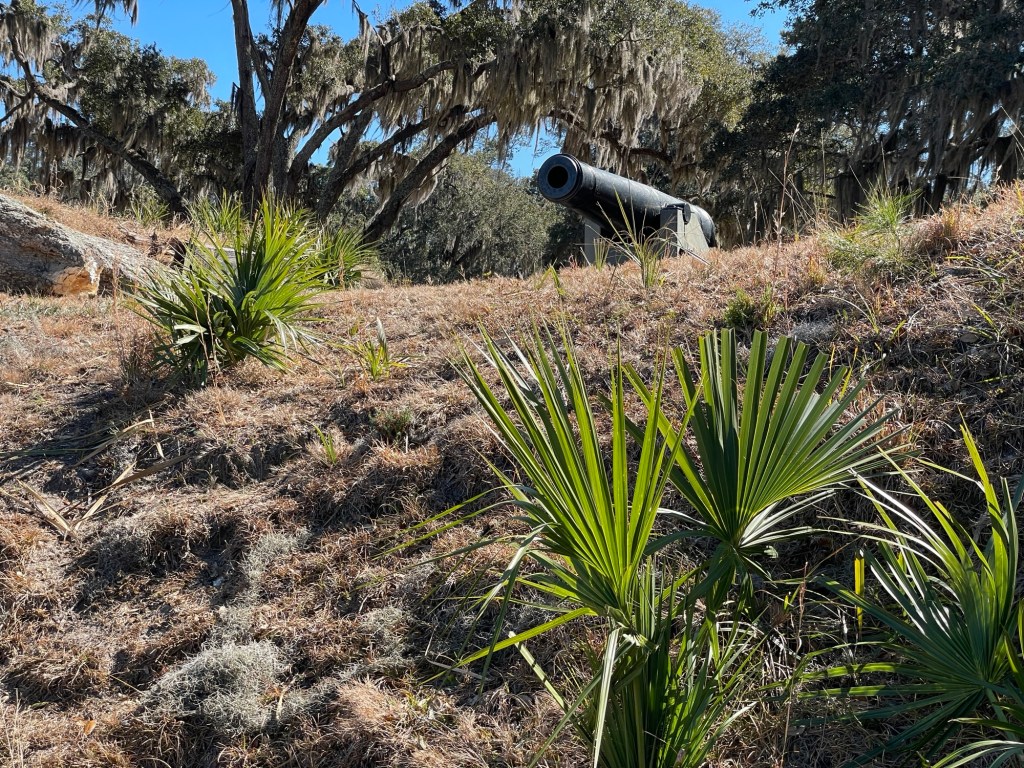
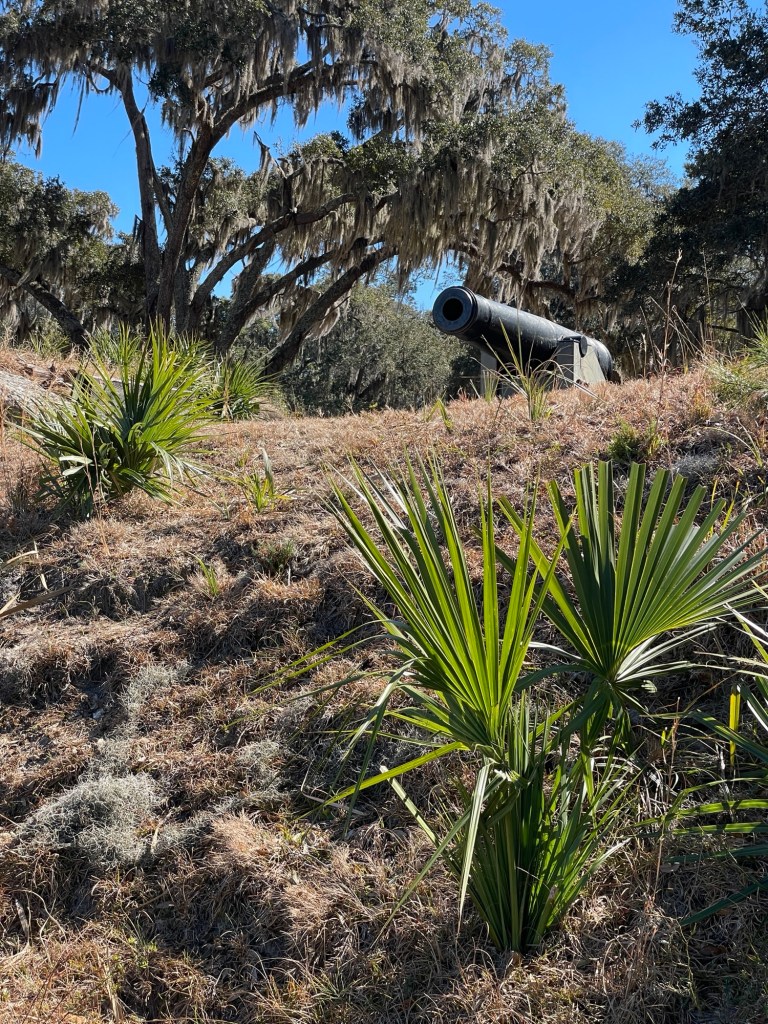
Fort McAllister cannon amid the regrowth
Quickly built in 1861, the earthen walls of Fort McAllister repeatedly absorbed bombardment by the pride of the Union navy, their new and much feared Ironclad Monitors. Eventually, the navy gave up trying to shatter Fort McAllister’s walls and sought out other targets. Not until General Sherman’s forces arrived in December of 1864, when only a skeleton crew of the very young and the very old were left to defend it, did Fort McAllister fall (to an infantry attack that only lasted 15 minutes). In the end, it was the last fort defending Savannah. Not bad for some dirt walls.
For approximately 80 years, the fort sat quietly along the Georgian coast, increasingly forgotten. Trees grew on and around the fort’s walls. Palms and sea grasses took root in the boggy plains. The bombproofs, powder magazines, infirmary, kitchen, and sleeping quarters sat empty, holding their secrets within while their doors rotted away. The wooden pikes that lined the moat broke, disintegrated, or fell down and got covered by soil and time.
Indeed, it was the fort’s forgotten status that protected it so well. Fort McAlliater is now owned by the Georgia State Park system and they do a good job of keeping its history alive, making it accessible to visitors, and telling the story of the fort in a small but information-deep visitor center. A few people online have groused about having to pay the small extra fee if they’ve paid to camp in the park, but the truth is that maintaining historical structures and funding ongoing archaeological efforts cost money. You can’t do it on vibes and internet exposure.
Shot, powder, and grape
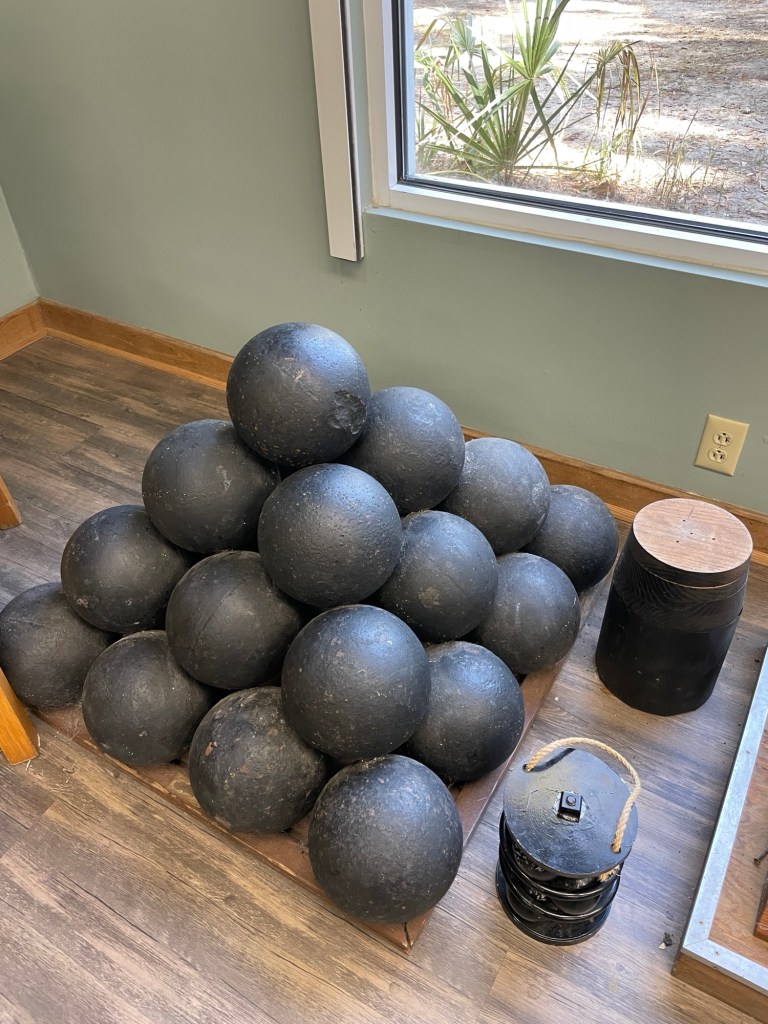
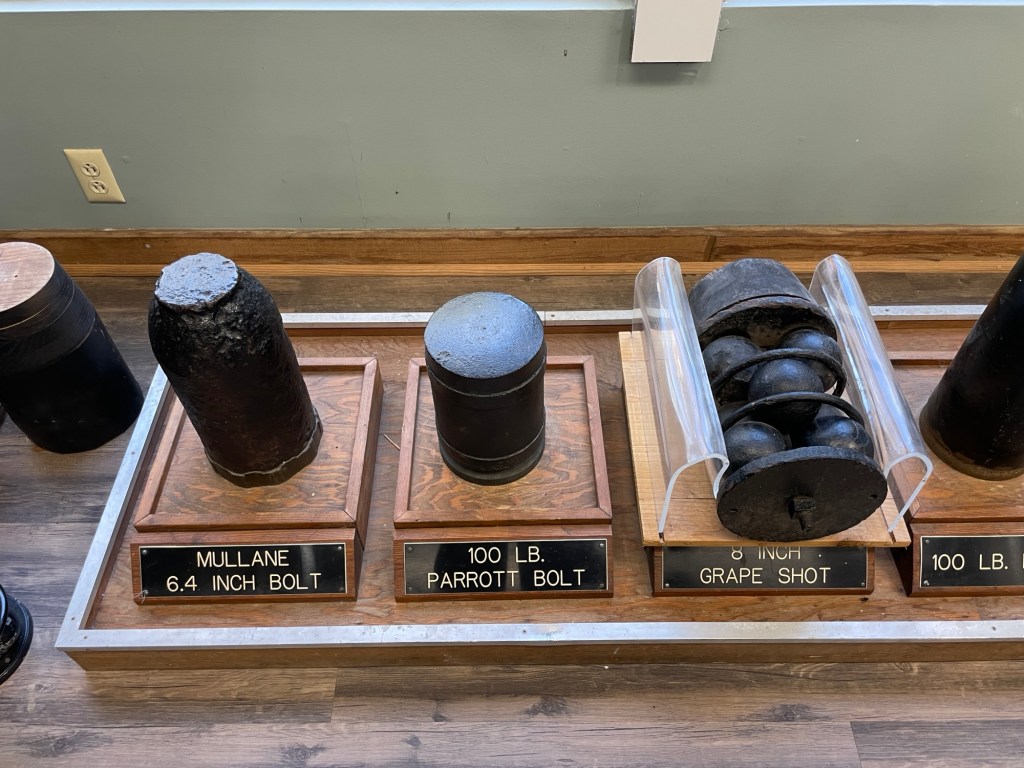
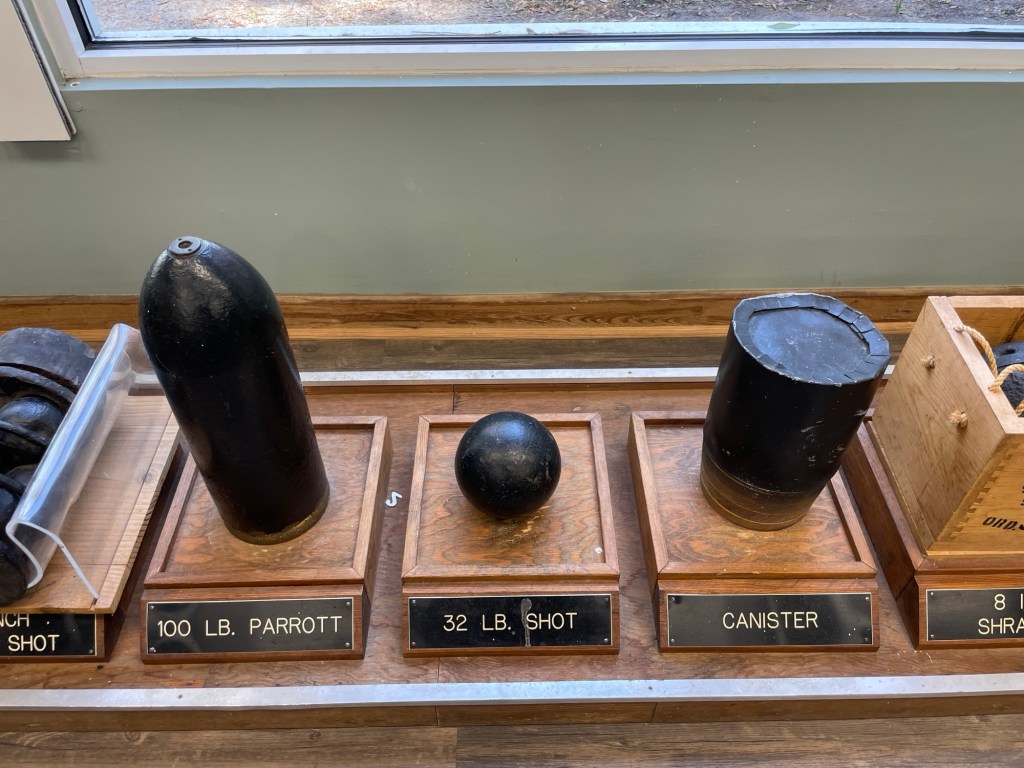
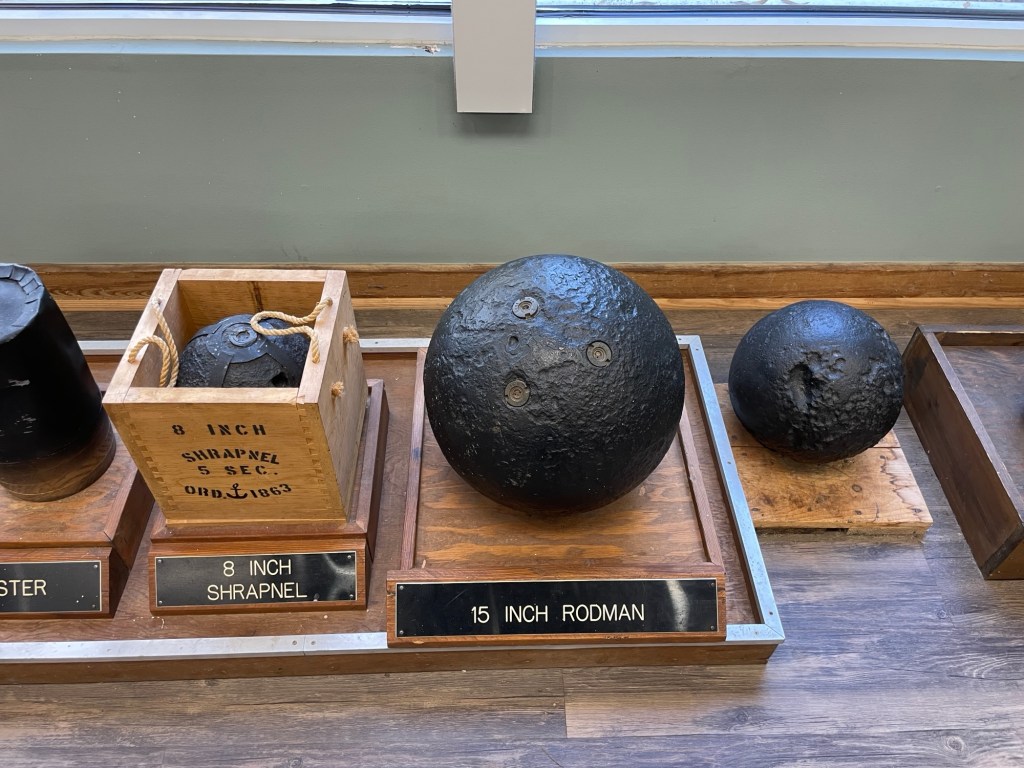
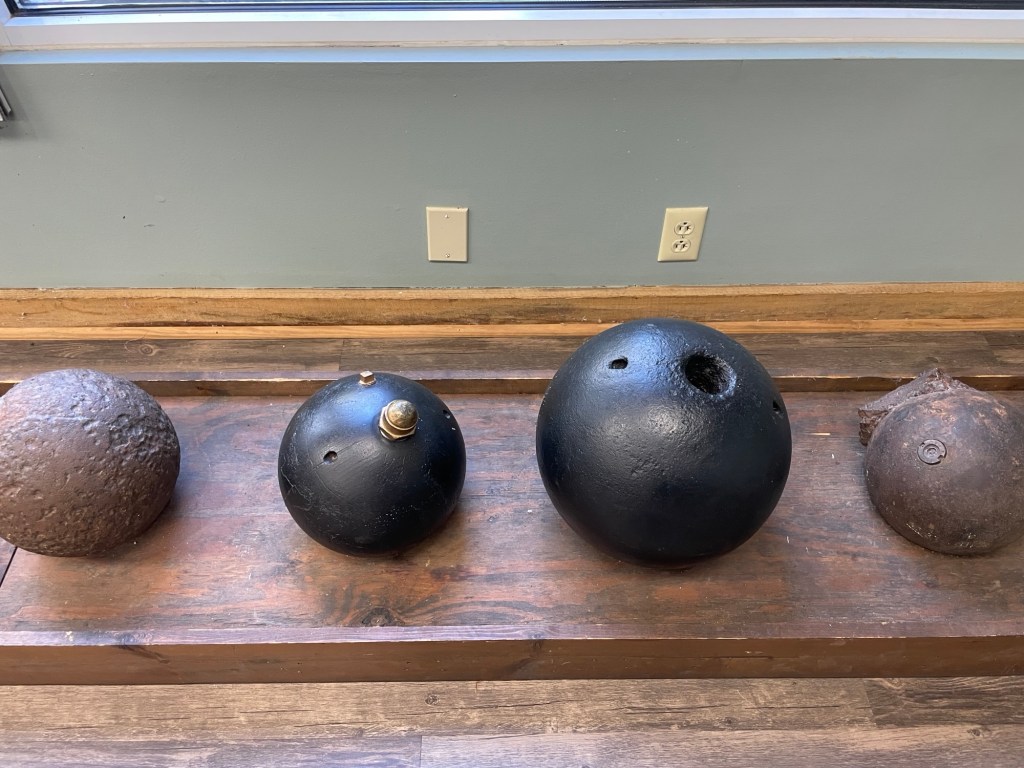
I wish that I’d been able to visit the fort’s armory room before reading about Civil War battles, because they have a good exhibit about the different types and sizes of shot for mortars, howitzers, and cannon. Authors tend to assume that you know what they mean by 30 pound shot, bolt, grape, canister, etc. I did not. Sometimes I thought I knew what they meant, but learned that I hadn’t always understood correctly. Paid a little, learned a lot.
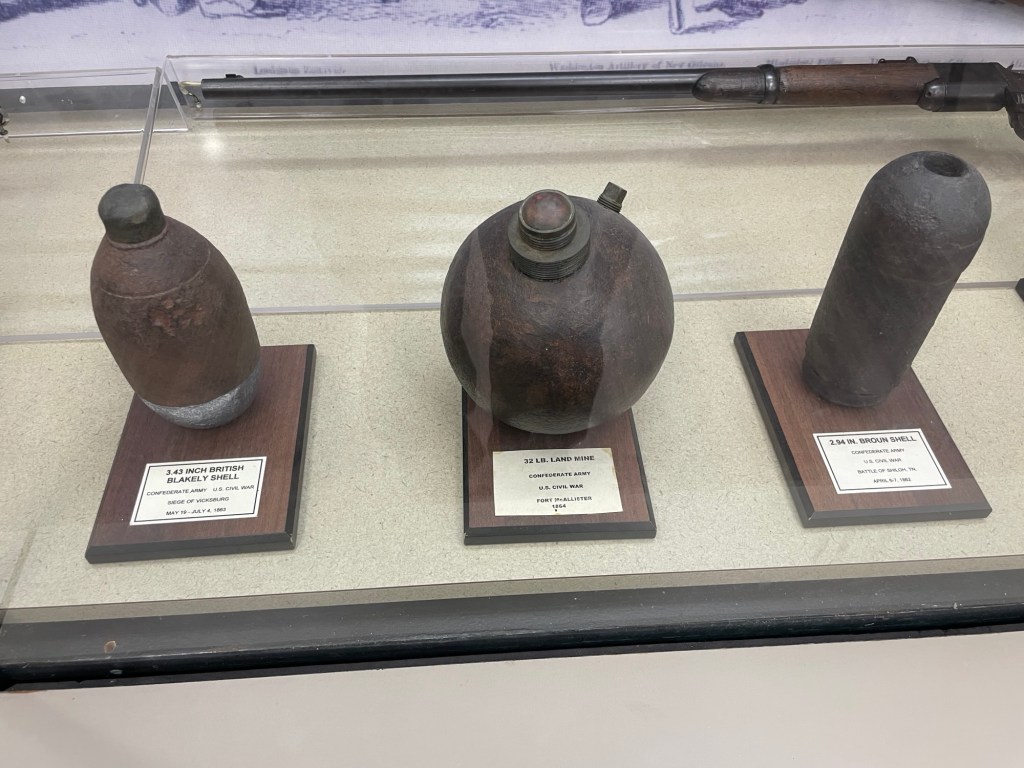
Grape. The name makes sense now. They seem so small to be so heavyShrapnel shells were filled with… shrapnelThe center two are land minesThis landmine is from Fort McAllister
General Sherman was so irate about land mines being used around Fort McAllister — he considered it ungentlemanly and beyond the scope of decency during war — that he made Fort McAllister’s soldiers, including its leadership, remove each land mine placed outside the fort. And they did it by hand.
As the month comes to an end, numbers clang about in my head. It’s been three months since someone crashed into the truck, six months since Jeff and I rolled out of Colorado, nine months since we picked up the HMS Beangle and I fired up this blog, and two years since our son died. Nothing prepares you for the worst moment of your life.
If you’ve made it this far, thank you. Thank you for your interest in our journeys and my attempts to make sense of them. If you’ve left comments or liked posts, thank you for that as well. I genuinely appreciate the feedback. If you’ve reached out lately, thank you even more. February is a tough month for us. Hold your people close.
It’s old. It’s pretty. It’s full of gorgeous buildings, more leafy trees and blooming bushes in February than I could process, and far far more cobbles and uneven stone pavers than is good for Jeff’s dodgy ankle.
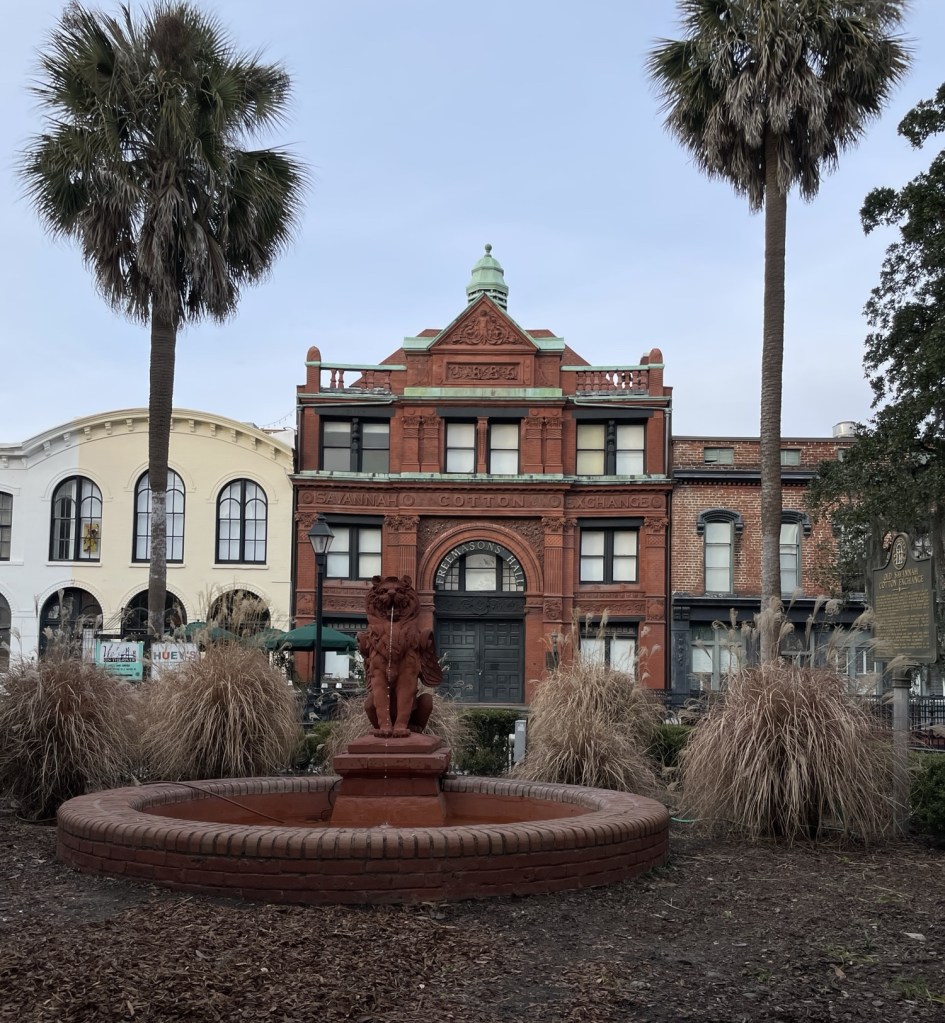
Savannah Cotton Exchange building, now known as Freemason’s Hall In this building cotton brokers once gathered to set the price per ton of cotton before sending it out for shipment worldwide.
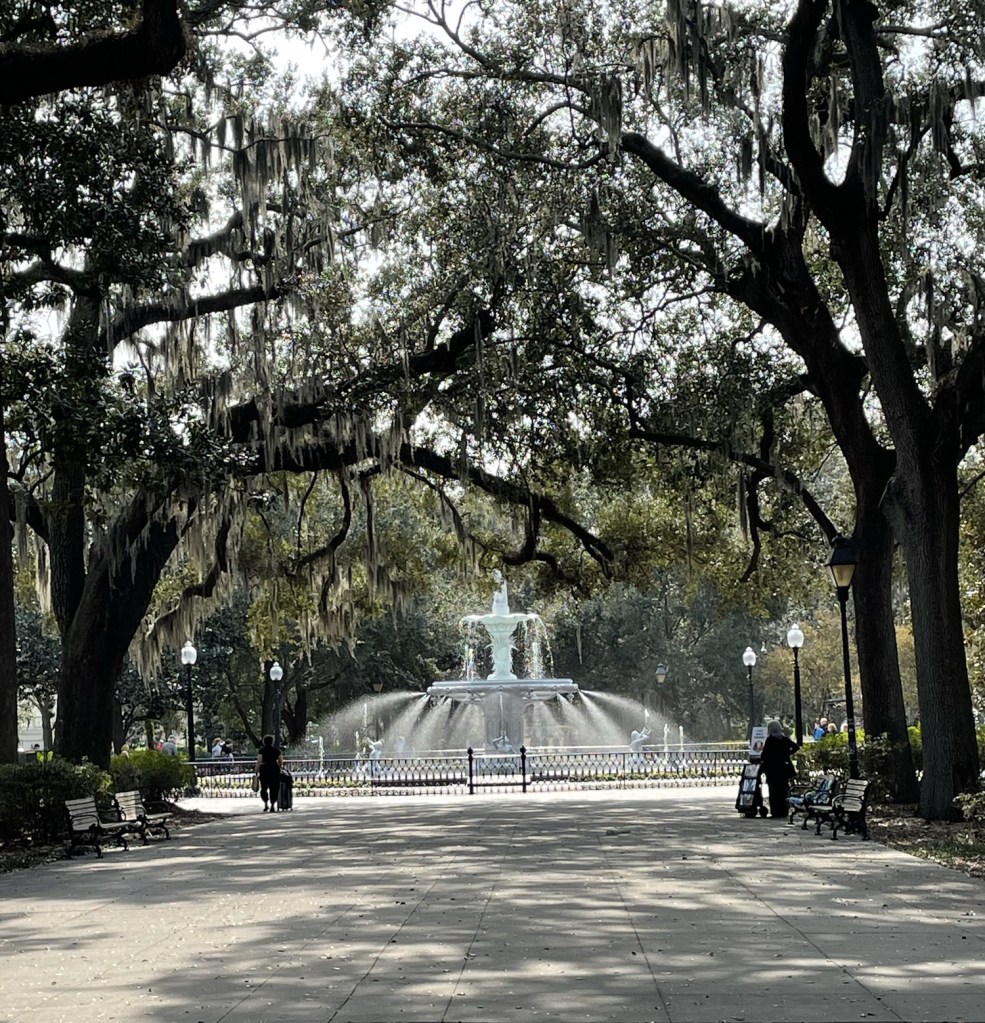
Savannah is also the setting for John Berendt’s non-fiction crime novel, Midnight in the Garden of Good and Evil. If you’ve seen the movie adaptation with John Cusack, Kevin Spacey, and Jude Law, you’ll recognize the location below. If you haven’t, go watch it. It captures the beautiful oddity that is Savannah, Georgia.
Forsyth Park
I wish Jeff and I had watched the film again before heading into the city, because we definitely recognized a couple of things while we watched it last night.
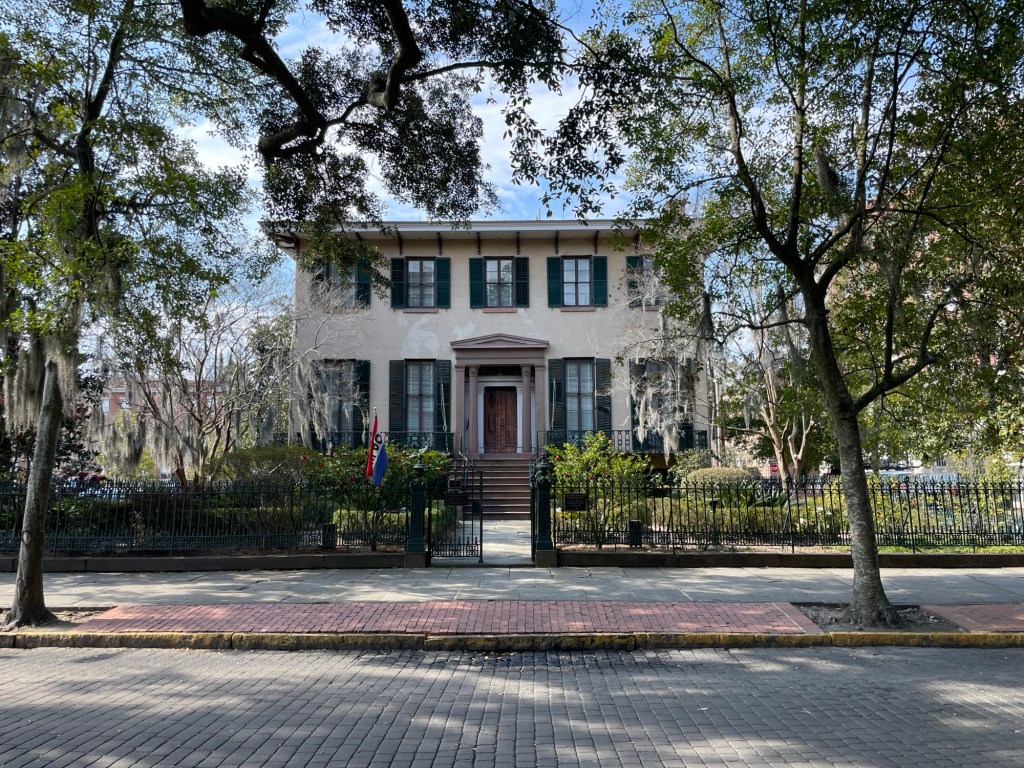
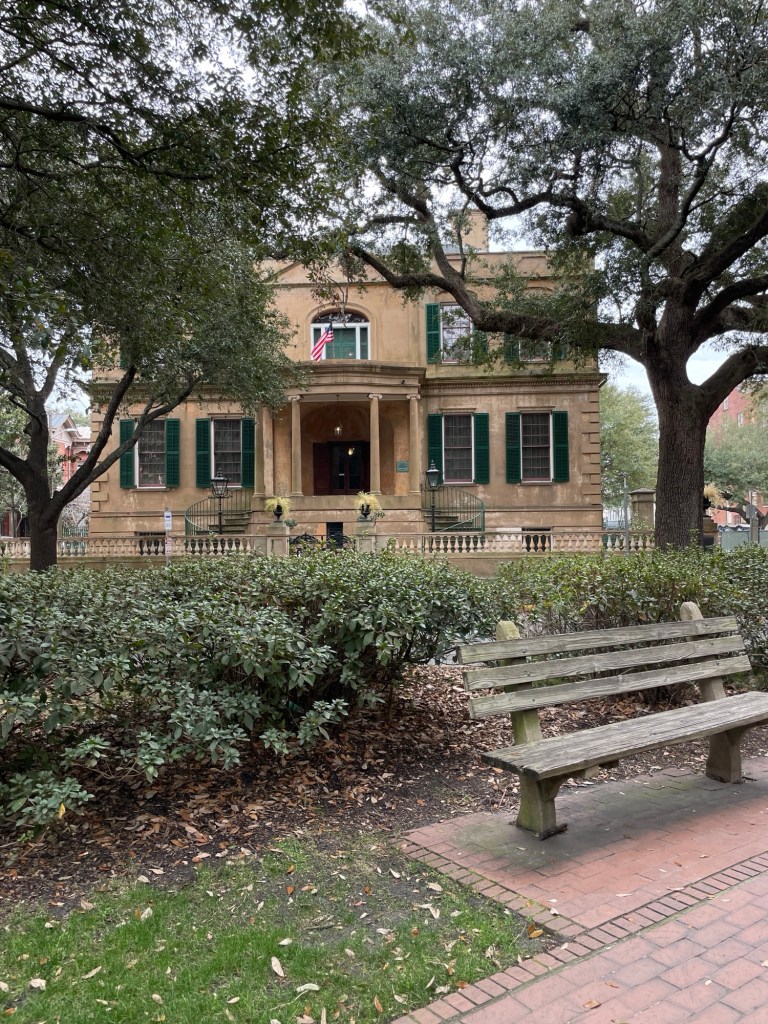
These homes aren’t in the film, so far as I know. The city seems to have a tree — usually a wide-branching Live Oak tinseled with Spanish moss — growing in every spot not covered by asphalt, brick, or stone. And in some spots that are. So many trees. In fact, I found it quite difficult to take photos of the city’s large homes and public squares because they just ended up looking like exercises in tree limbs, leaves, and bark.
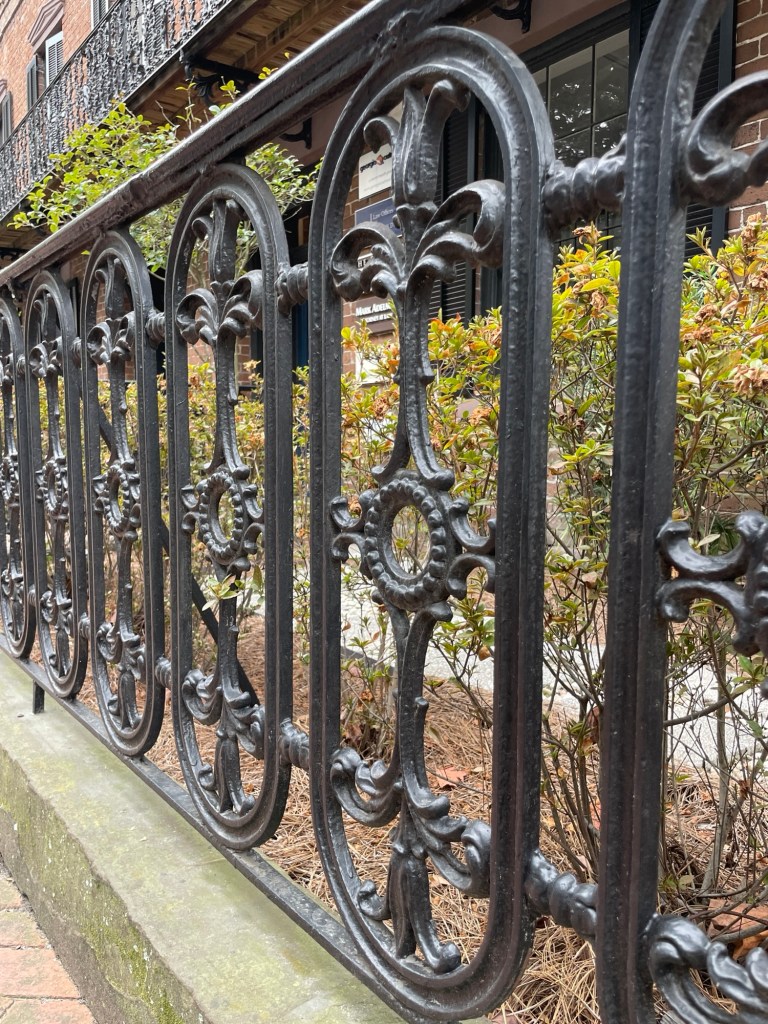
The cast iron detailing around the city is superb
Savannah, you might remember, was also the destination for General William Tecumseh Sherman’s infamous yet arguably essential 1864 March to the Sea. After the Union decisively took Fort McAllister at the entrance to the Savannah River, and knowing that the Union army was almost on the city’s doorstep, the Mayor rode out to surrender the city, asking only that the city, its citizens, and their property be spared.
Sherman, a lifelong fan of Southern cities, Southern manners, Southern ladies, and Southern culture from his earliest days agreed, proclaiming in his famous telegram to President Lincoln, “I beg to present you as a Christmas gift the City of Savannah.”
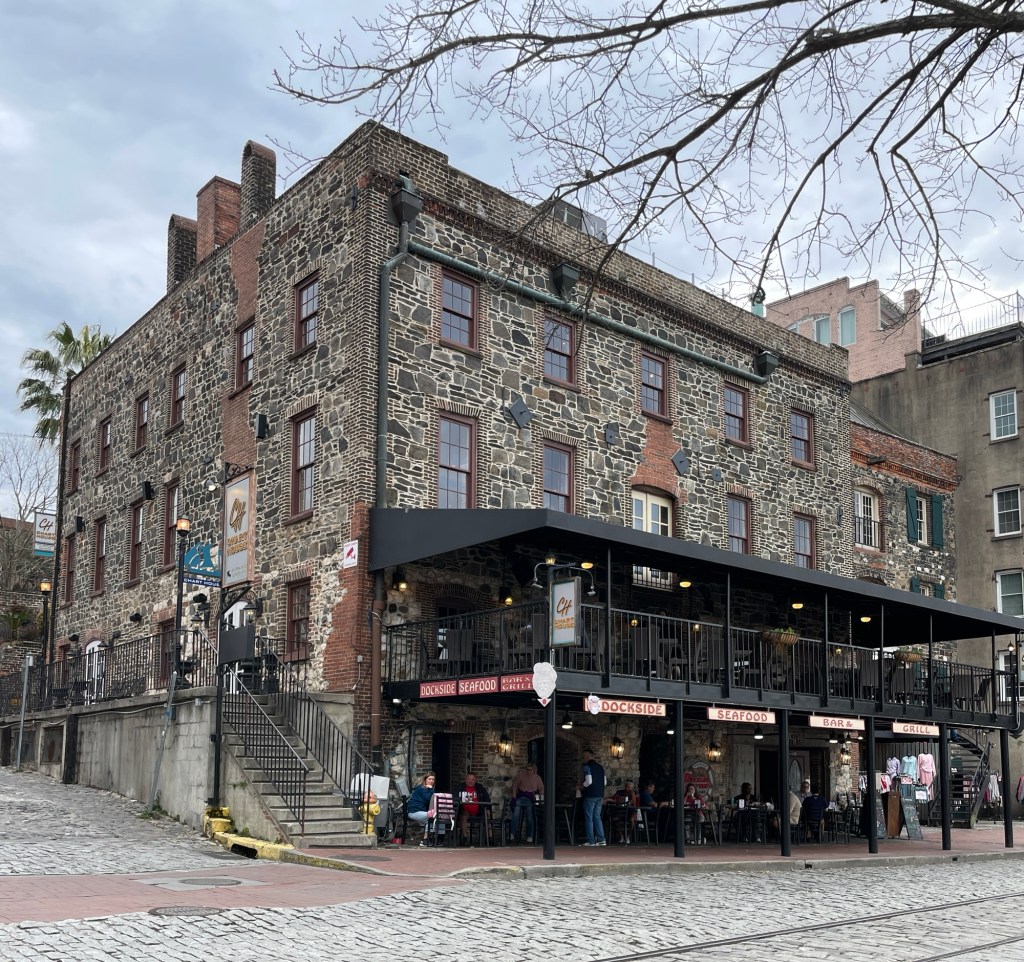
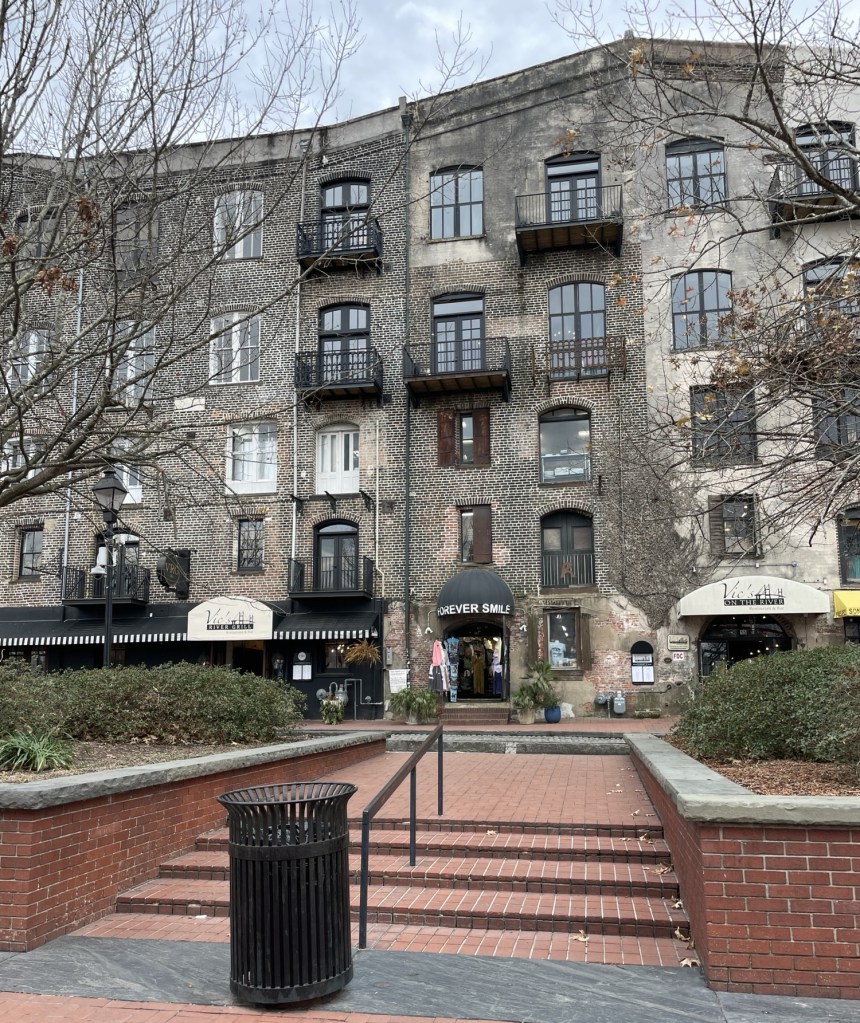
The wharf is lined with former shipping warehouses. Now home to restaurants, bars, candy shops, boutiques, and etc, they’ve retained their gritty trade origins. And I love that.
Due to the Mayor’s pleas and Sherman’s promises, Savannah retains its beautiful old mansion houses, its crazy wharf buildings that sit far below the level of the city’s streets, public squares of all sizes, a conglomeration of religious houses, and its messy mix of history dating from colonial times through the modern day. How glad I am that Savannah was spared the flames that devoured so much of Georgia and the Carolinas during those final military campaigns!
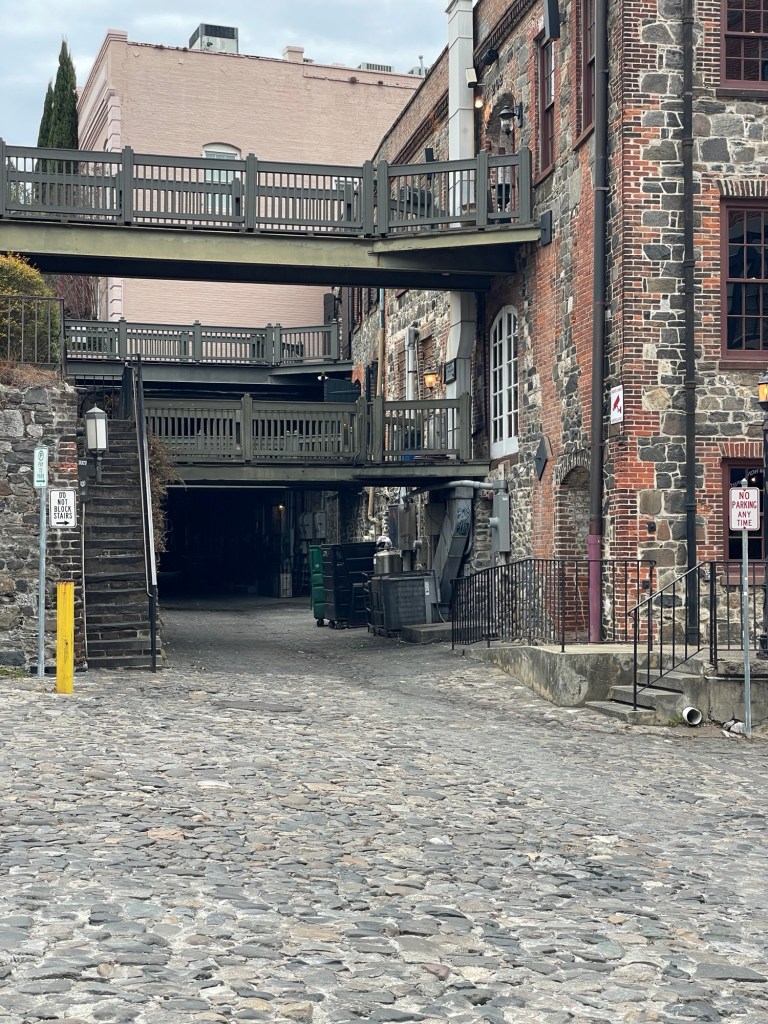
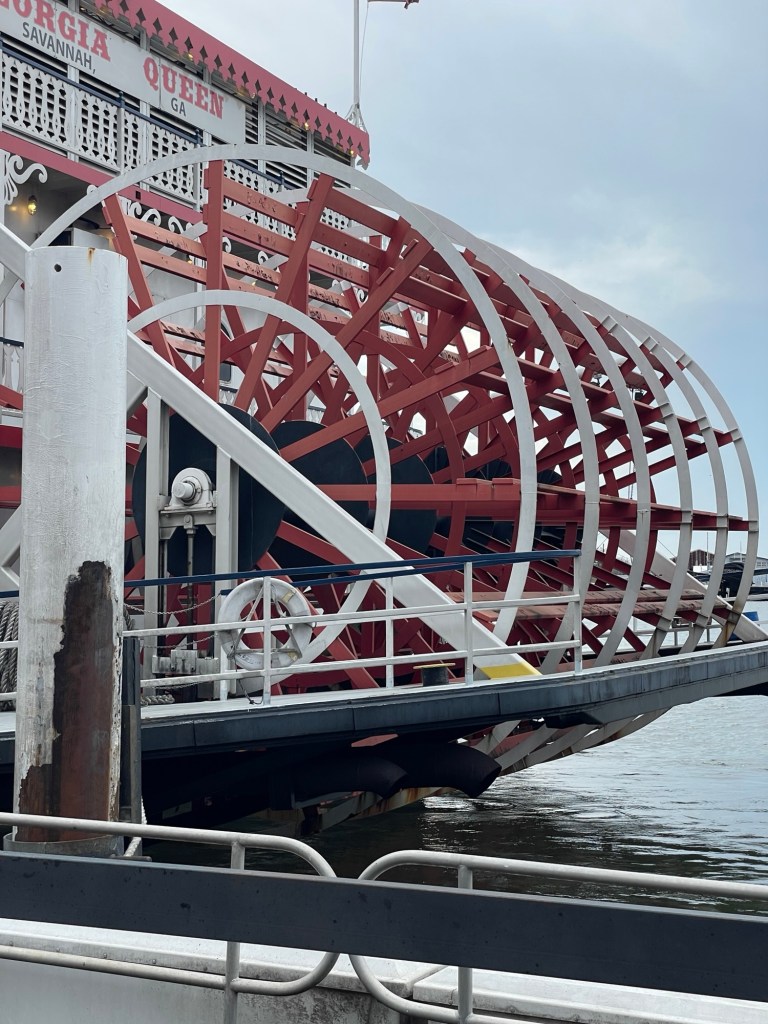
Back of the wharf’s warehouses. More dodgy cobblestone roads to torment Jeff. Due to the streets’ height differences, wooden and cast iron pedestrian bridges stretch from city level to business entrances at the rear of the former warehouse buildings. Some bridges appear to be in questionable condition, so use at your own risk.The Savannah Queen still plies the waters, entertaining tourists and telling the city’s tales
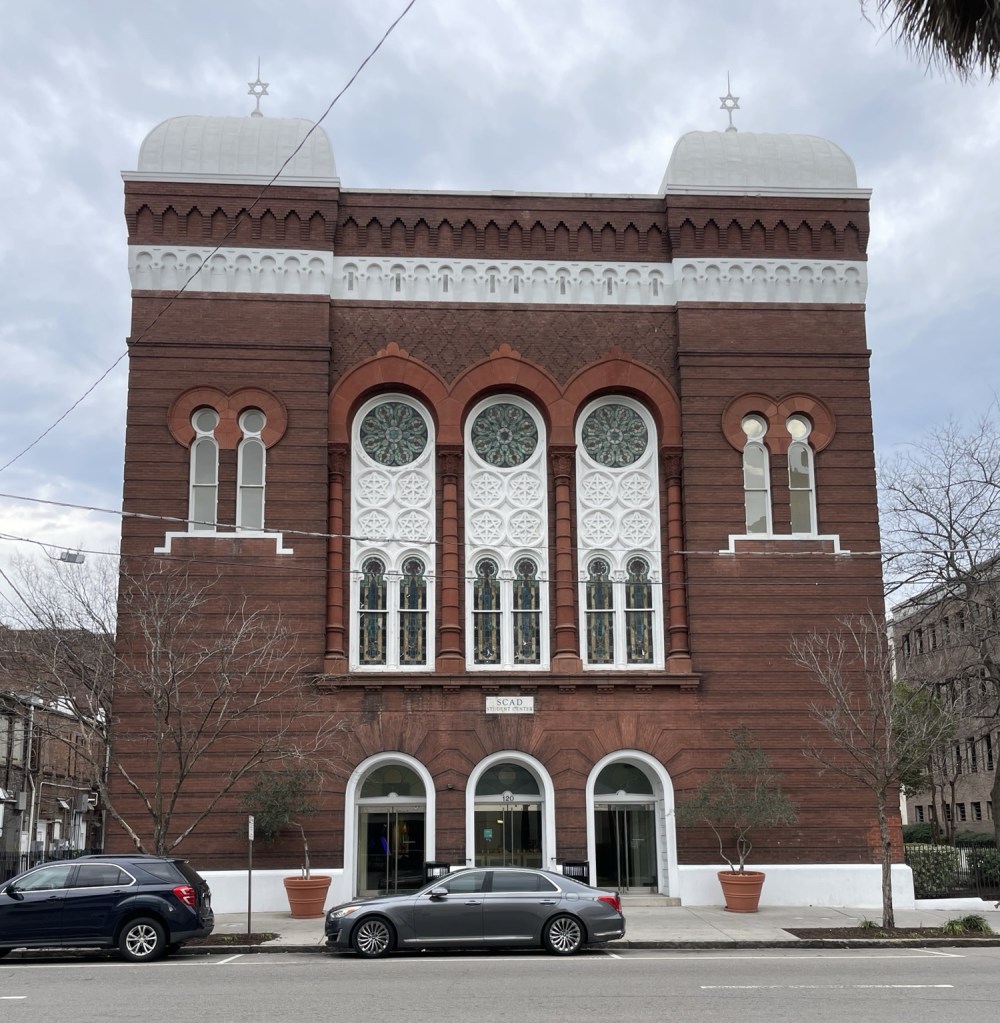
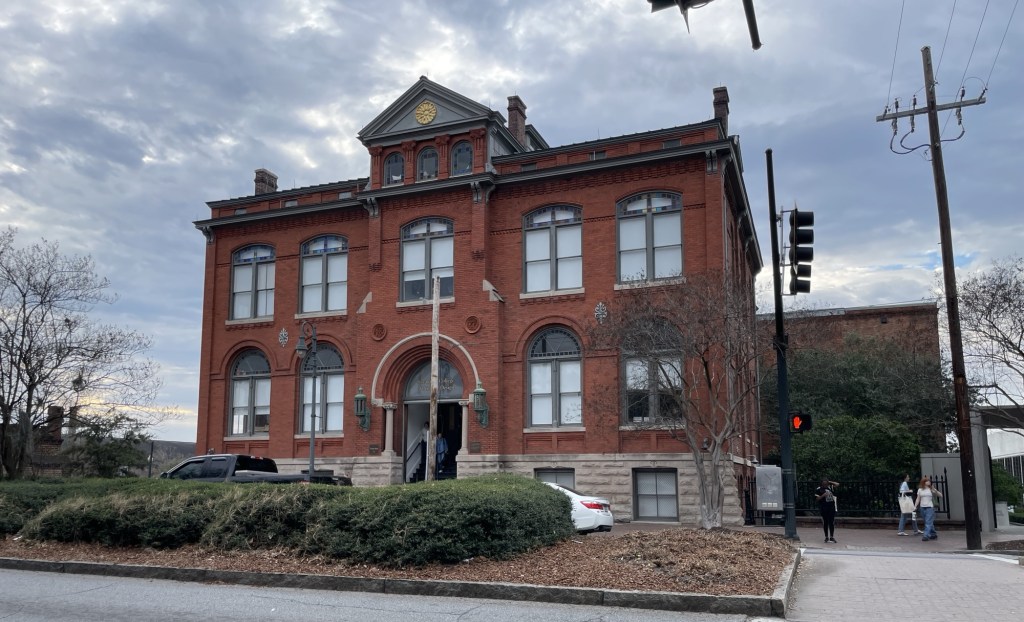
Although you’d expect to see the name Savannah all over the city, something you’re just as likely to see is SCAD – Savannah College of Art & Design. There are SCAD busses running all across town, SCAD classroom and administrative buildings on almost every corner, a SCAD coffee shop run out of an old, red double decker bus, and SCAD clad students crossing your path constantly. A large majority of the coolest restored buildings are part of the Savannah College of Art & Design. Below are just two, but they highlight the way the school is putting historic buildings to good re-use.
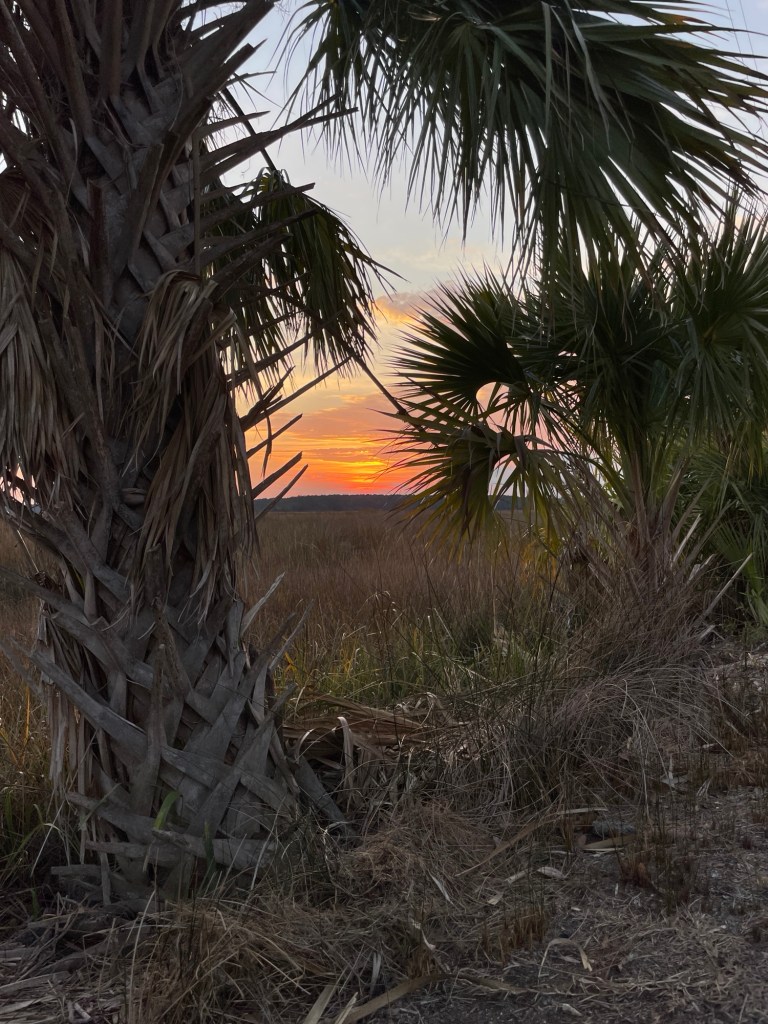
This Jewish temple is now the SCAD Student CenterOnce part of the city’s train depot complex, this now houses SCAD classroomsPostcard sunset outside the Fort McAllister State Park campground
Driving back from Savannah and right before we entered the campground, I yelled, “Stop the truck.” I feel justified for my outburst.
No, not Jeff. But Jeff will make sure that you have fresh hot coffee every morning, despite needing a hat, gloves, and a winter coat to make it sometimes
Since there was only one spot available at Crooked River State Park in St Marys, Georgia, we didn’t look too far into the site’s details. ‘Will it fit a pickup truck and 15’ trailer? Yes, ok good thanks.’ One of the deeply fun parts of having a small teardrop trailer is backing into a ridiculously long RV spot. We could have almost parked two sets of our truck and trailer front to back and side to side. While the folks across from us had to wedge their fifth-wheel in and park their truck diagonally across it, we were rolling backwards like Kramer on the highway. Luxury.
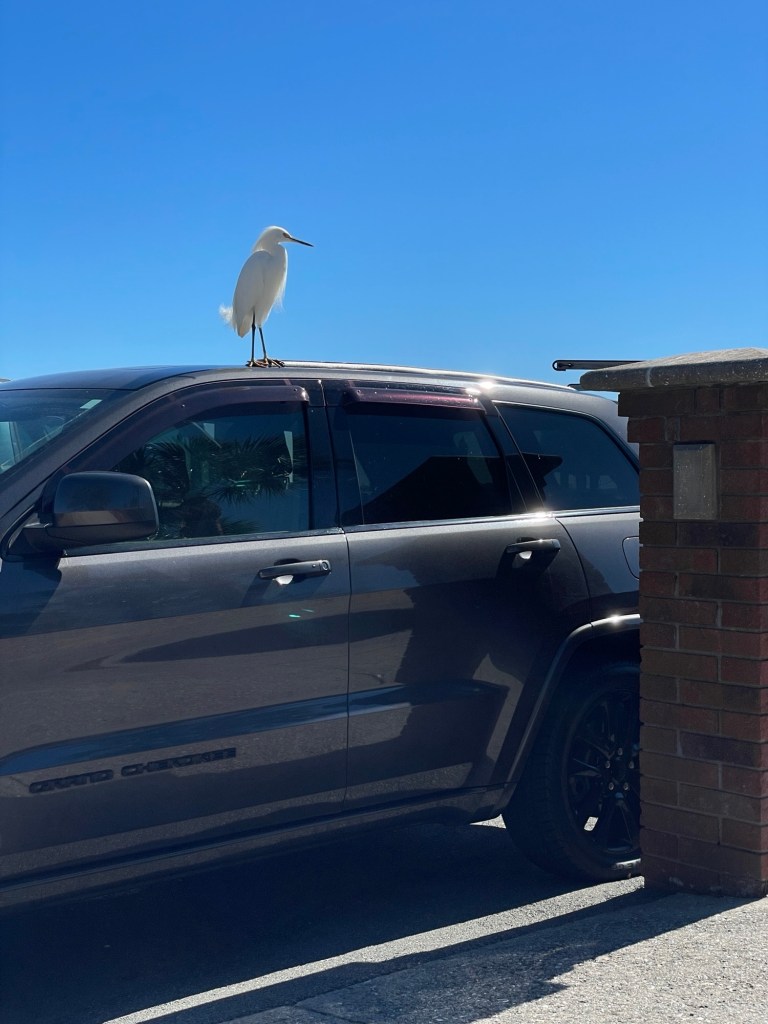
No, not this guy either. He was just chilling.
Isn’t this snowy egret cute? He sat on top of that SUV, feathers rippling in the breeze, the entire time I sat near the pier. When we drove into the small nearby town of St. Marys, we were surprised to see how the birds seemed content to be around humans. Not begging or acting like they’re used to being fed, just hanging around. A great blue heron, for example, was walking around the little town square as if it was desperately trying to relax on its lunch hour. ‘Ugh. Gotta get back to the desk in 20. Big meeting at 1.’
We visited the local submarine museum, which was a bit of a hodgepodge of veterans’ memorabilia and seemed rather out of place in this cute little coastal town until we realized the State Park is right next to a national nuclear submarine station. Then it made a lot more sense.
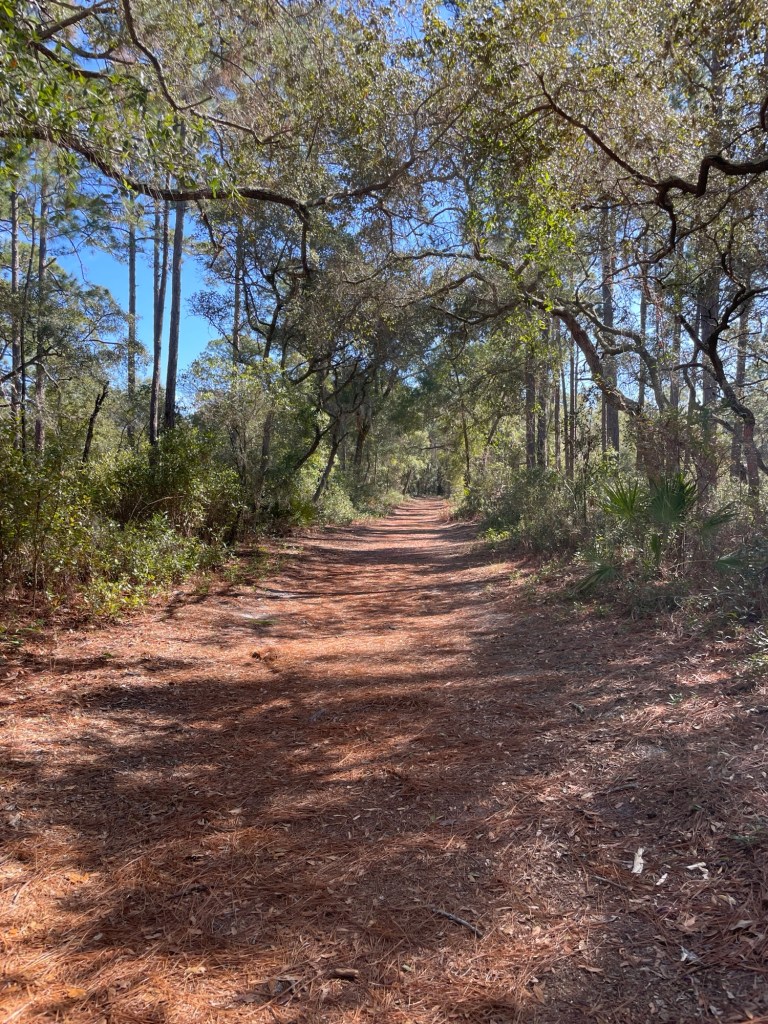
The night trail the next day.
We were intrigued by the notice of a night hike, so we signed up and arrived in the dark with only a few moments to spare. The Ranger and naturalist intern explained the rules to the group, handed out some glow sticks to help keep track of us, and led us into the dark.
Rules, guidelines, reminders. They seem like simple things, yet so many people just won’t follow them. I thought the Ranger did a good job of explaining why each request would help us to see and hear the night animals of the forest, but each got ignored almost immediately. Children running around. People yapping to each other. Bright white flashlights on. No semblance of a single file line.
Not surprisingly, we didn’t see the night animals nor did we hear any owl calls. We did see a tree scorpion which was pretty interesting. Although they fluoresce under black light like the Arizona desert variety, these ones live under the bark of Longleaf Pines and are small and harmless.
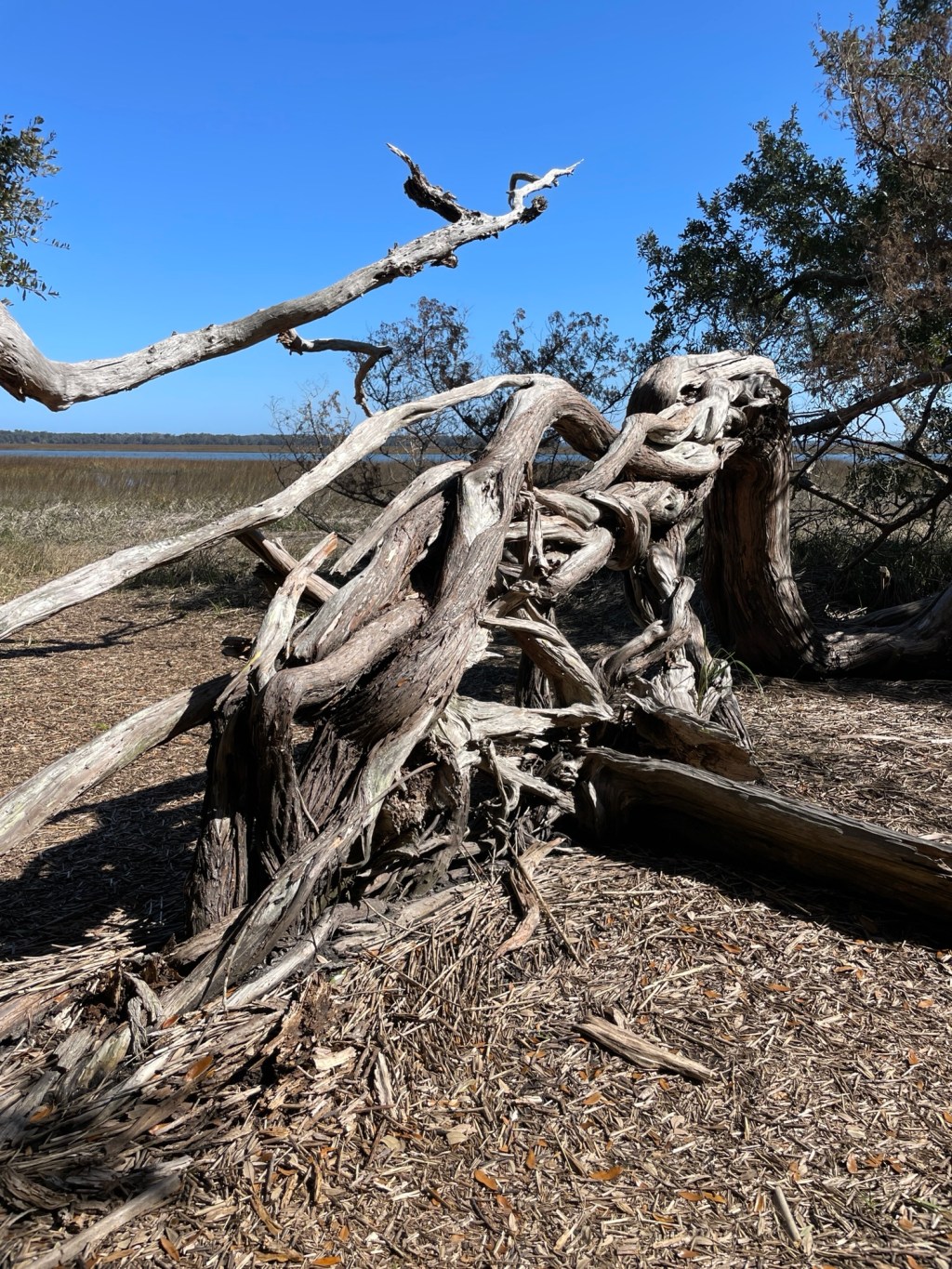
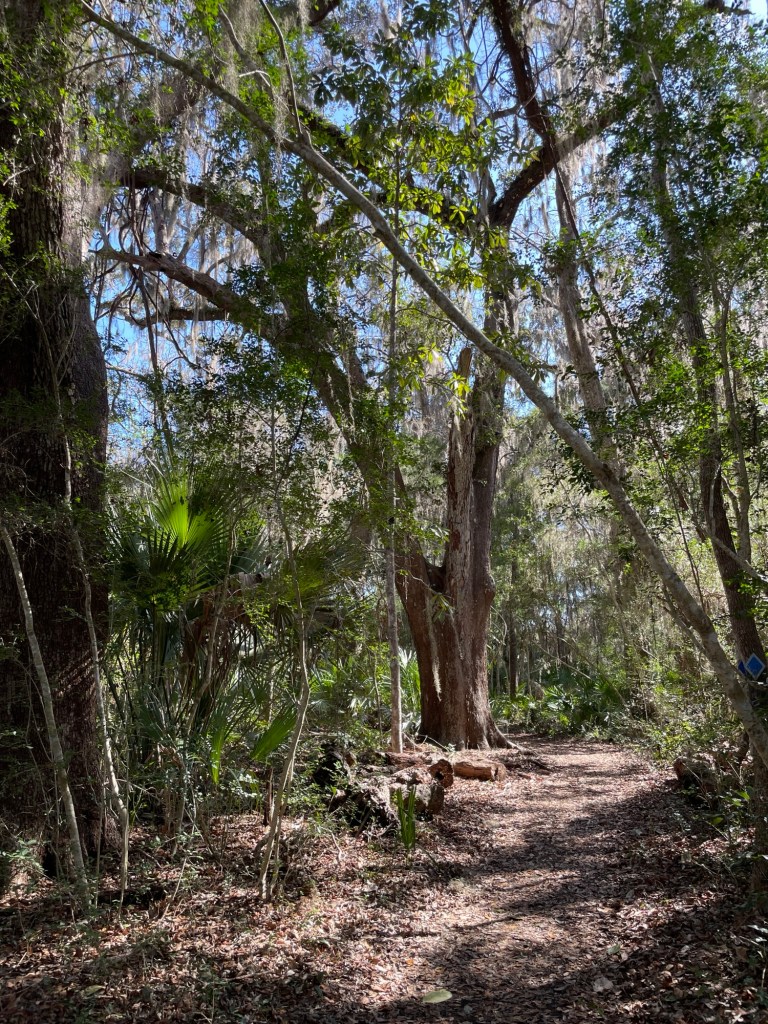
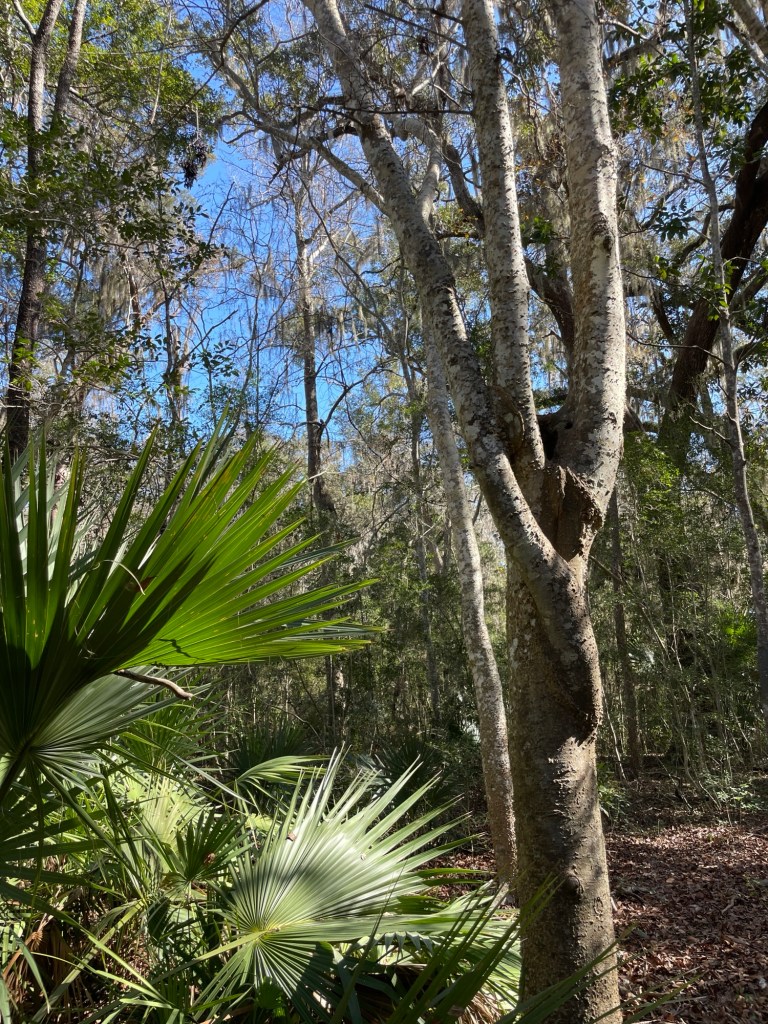
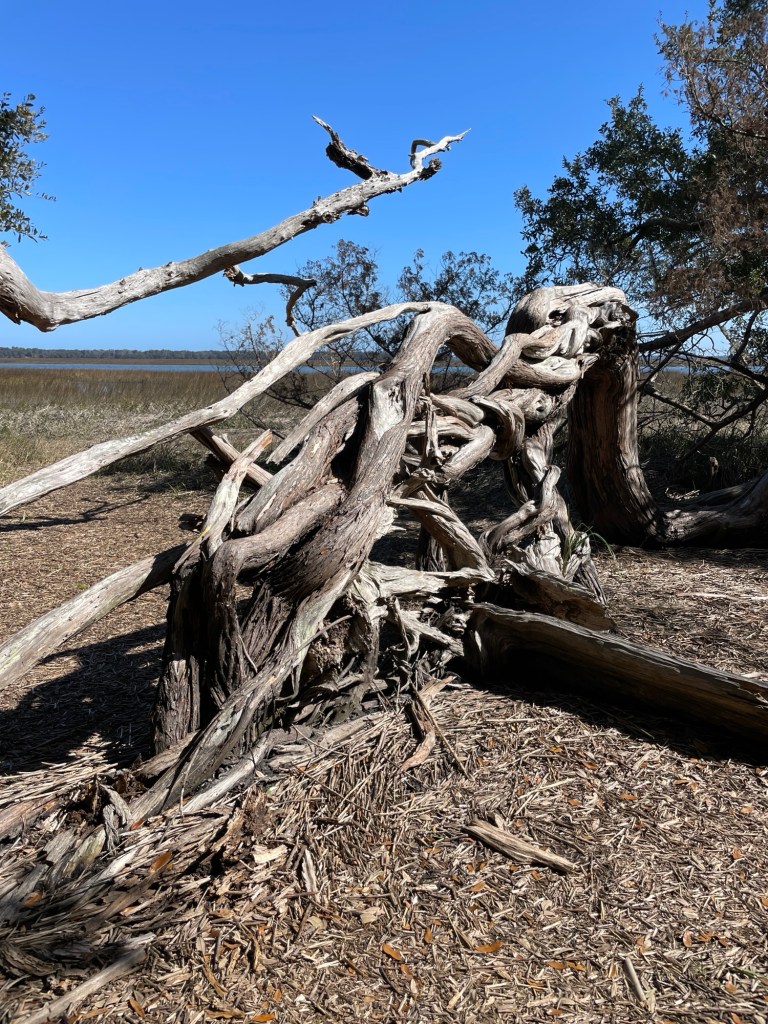
Along the coast the next day, we saw lots of tracks and some wonderfully turned and twisted trees and stumps. Can you imagine the long-term forces required to cause a tree to grow into that form?
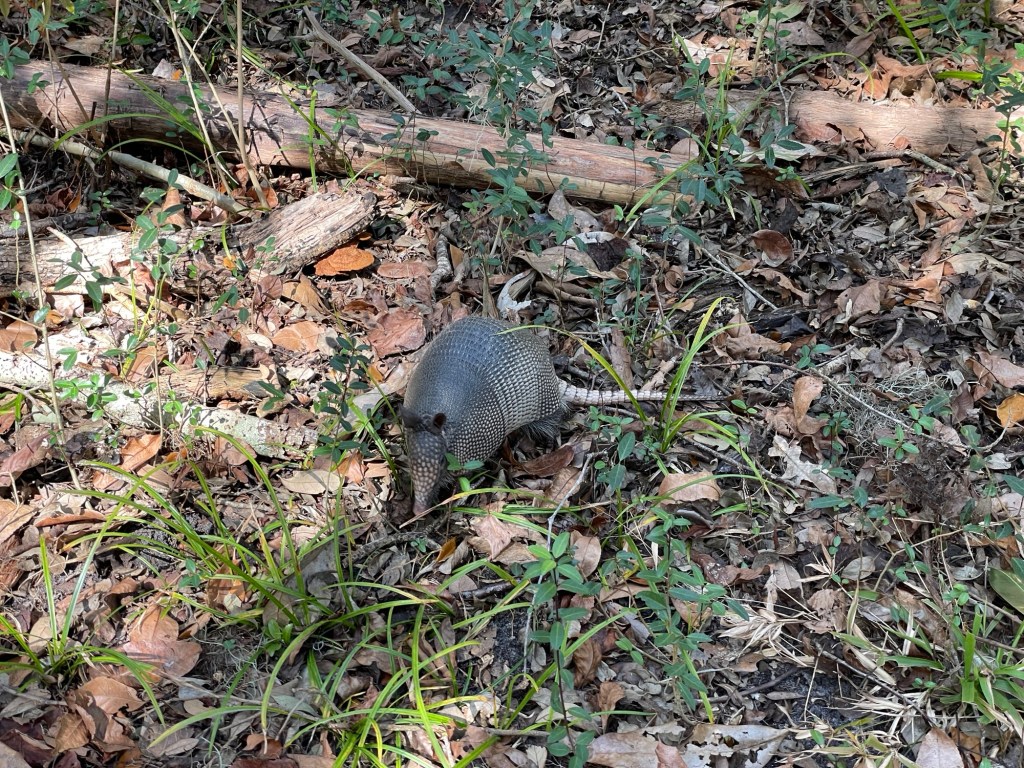
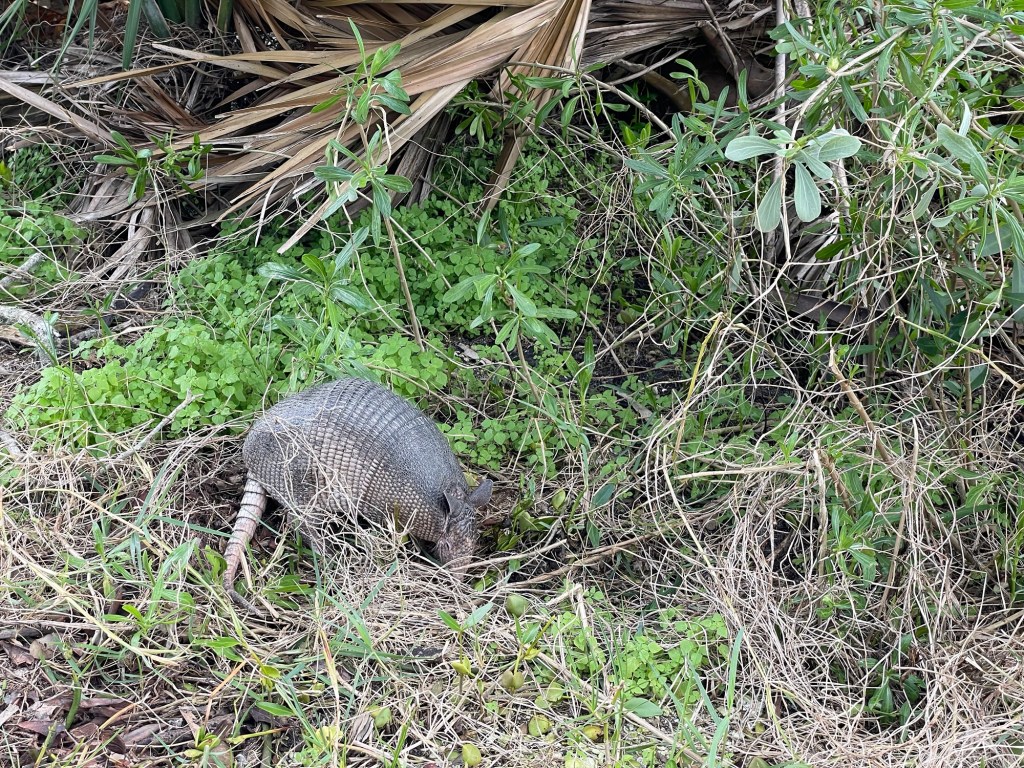
Now this little beast (below) was right next to the trail and as I stopped to snap his photograph, it reared up and leapt forward, chasing me down the trail a bit! Gave me a good start, I fully admit it. Who knew their placid demeanor hid such a wrathful heart.
Don’t underestimate their comically gentle appearance! Inside lies an armored beast.
When I say the temperature dropped the last night we stayed near Cape Canaveral, I mean it dropped. The temps slid downward all day Sunday and the winds climbed steadily upwards. Overnight, wind gusted up to 50mph and the actual temperature fell to 20°F on Monday morning. Our camp hosts were so concerned about us freezing that they brought out a small electric heater Sunday night and insisted that we take it into the trailer with us. Based on experience, we knew that the electric blanket would be sufficient, but we appreciated their concern. We were more scared about the heater starting a fire, so it stayed unplugged and out of the way overnight and was returned the next morning.
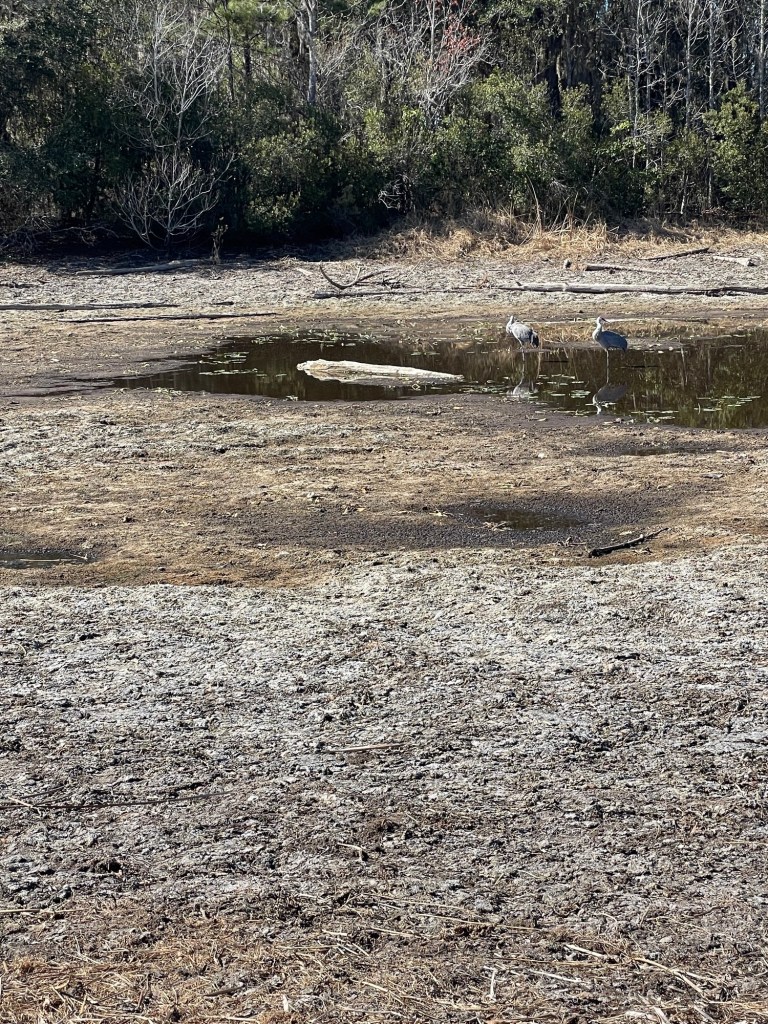
A few Sandhill Cranes trying to scratch out a meal next to the campground
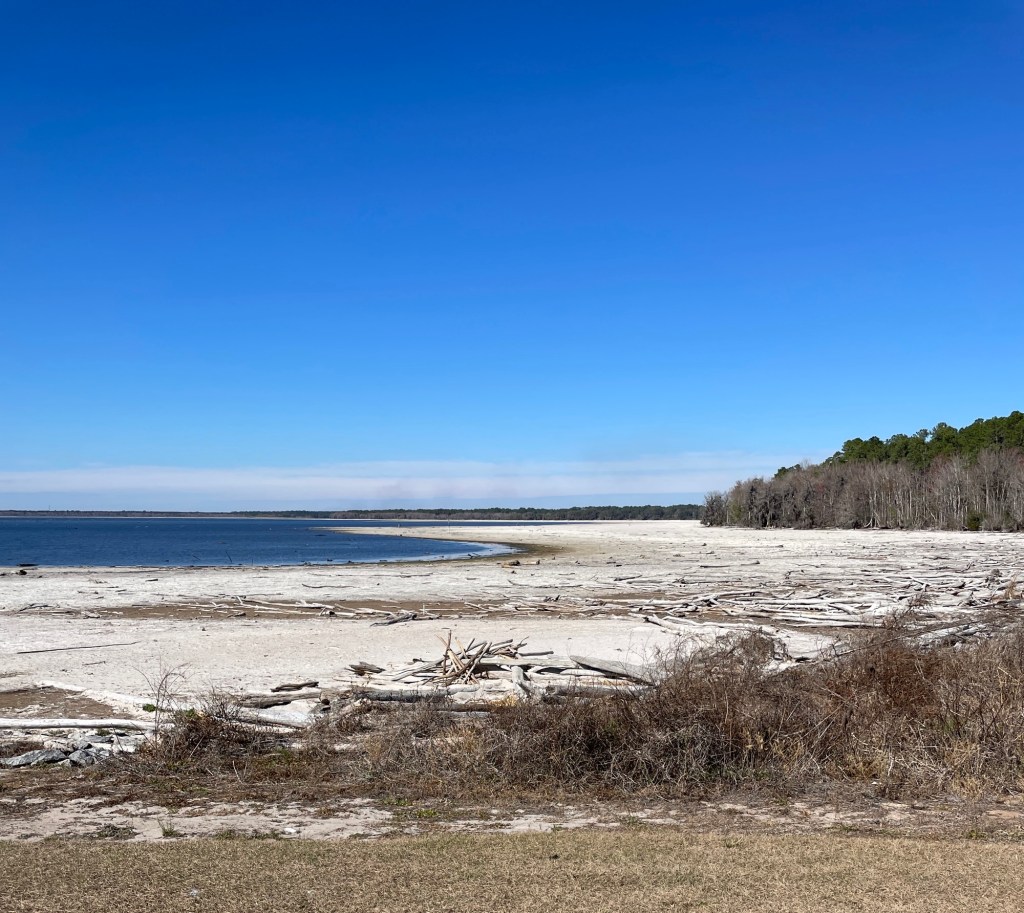
Arriving at Rodman Campground in Palatka, FL, we learned that Rodman Reservoir (if you’re pro-dam) / Lake Ocklawaha (if you’re not) was in its every 3-4 year drawdown cycle. To starve out aquatic invasive vegetation and manage sedimentation, the Kirkpatrick Dam is opened and the reservoir dries out significantly, dropping from 18 ft to 11 ft above sea level.
An extended (and kind of soggy) beach
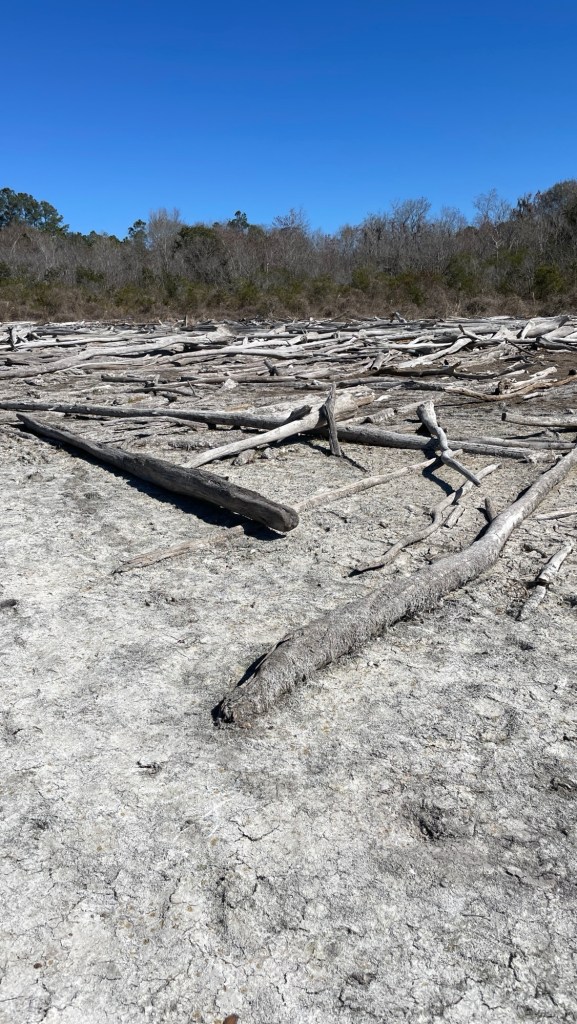
We learned that during the drawdown several inundated natural springs can again be seen, although we didn’t go looking for them. We did see the usually submerged remains of the forest that once lined the Ocklawaha River though. It’s a bit eerie to see a forest of bleached trunks standing upright above the waterline, with the skeletons of other trees piled along the shoreline.
Normally these are all under water
Several days with 18+ hours below freezing meant that our campground’s waterlines froze two days in a row and the system had to be repaired the day after we arrived. Luckily the state park was able to get it fixed by the end of our first day there. If not, we’d have had to pull out the as yet untested bucket toilet system. Frankly I think we’re both ok with never having to put that to the test.
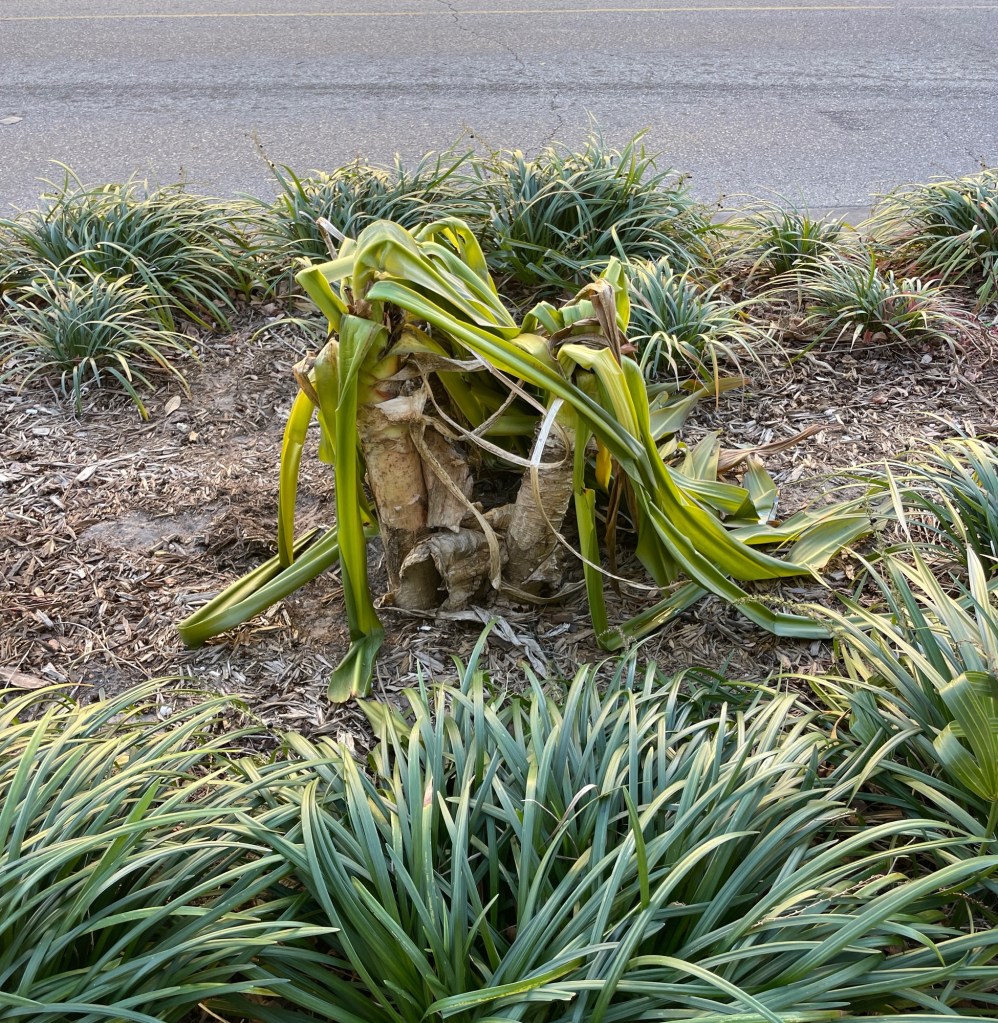
Palm post-freeze
For the tropical plants in the region, the hard frosts meant either death or severe damage if they didn’t get covered. Only the temperate plants and trees, such as oaks and pines, appeared to have survived unaffected. It was really depressing to see the region’s beautiful, cheerful landscaping take such a hit. I hope it rebounds quickly.
Since the weather wasn’t conducive to relaxed hiking or biking, we decided to check out the nearby town, get groceries, and run some errands. Palatka struck me as a town we could live in — it has a nice small town feel, full of history, charm, and friendly residents. It’s clearly seen better days though, like much of Main Street USA.
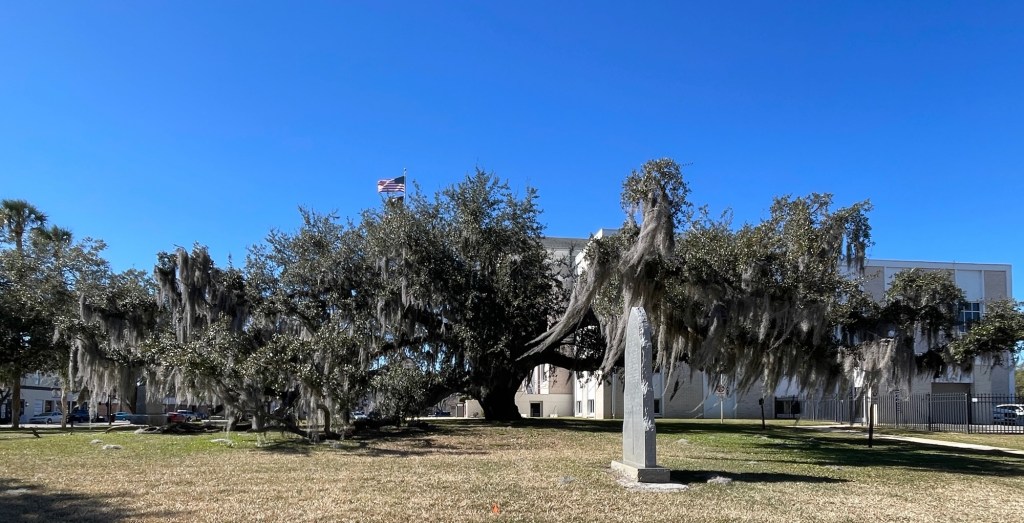
The Great Oak
The giant, draping 200 year old Live Oak in the middle of town appears to be nearing its age limit. While it’s impressive to look at from a distance, up close you can see that it’s in significant decline. My guess is the town will go into a period of mourning once its beloved tree’s giant limbs begin snapping off. The near one is already on the ground and looking pretty bad.
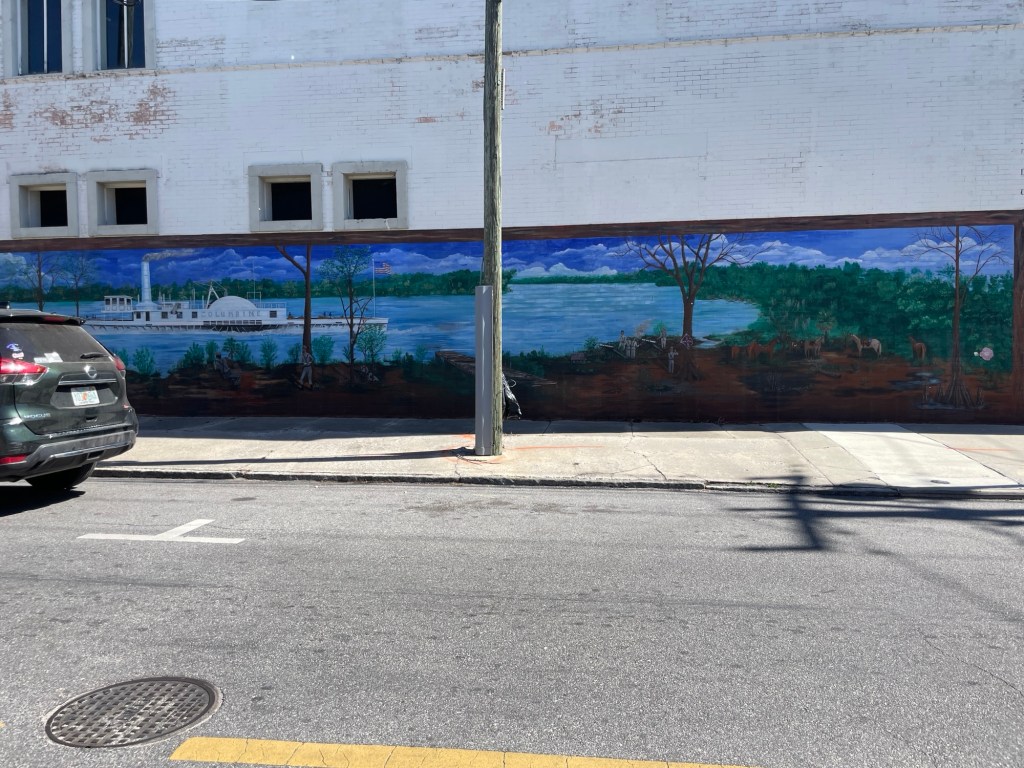
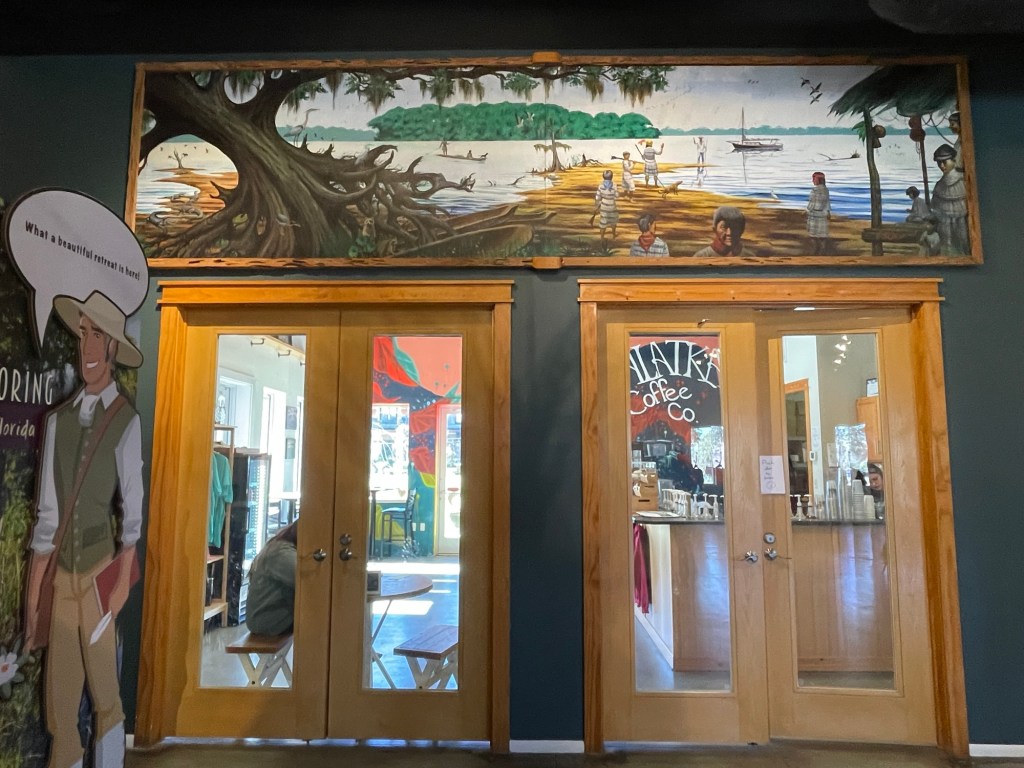
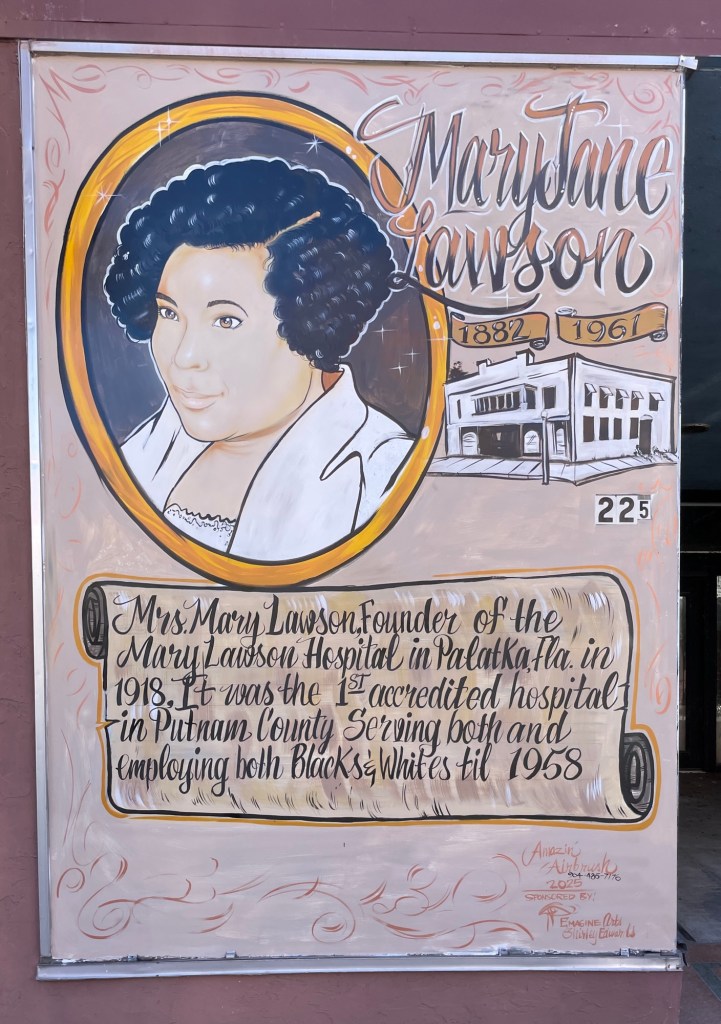
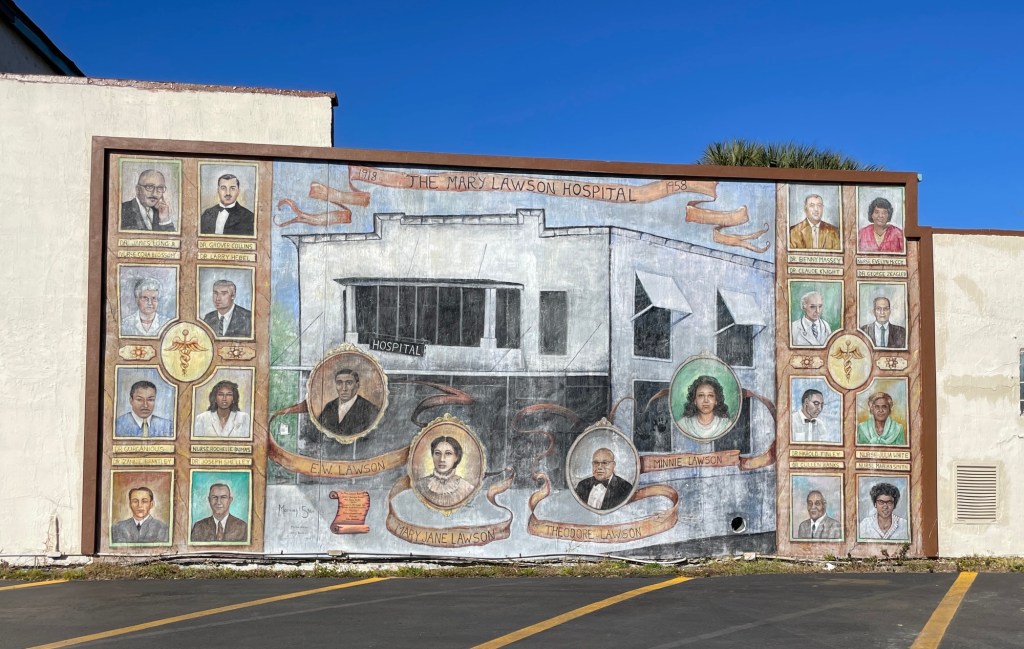
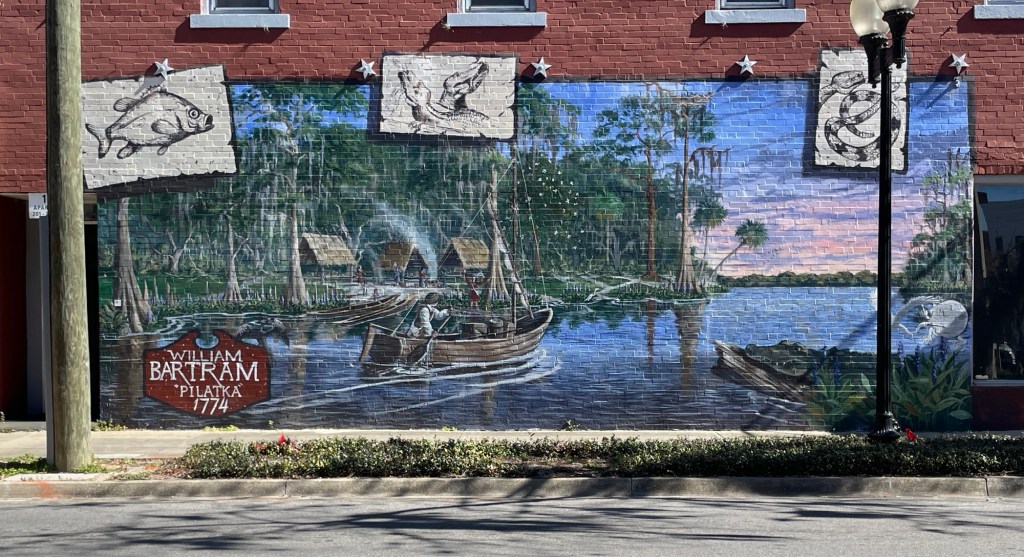
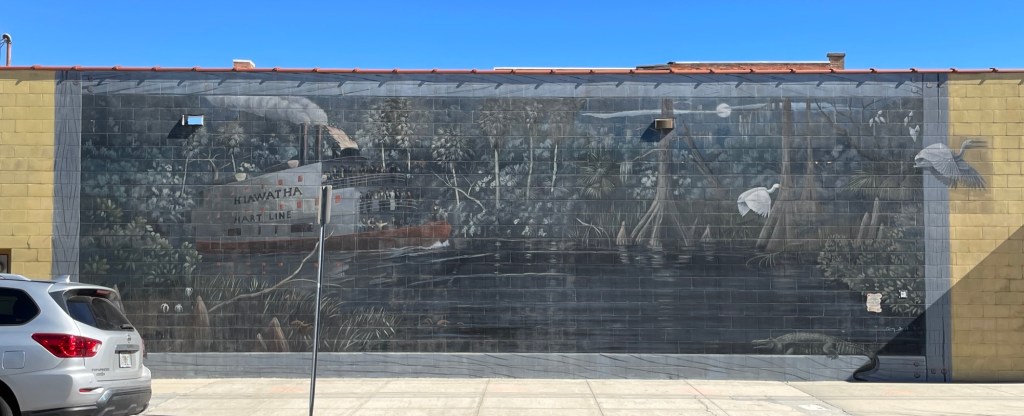
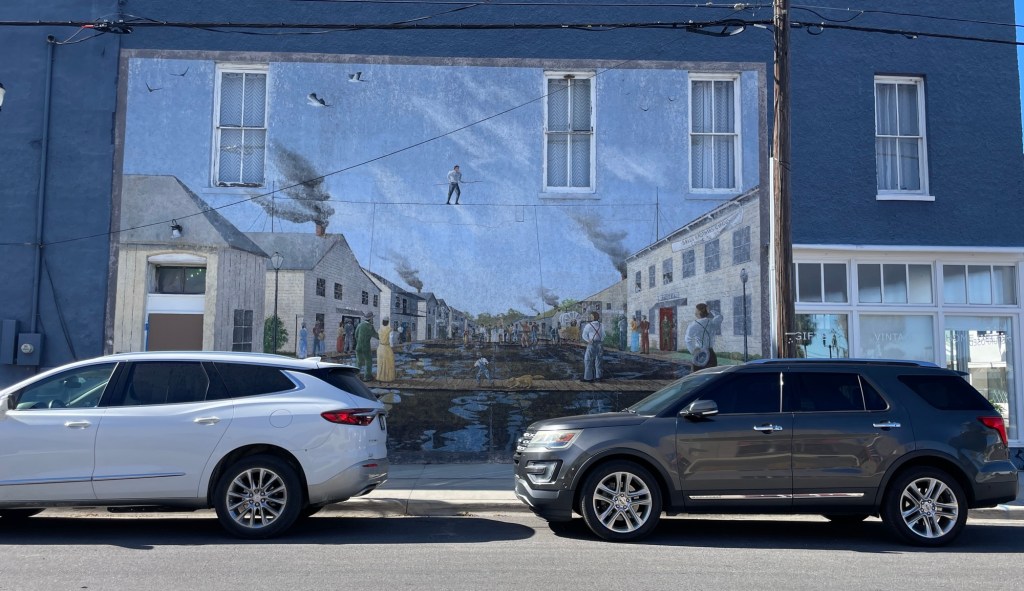
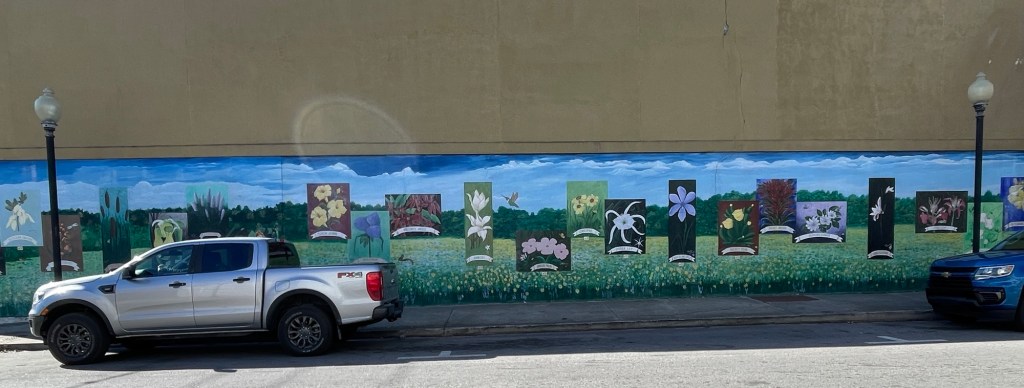
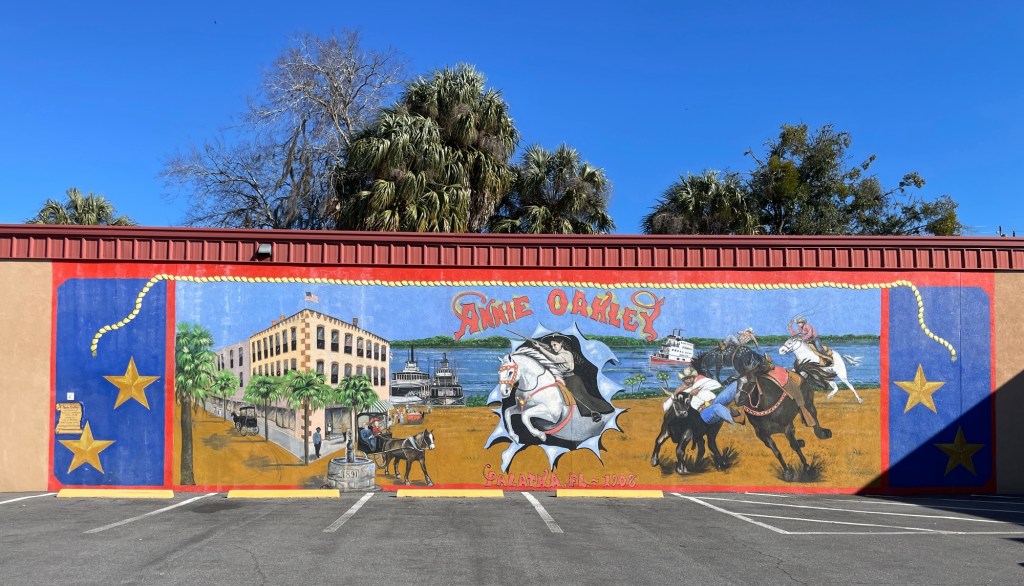
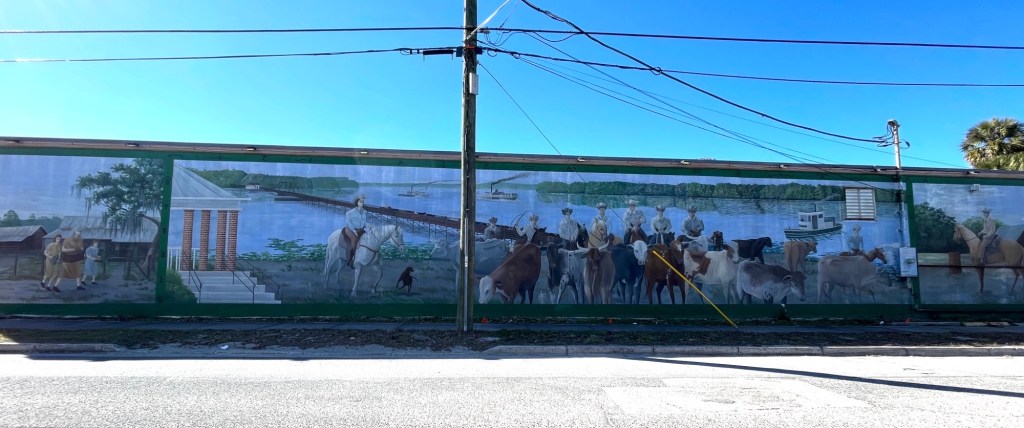
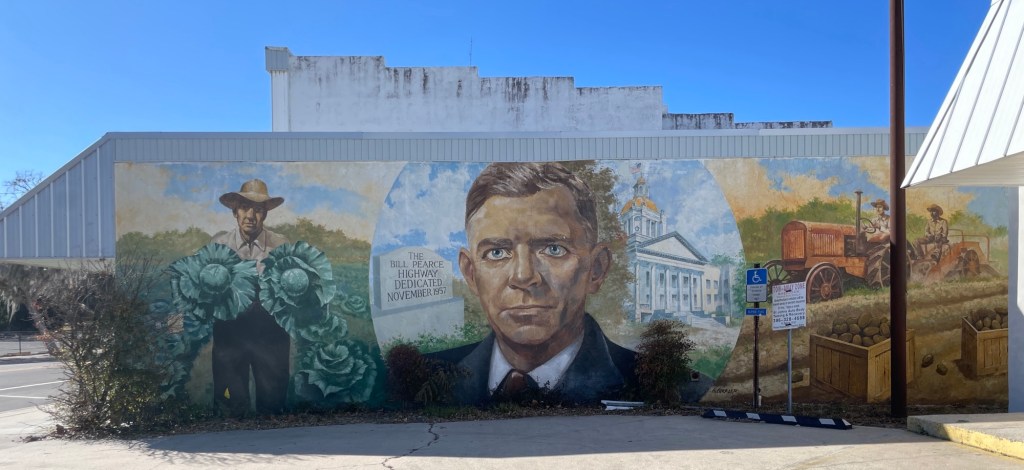
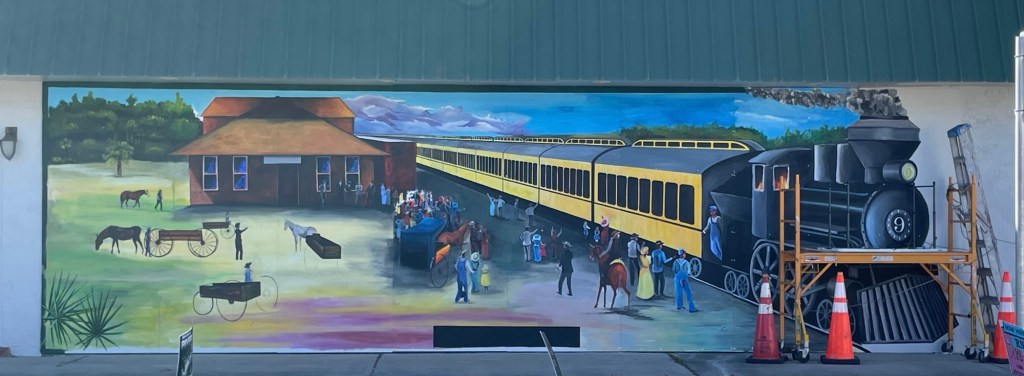
Palatka began funding murals some years back and the town has really gone all out. There are more than the ones highlighted below, but these were some of my favorites. Click on any that you wish to see in greater detail.
Battle at Horse LandingIndigenous PalatkaMary LawsonMary Lawson Hospital, 1918-1958William Bartram, explorer, c. 1774Night Passage of the Hiawatha, c. 1909High Time in Palatka, c. 1872Putnam County WildflowersAnnie Oakley, c. 1908Cattle Drive to Paynes Prairie Senator B.C. PearceTrain Station
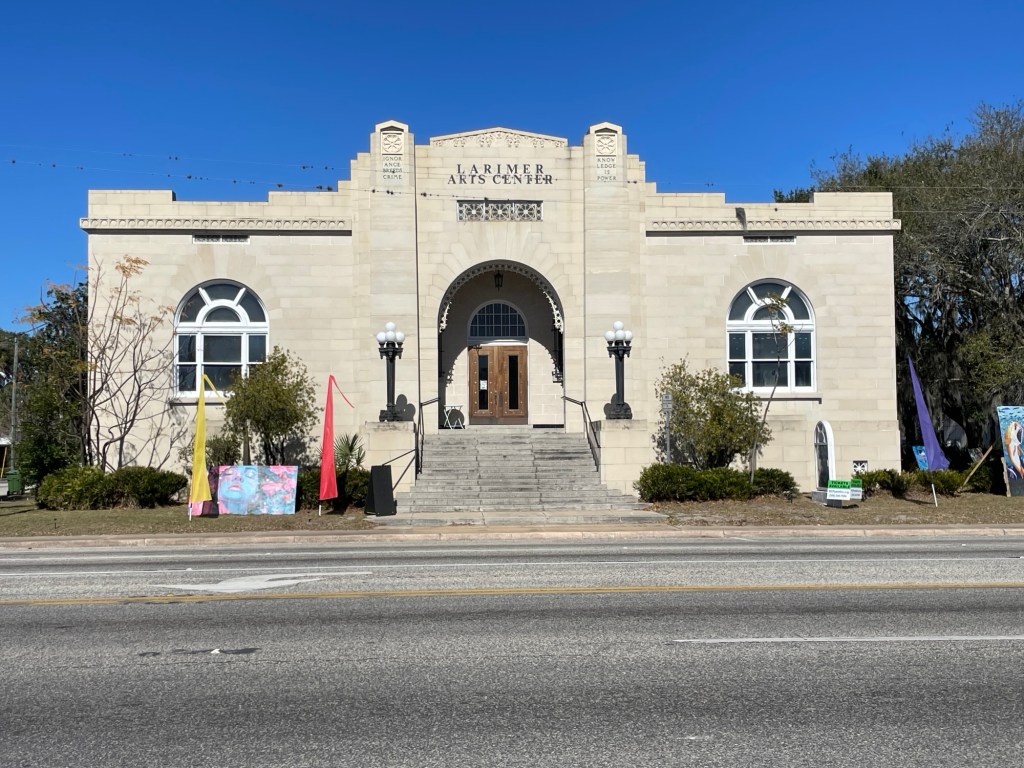
The Larimer Arts Center, below, is housed in the former library building. The simple, balanced design and its light stonework against Florida’s bright blue skies made me stop to look at it while we were out walking around. Peering closer, I saw that the upper columns had important reminders carved into them. I recommend taking a closer look at the building’s subtle stone work and detailing.
L – Ignorance Breeds Crime R – Knowledge is Power
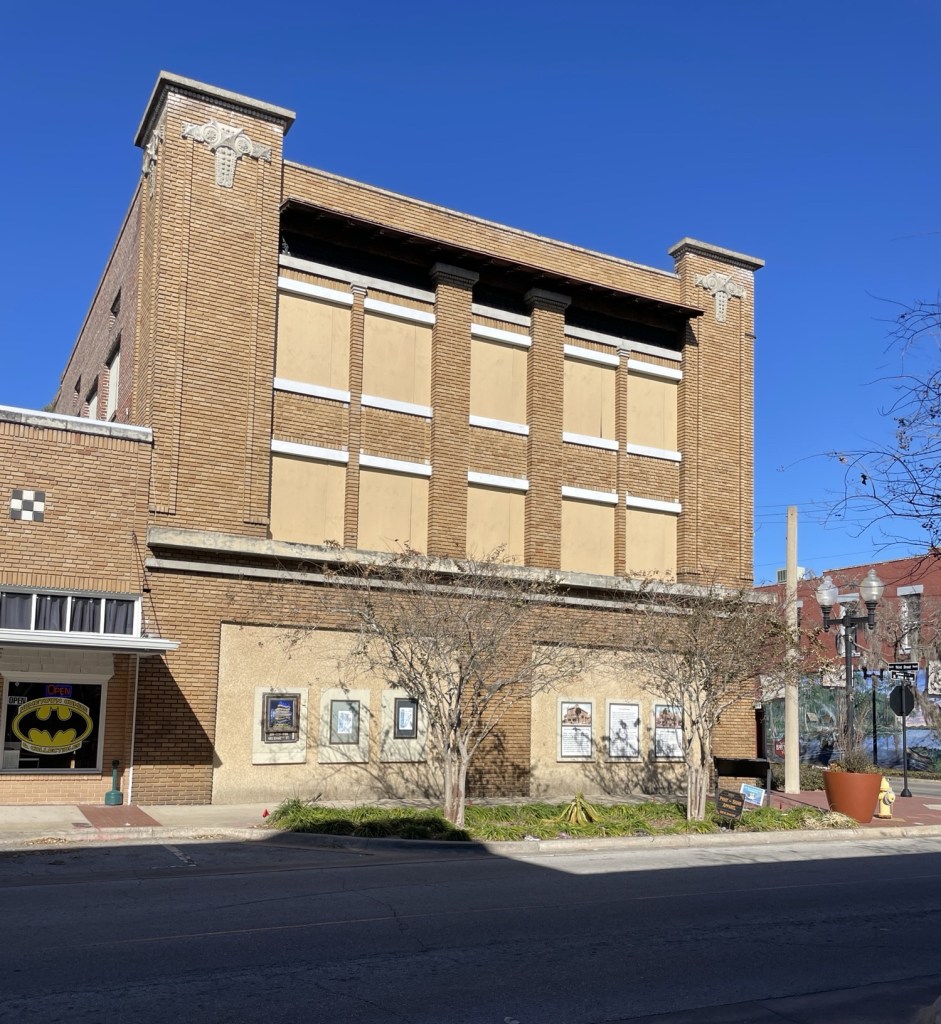
It’s hard to believe, but the building below was once a favorite of musicians and movie stars in the early-mid 1900s and was considered the high of luxury and elegance. It’s theoretically undergoing renovation to bring it back to life, but it doesn’t appear that much — inside or out — has been done since the project achieved National Register of Historic Places status and became eligible for restoration grant funding several years ago. I read that the LLC that bought it did some crowdfunding back in 2018 to get the ball rolling. The ball doesn’t appear to have rolled very far. A big part of me suspects that those well-intentioned dollars are long gone.
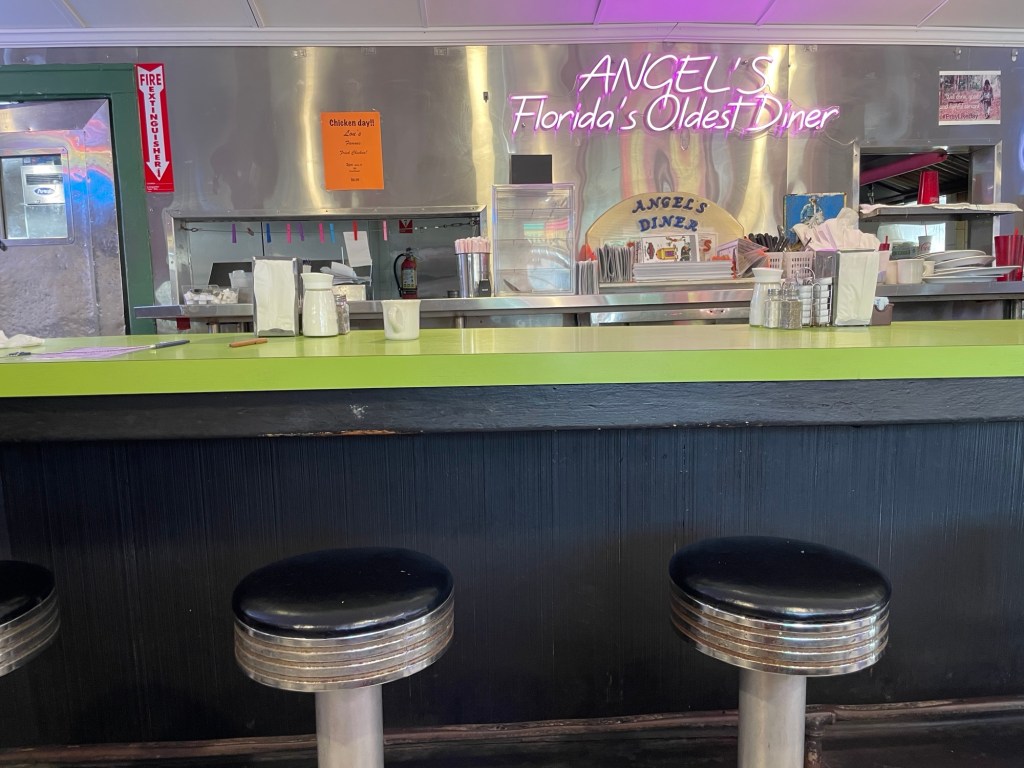
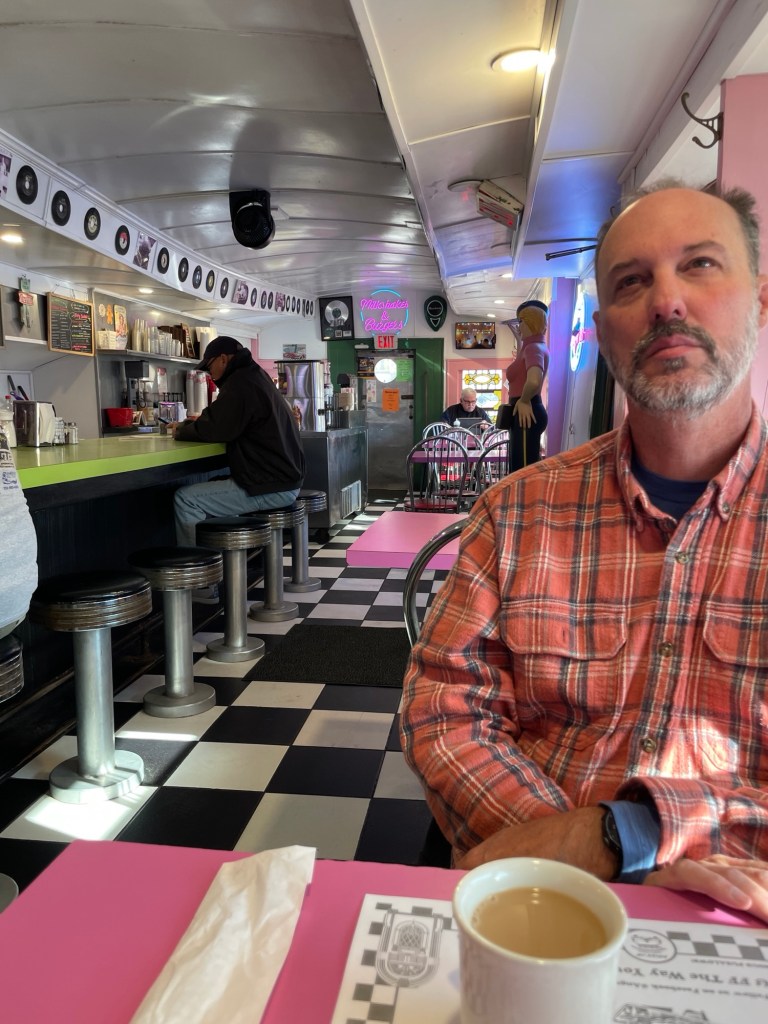
The oldest diner in Florida, apparently, is in Palatka in an old passenger rail car. The food is simple but freshly made. The waitstaff are probably the sweetest you’ll ever meet. I hope it’s in business for decades to come. The M and W toilets are outside on the back of the train ‘car’ and are an experience in and of themselves. I’m going to just leave it at that.
It’s off topic, but something I started doing last September, after we drove out of Denver, was to put my phone away more often. And once January arrived, I made the very deliberate choice to keep it zipped in my coat pocket for the bulk of each day with notifications and sound off, using it primarily for photos and the occasional text. What a change that has made!
I knew my attention level and ability to just be without some kind of distraction had dropped in the last decade and a half, but the extent to which they’ve come rebounding back is shocking. I’ve always been a big reader, that’s not new, but what is new is the ability to focus intently on 80 or so pages of a dense Civil War text. To just sit and read. I know that I couldn’t have done that nine months ago. Having just finished all the Civil War history books we brought along, I started a book about the Edmund Fitzgerald today. Fans of the Great Lakes, go grab a copy. It’s excellent.
But let’s return to Florida.
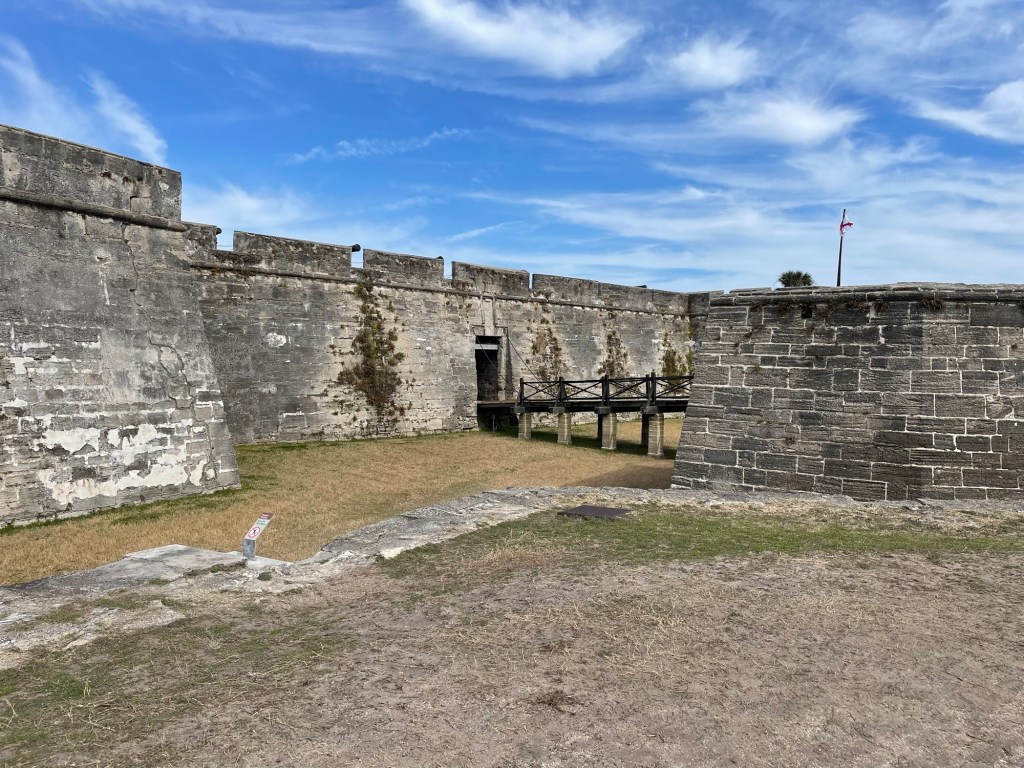
This was a dry moat. What it lacked in alligators, it made up for in domestic animals during times of siege and attacks on the city.
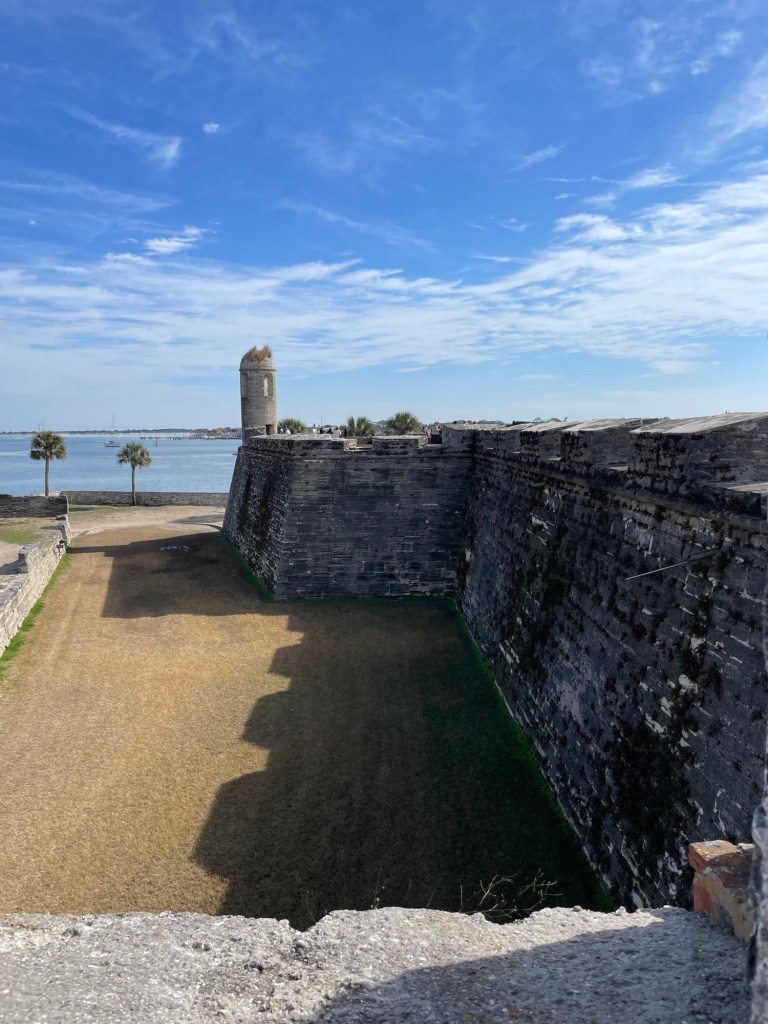
One of our primary goals for Florida was to see St. Augustine, or rather, to see the Castillo de San Marcos National Monument, the oldest masonry fort in the continental United States.
St. Augustine was established as the region’s capital city by the Spanish in 1565 as a way to protect their claim to the region of La Florida (roughly current Florida and a bit of the surrounding states). After a series of wood forts, the current Castillo (castle) was built 1672-1695.
Castillo de San Marcos National Monument
Let’s do a quick overview of dates so that we’re all on the same page.
• In 1513, Juan Ponce de León claimed the region, La Florida, for Spain.
After this absolutely illegitimate claim about an already inhabited land: (Remind me, who was calling who savages again?)
• In 1564, French Protestant Huguenots claimed an area just north of St Augustine (very much inside La Florida) for themselves. Spain was appalled. “Who’s next? The Portuguese? The Dutch?! ¡Dios mío, no! ¡Imposible!”
After to a seemingly endless series of religious wars and political pissing contests all around the Atlantic:
• In 1763, the English took control of Florida at the end of the Seven Years’ War and the structure became known as Fort St. Mark.
As part of the post-Revolutionary War agreement:
• In 1783, _Castillo de San Marco_ was back on the mailbox when England was forced out of the region and returned Florida to Spain.
• In 1819, Spain ceded Florida to the United States in exchange for the US renouncing its claim to Texas (👀), and in 1825, the US changed the fort’s name to… Fort Marion.
• In 1861, Florida left the Union to join the Confederacy (1861-1865). Confederate troops demanded that the lone Union caretaker hand over Fort Marion. He asked for a receipt and travel money and walked out the door. Federal troops regained control of both St Augustine and Fort Marion a year later.
• In 1933, Fort Marion was decommissioned and passed to the National Park Service. The name was reverted back to Castillo de San Marcos by an act of congress, thereby acknowledging and honoring its Spanish origins.
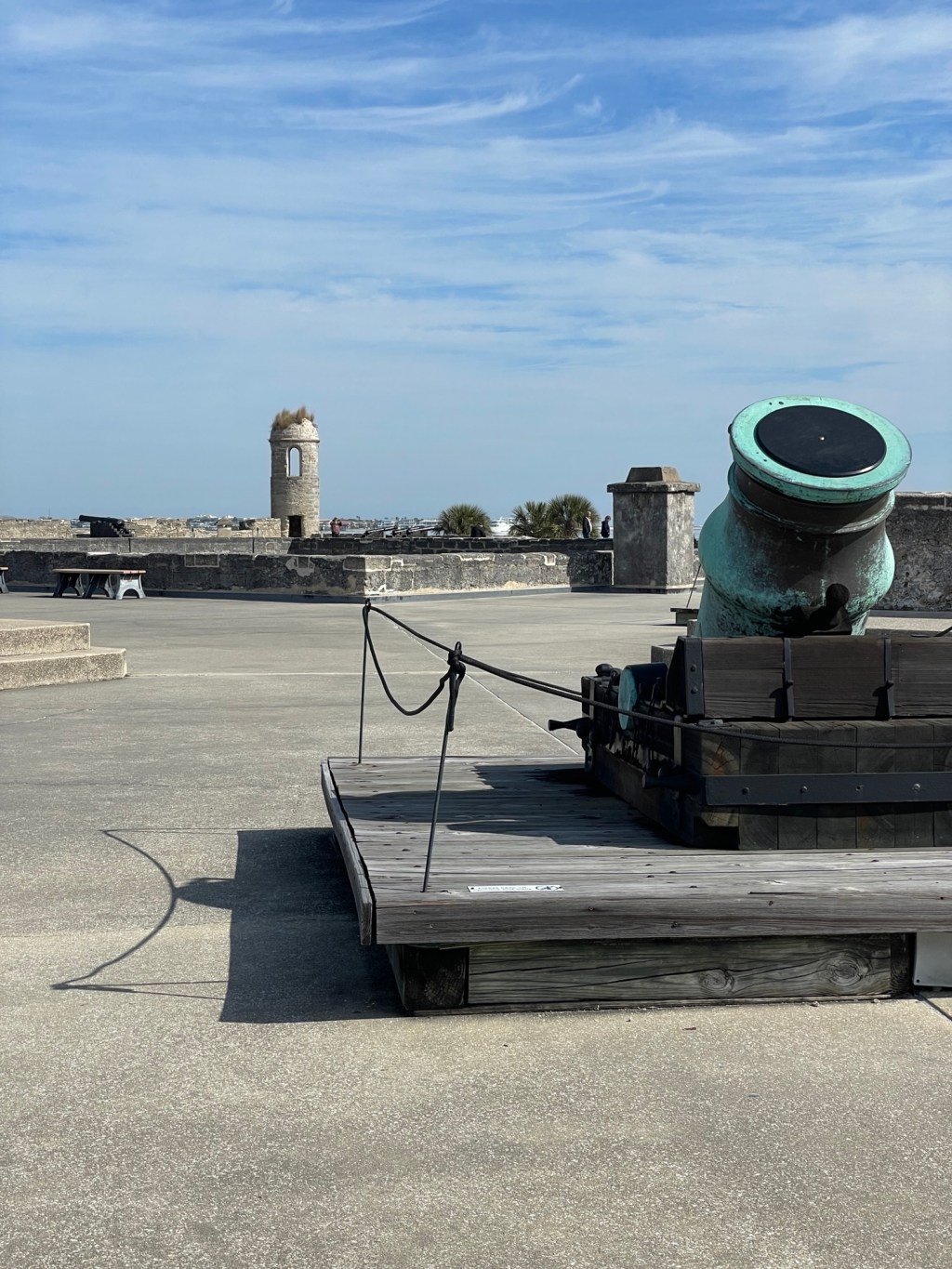
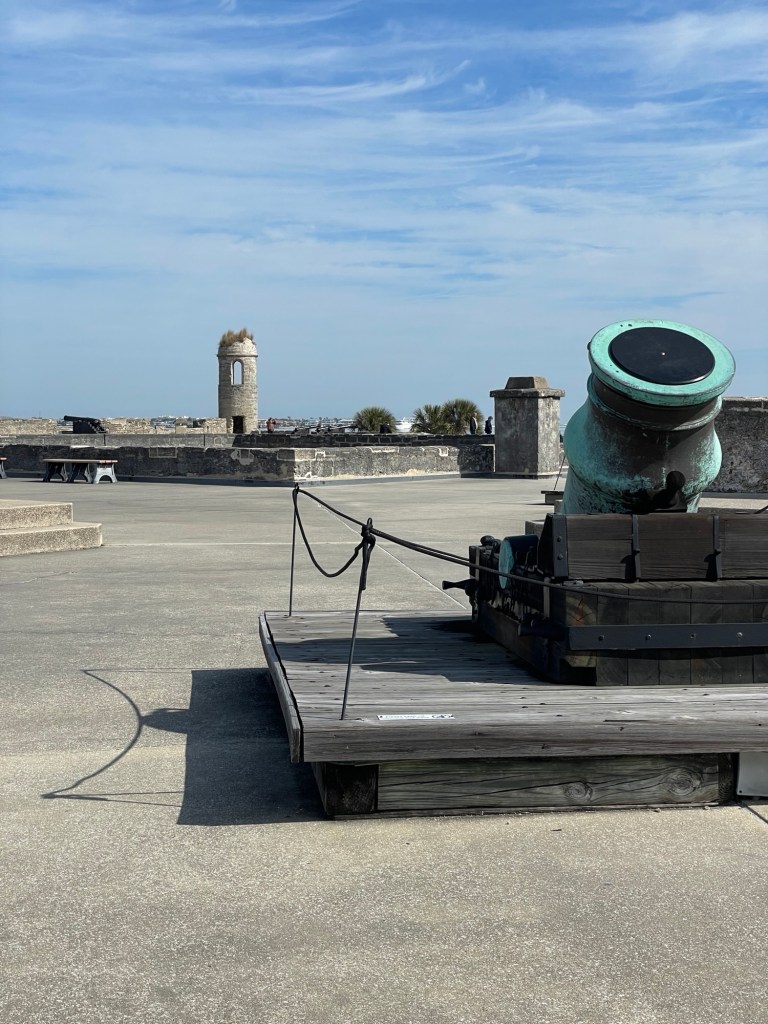
This is a mortar, a small portable front-loading gun. These were aimed high and fell in a downward U on relatively close targets.
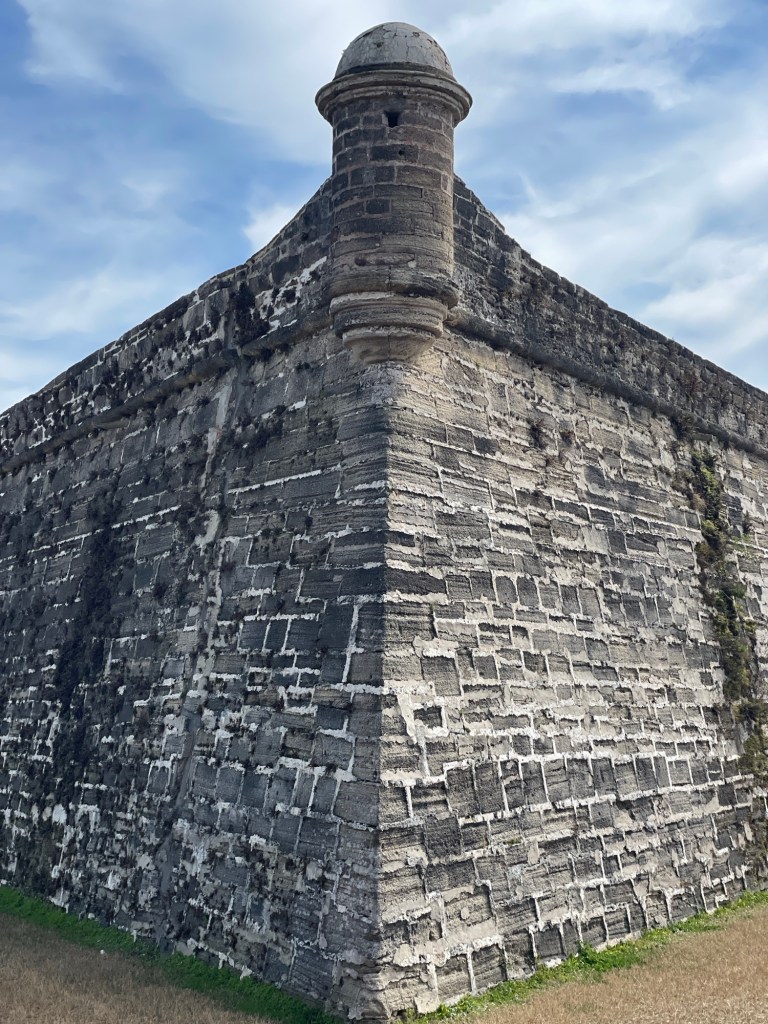
In all its long history, Castillo de San Marco/Fort St. Mark/Fort Marion was never breached or taken by force. Because it was made from slabs of naturally occurring coquina limestone, the natural give of the material absorbed the impact of naval shelling, protecting the fort’s walls from rupture. I imagine it Looney Tunes style, with cannon balls bouncing off in all directions accompanied by a springy ‘Boing!’ sound before harmlessly rolling away. Can you even imagine the first time Spanish soldiers and English sailors saw these walls absorb the impact of those cannon balls? It must have looked like divine intervention.
I wonder if the architect knew how much of the fort’s survival would rely on his decision to use this locally quarried stone. If he had had bricks to hand, would he have chosen them instead? Probably not! What a difference that would have made.
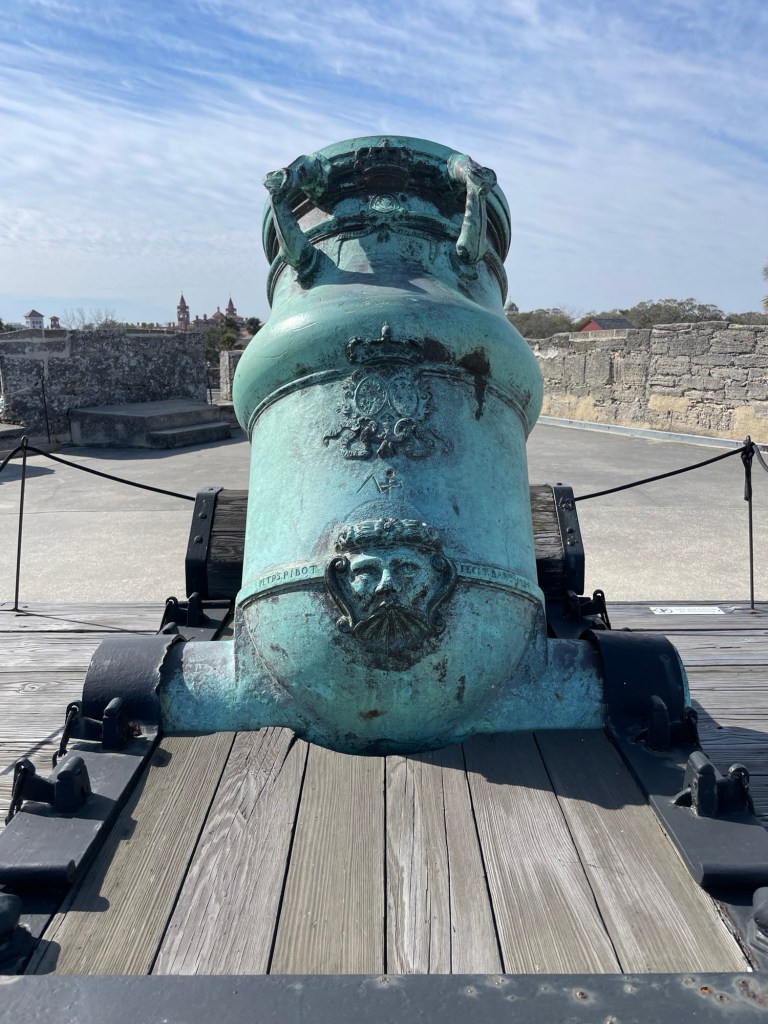
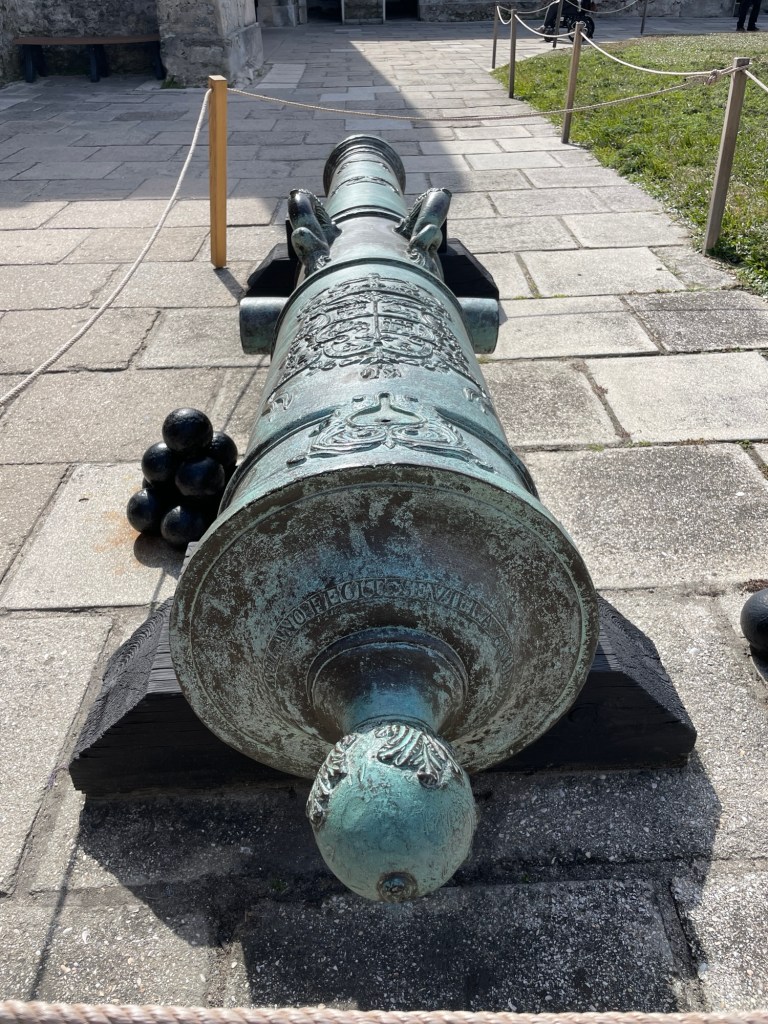
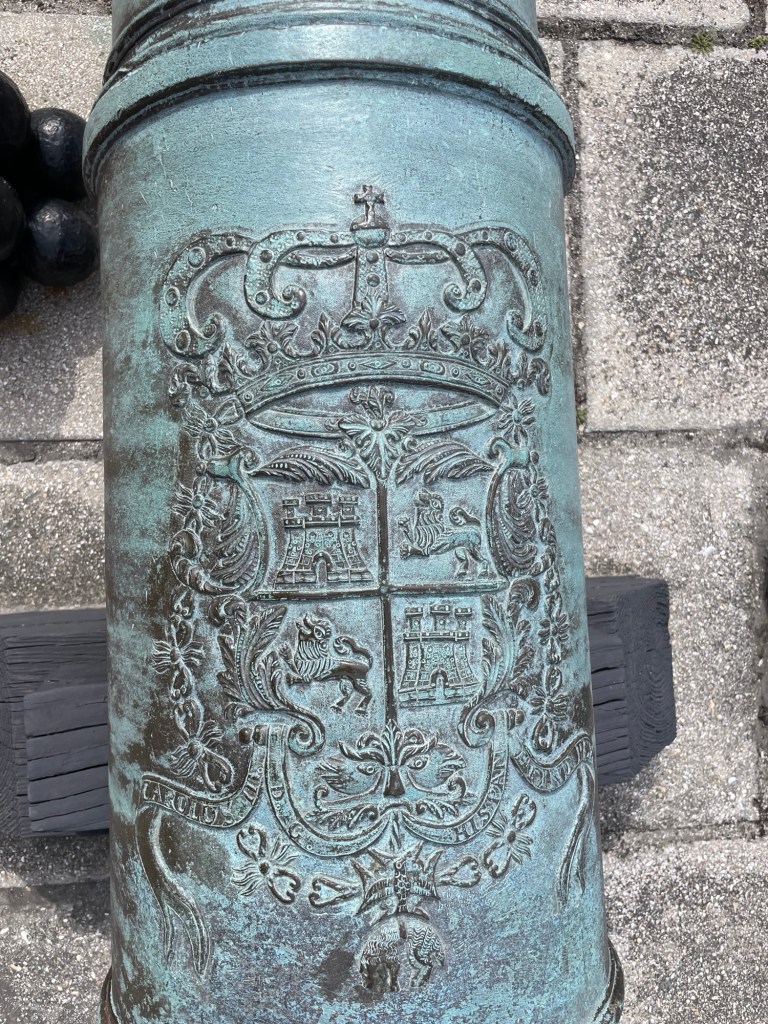
MortarCannon (long barrel, low-trajectory, used for long distances)Royal coat of armsAnchoring point for a hoist gin
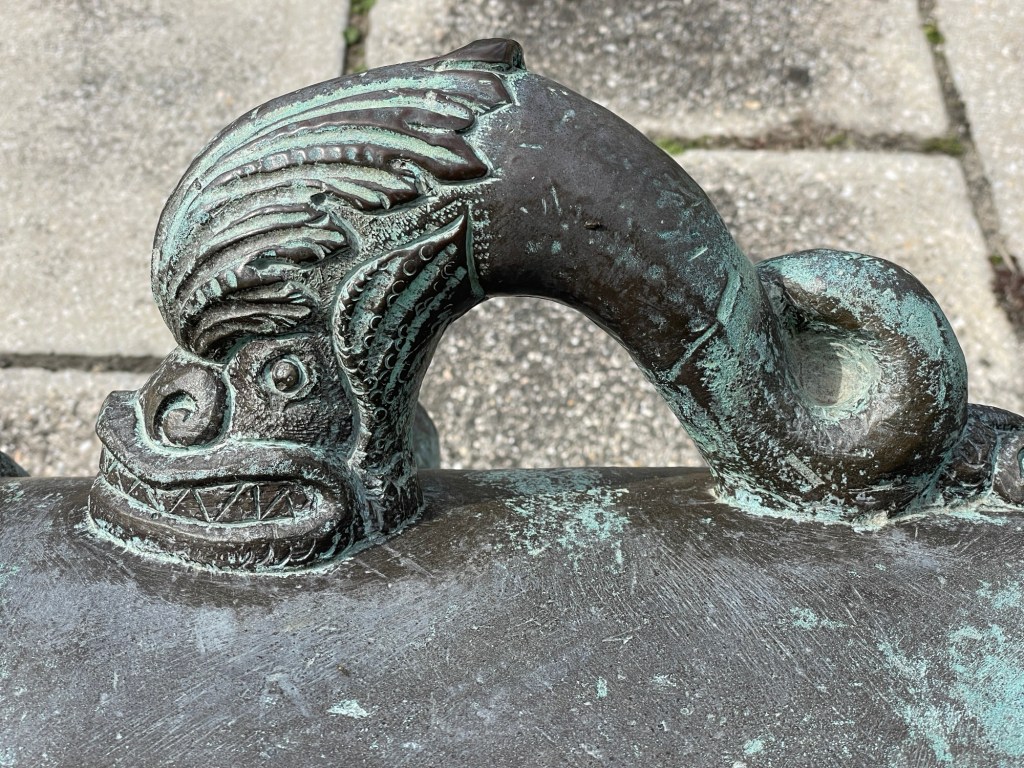
Something that endlessly delights and amazes me is the beautiful details for things as utilitarian as war machines, things that could reasonably be expected to explode if they were weren’t cleaned out meticulously after each use, to be blown up by enemy shot, or at the very least melted down and recast after they were fired too often and broke down. Yet, lavishly decorated they were. The King and Queen of Spain’s coat of arms in pride of place, quotes around the barrel, faces and flourishes, the manufacturer’s name and mark, plant and animal forms built into handles and hooks. They’re absolutely beautiful. Horrible, murderous machines, to be sure, but beautiful ones.
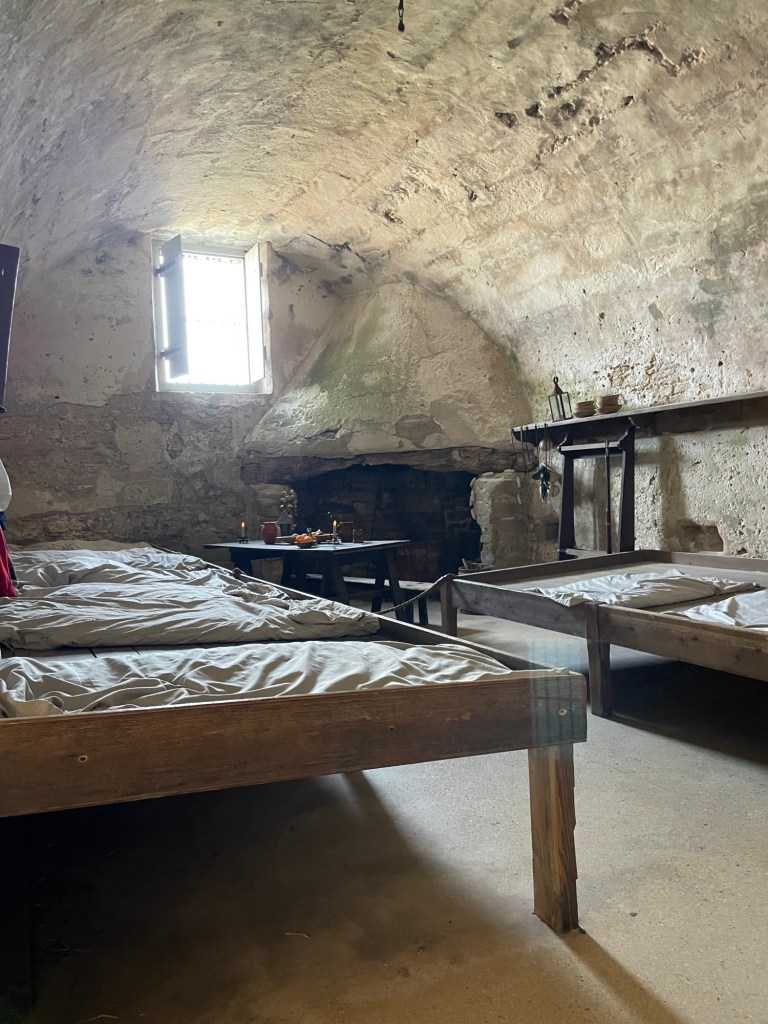
Guard quarters
The Spanish guards slept and ate in this little room when not on duty, two to a bed, on their 24-hour rotation days — 4 hrs on duty, 4 hrs off. When not on rotation, they slept in their own residences in St Augustine. Prisoners were held in a similar, albeit less comfortable, room next to this one.
I don’t think I would have done well with a split 4 hr guard duty schedule, even if it was just for 24 hrs at a time.
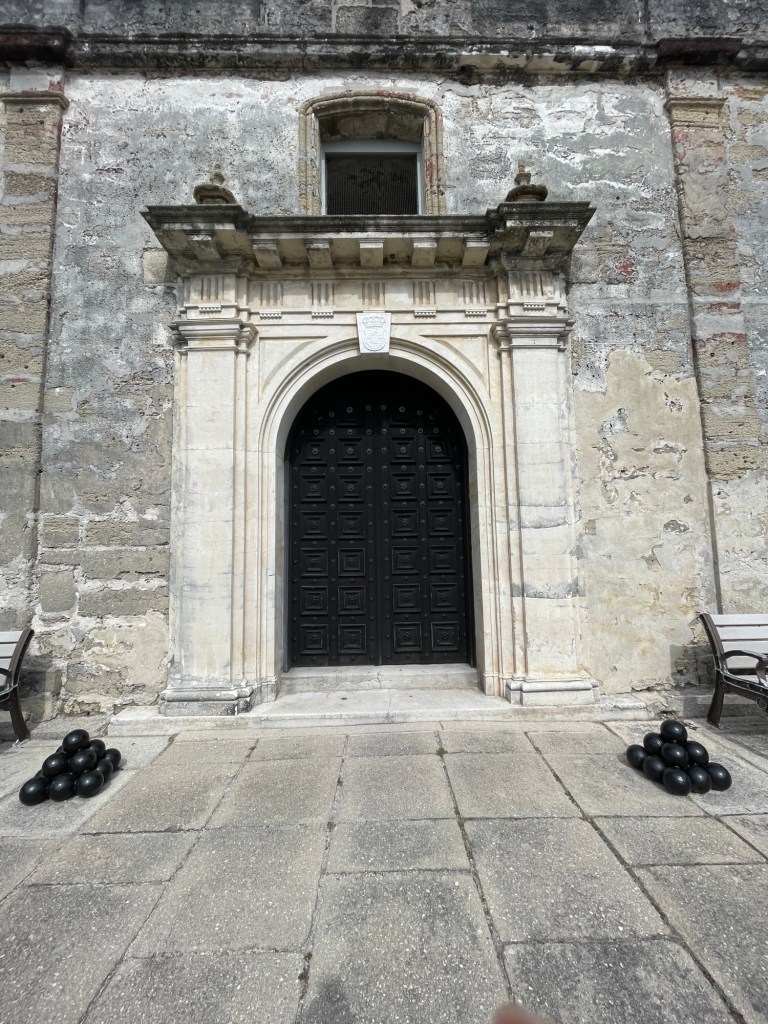
The chapel entrance, flanked by cannon balls
Inside the fort, most rooms are set up to look as they would have during its use by the Spanish soldiers. Their Catholic chapel has holy water basins on either side of the entrance shown above. Baskets of fruit, barrels of salt pork, and shelves of sundries line the walls in the kitchen and commissary. Black powder kegs and spare sponges are near the powder magazine. A sign near the latrines explains the twice daily ‘tidal cleansing’ process used to keep the fort from drowning in its own waste. Other rooms tell about the unexpected finds, restoration process, and preservation issues associated with the building and grounds. Another room tells about the fort’s use as a prison during the Seminole and Plains Indian Wars from a first person perspective.
Blocks of quarried coquina limestone mortared together with a mixture of coquina shells, lime, & water
The Castillo de San Marcos National Monument met all of our expectations and then some. It’s clear that a lot of hard work has gone into the preservation and restoration of this remarkable place. Just reading about the triple challenge of protecting the soft & easily damaged coquina walls, and keeping the facility open and available to the public, while keeping lichen, mold, & mosses at bay in this perpetually humid city made my head spin.
We don’t — as a nation — give conservators, historians, preservationists, and National Park staff enough credit. Without them, publicly accessible history anywhere near this quality simply wouldn’t exist. Yes, it requires public funds and a good deal of it. But what would we, as a nation, have lost if this site had become just another golf course, members-only marina, or strip mall? I don’t even want to think about it.
With sore feet, we ran out of time in St Augustine and missed the chance to some of the other local attractions, such as the Flagler College campus and the Flagler Memorial Presbyterian Church. Green cars everywhere.
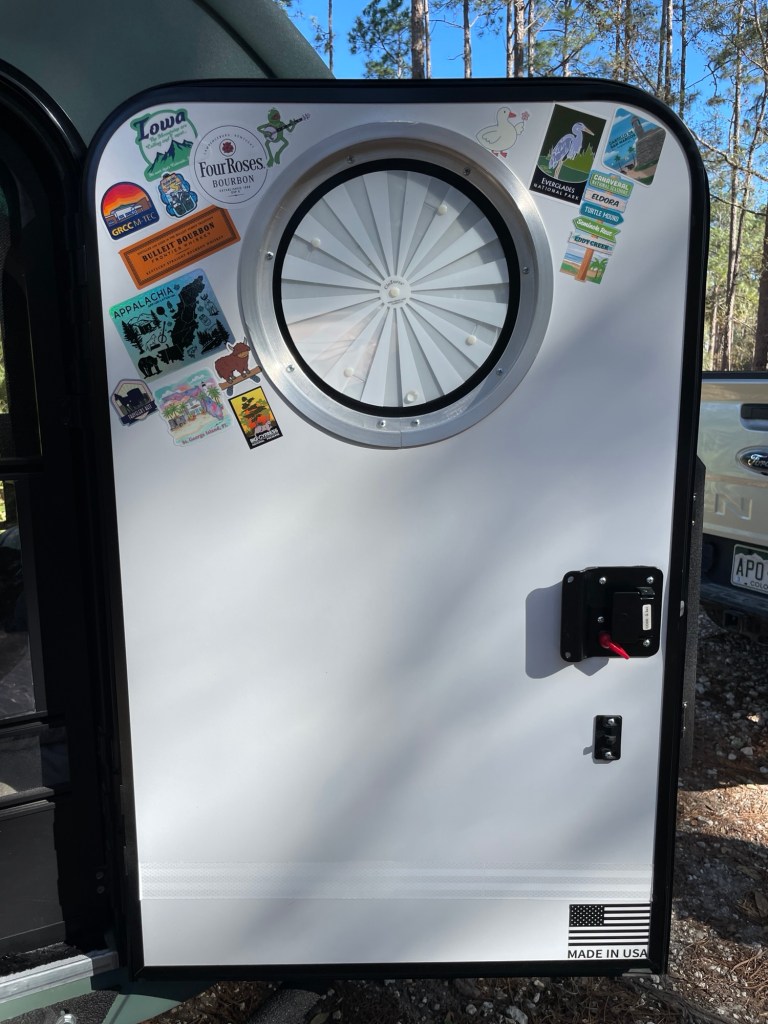
My sticker collection is growing
Back at the trailer, we pre-packed up so we were ready to head out of Florida first thing in the morning.
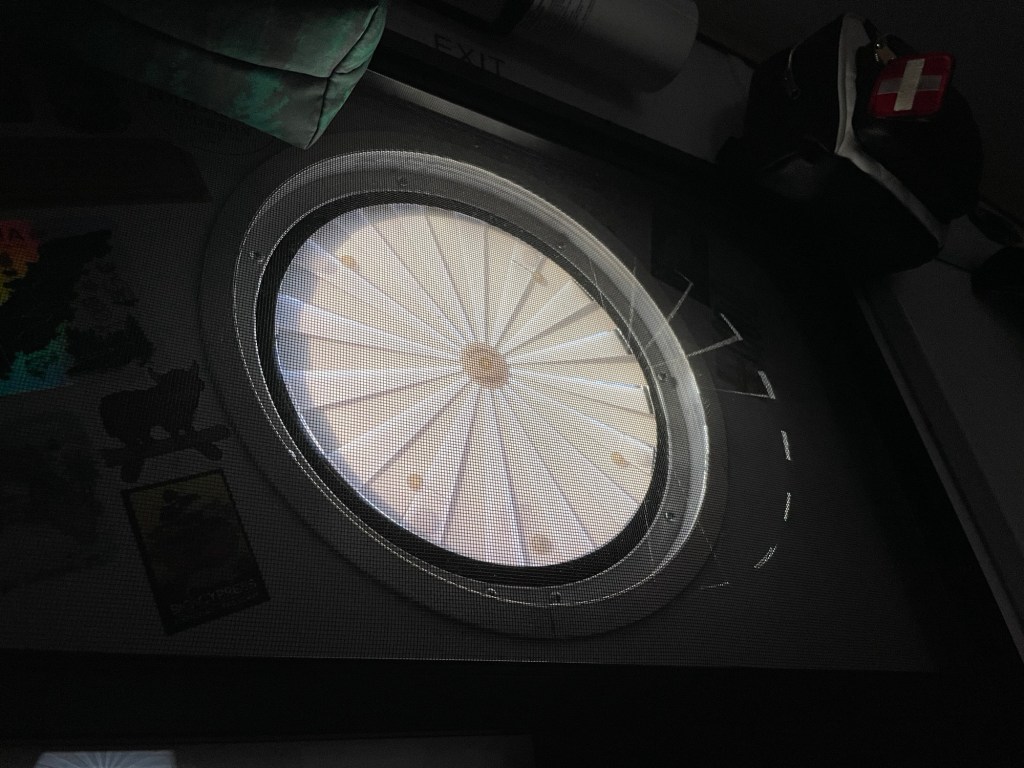
Light playing across my door’s porthole. A lovely way to wake up each day.
The company that Jeff used to work for has an office in West Palm Beach so he wanted to make sure that we stopped there long enough for him to say hello to some of his former colleagues. Now that coastal community is rather $$$Fancy$$$ so we were surprised to find the John Prince Park Campground in Lake Worth, a fairly quick drive to the island beach area, an easy on-off Interstate 95, and not too far from the company office. We were even more shocked to find out how reasonable the price was for being right in the thick of it all. Sure, it takes an age to get anywhere regardless of distance in the Palm Beach area, especially during the commutes, but that’s the case all the way along the southern half of East Florida.
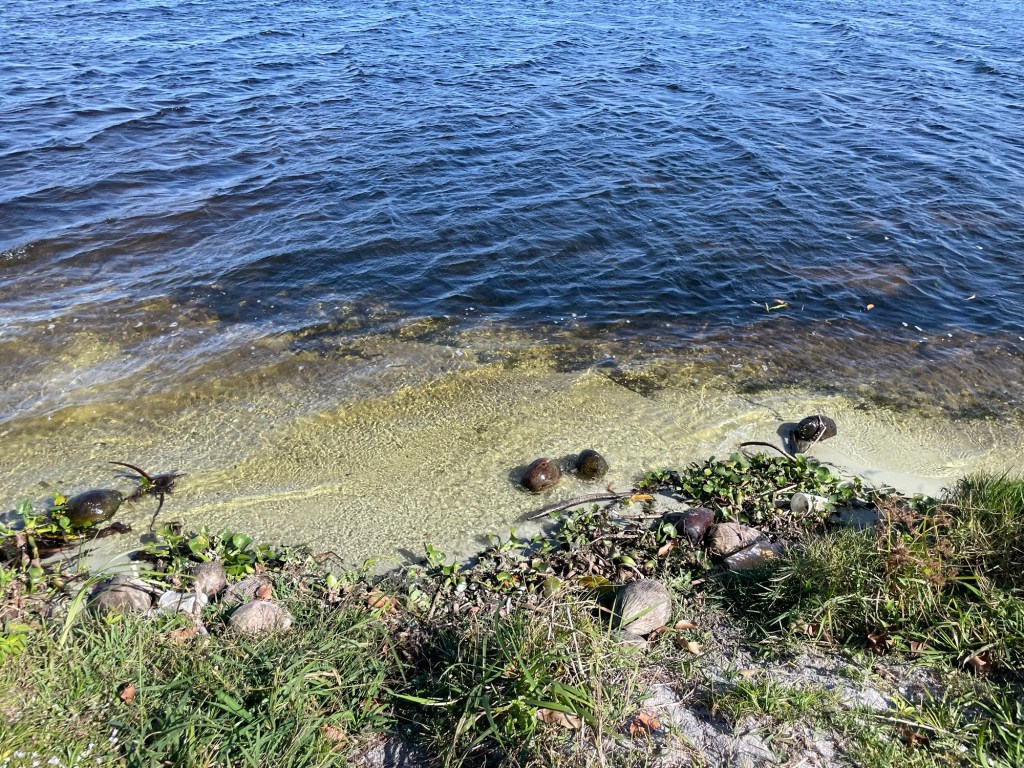
Coconuts and creepy sea creature (left)
Our campsite was right on the water and a few coconuts were bobbing at the water’s edge. What a nice welcome. We had friendly and down to earth neighbors, with lots of them stopping by to chat. The HMS Beangle often draws a crowd. An iguana catcher made the rounds. I wish I’d taken a picture of him holding one because those things are HUGE.
After settling in, we headed over to Michael’s home and met his lovely wife and son. Jeff and Michael caught up on things, we all enjoyed a glass of wine, and in a truly amazing feat of spur of the moment cooking, his wife made Jeff and me the most shockingly delicious meal from what she termed ‘bits and pieces’. I could never.
I. Could. Never.
In the strangest twist of fate, Michael and I found out that we had both lived for a bit in the Netherlands — he for a year as a high school exchange student, me as a graduate student intern! It was such fun to randomly be speaking Dutch again and to talk about the country, the people we miss from there, and our desire to go back again.
As for West Palm Beach, Jeff and I spent two days relaxing, catching up on laundry, driving the A1A coastal road, and having some spectacular caught-that-morning ceviche with fried plantain strips. Highly recommended. I wish we could remember the name of the specific fish, as it was pretty rare and was only caught when the weather turned cold. It was very delicious. Meaty, mild, and firm textured. I’d order it again and again if we lived anywhere near there.
You know how when you buy a green car you see green cars everywhere? I experienced that after going to visit the Flagler House and Museum while Jeff had lunch with a few colleagues.
Henry Flagler made his fortune as one of the five men who founded The Standard Oil Company, with Flagler directing the accounting side of things. After amassing an absolutely obscene amount of money (from one of the dirtiest and most ruthless companies/industries in American Gilded Age history), Flagler went on to buy up disparate railroads around Florida and converted them to a standard gauge, initially to make travel to Jacksonville, FL where his first wife had moved for her failing health easier. He and his second wife, moved to St Augustine. Soon after, he and his third wife settled in West Palm Beach and it’s there that I toured their palatial home, now turned museum. His rail lines, like his infidelity, connected them all.
Later, he had new rail lines built along Florida’s eastern shoreline all the way to Miami (which he named), under the name of the Florida East Coast Railway. Eventually he extended that rail line all the way to Key West, despite advice and expense. You see, for every mile of rail installed, the state gave Flagler 8,000 acres of undeveloped land. You can see how it went. He built more rail; he got more undeveloped land. From his more than two million free acres, Flagler had towns built around his rail stations and brought people into Florida to build and work in those hotels and other businesses.
It’s not an exaggeration to say that Flagler is the father of modern, tourist-based Florida. He was also, quite probably, not a very decent husband, but you can decide that for yourself. Once you know the name, you see it everywhere: Flagler College, Flagler Station, Flagler Airport, Flagler County, Flagler High School. Like I said, ‘Green cars. Green cars everywhere you go.’
At the house museum, I didn’t take a single picture. I just enjoyed myself as I traveled from room to room and listened to the different tour guides. Sometimes you just have to relax and enjoy the ridiculousness.
Armadillo that we stumbled across
Heading further up the coast, we snagged a few nights at another Hipcamp. This one was a wonderful, private, campground-like spot with no trash on the ground and no random hippie encampments on the other side of the makeshift fence. Niiiice. They did have an Appalachian Trail-style mouldering privy, which would take some getting used to long-term, but like alligators way too close to the sidewalk, you can get used to a lot of things if you train yourself to not think about them too much.
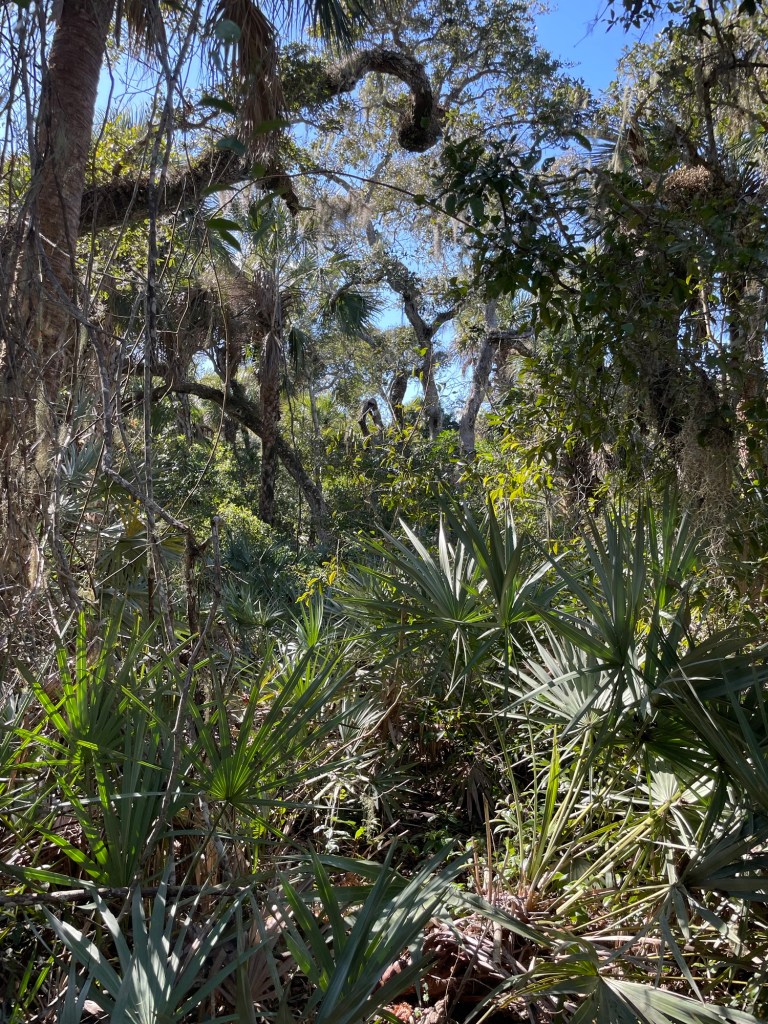
What much of Florida used to look like
We were quite fortunate to be close to Canaveral National Seashore, Merritt Island National Wildlife Refuge, and the Kennedy Space Center. Since we only had two days there, we planned to spend the first one following a 30 mile driving tour of the region to get an overall feel for things, starting at Canaveral National Seashore and finishing in nearby Titusville, FL. We never made it past stop one that first day.
The road into the National Seashore looks like any other stretch of a Florida coastal neighborhood, which was a touch concerning. Miles and miles of condos, bars, large coral-colored houses on stilts, restaurants, and 55+ apartment complexes. But then, suddenly, you’re at the preserve and it’s all quiet dunes, sea grasses, saw palmettos, and brown signs. We showed our National Park Pass and proceeded to the visitor center. Following the park’s map, we noted which parking lots were closed for resurfacing and that the Eldora Statehouse (just a normal house) exhibit rooms were open.
Our lucky break came as we climbed out of the truck at the Eldora Trail and promptly met The Plant Guy. That’s how he introduces himself. The Plant Guy. He’s a volunteer and he walked to the Statehouse with us and showed us many different plants and artifacts along the way that we would have walked right past, such as the location where an abandoned building with a glass fronted porch used to be, a plant that locals used to make them throw up and a plant to bind them up, as well as additional epiphytic plants hidden up high, such as a fern that lives in palm trees and the butterfly orchid that lives on the branches of live oaks.
He told us about how the settlers used to harvest curved branches from massive Live Oak trees on the island which were then sold to build the hulls of ocean-going ships. He told us about the many crops that were raised (primarily cabbage) and if they were consumed locally or put on one of Flagler’s northbound trains for resale all along the eastern seaboard.
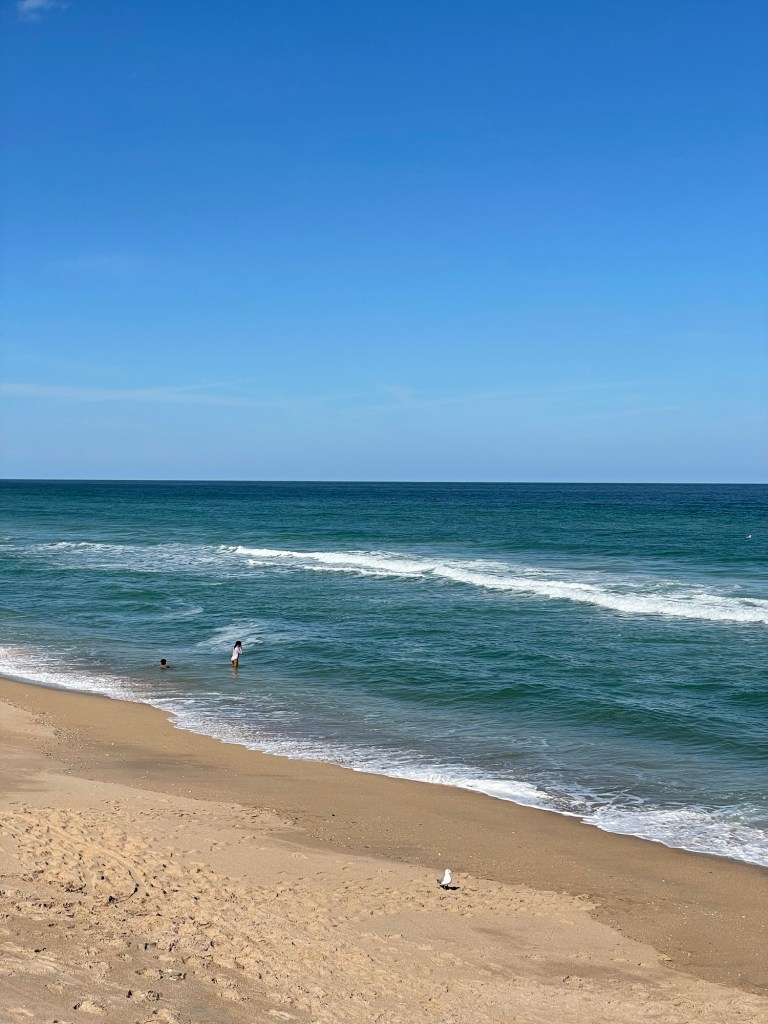
How do little kids stand such frigid temps?
Driving further down the shore road, we stopped at a few boardwalks and took in the Atlantic Ocean. A few were braving the chilly water, but most people watched from the railings or their beach chairs.
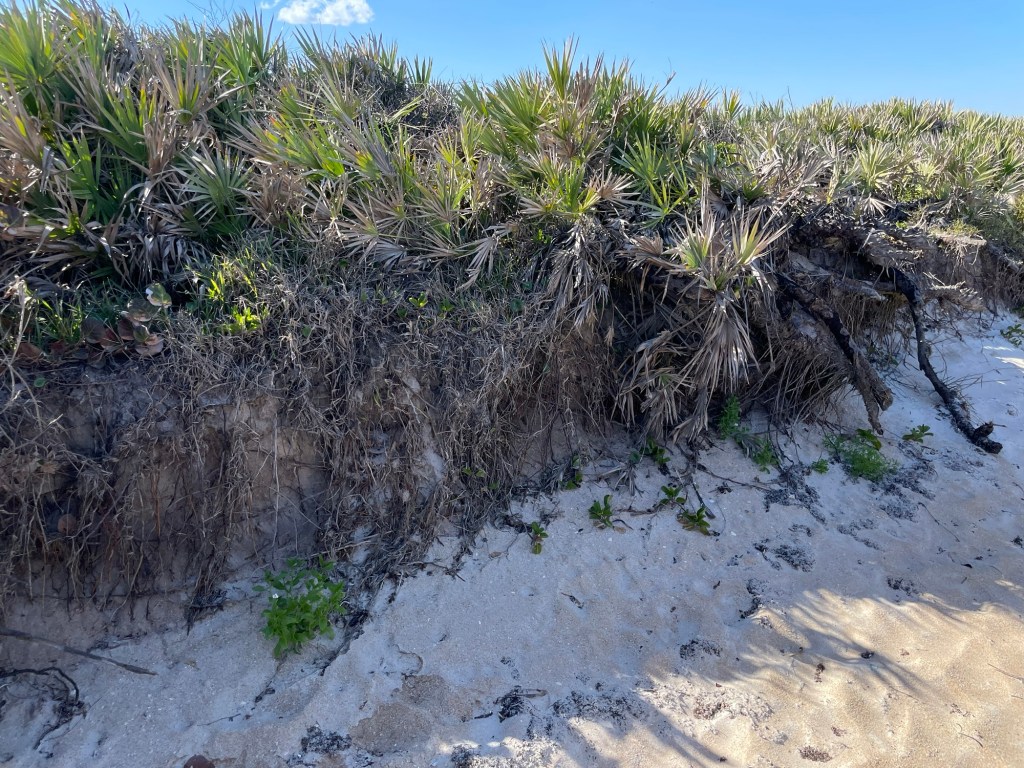
Intertwined roots of Saw Palmetto plants
There are signs all along the beach, road, and boardwalks reminding you not to walk on the fragile dunes. I get the impression that most of Florida’s barrier island dunes are surviving on hope and saw palmetto.
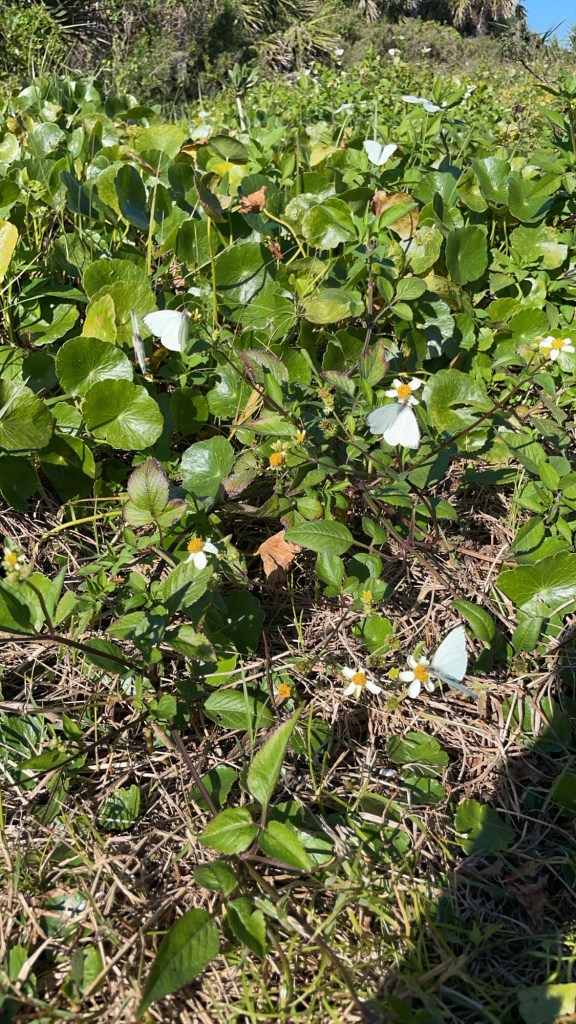
Great Southern White butterflies (Ascia monuste)
We’re told that the landscape throughout the National Seashore is very similar to what the indigenous population would have known before colonization. During the planting era, the landscape was changed dramatically and for the worse. Hurricanes scoured the land and tore apart the concrete barriers placed along the seashore. But once the planting pressure was removed and native plants were restored, the Canaveral National Seashore’s landscape rebounded and the coastline began to stabilize again. It’s almost like Nature knows best how best to protect and maintain a coastal landscape.
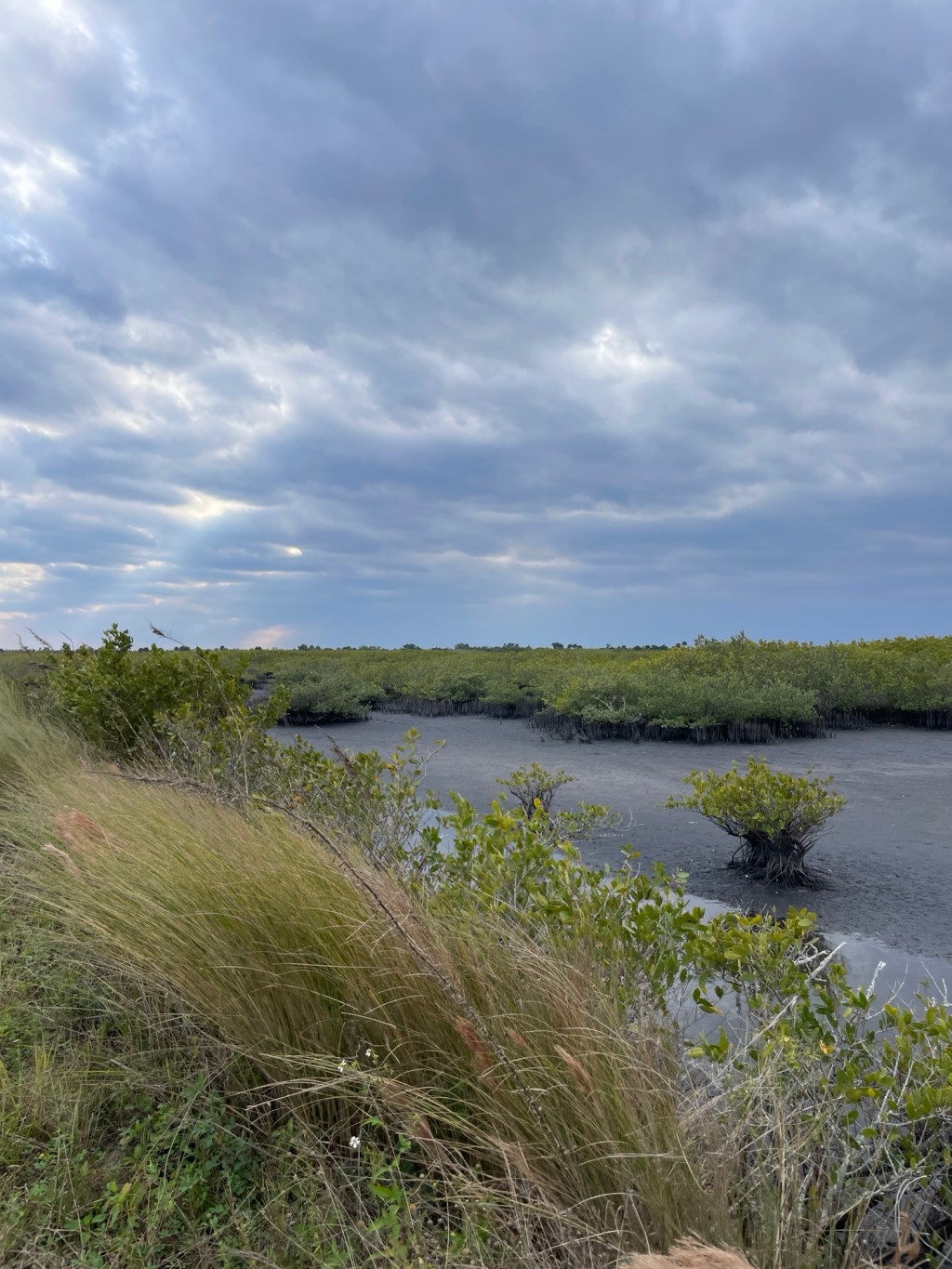
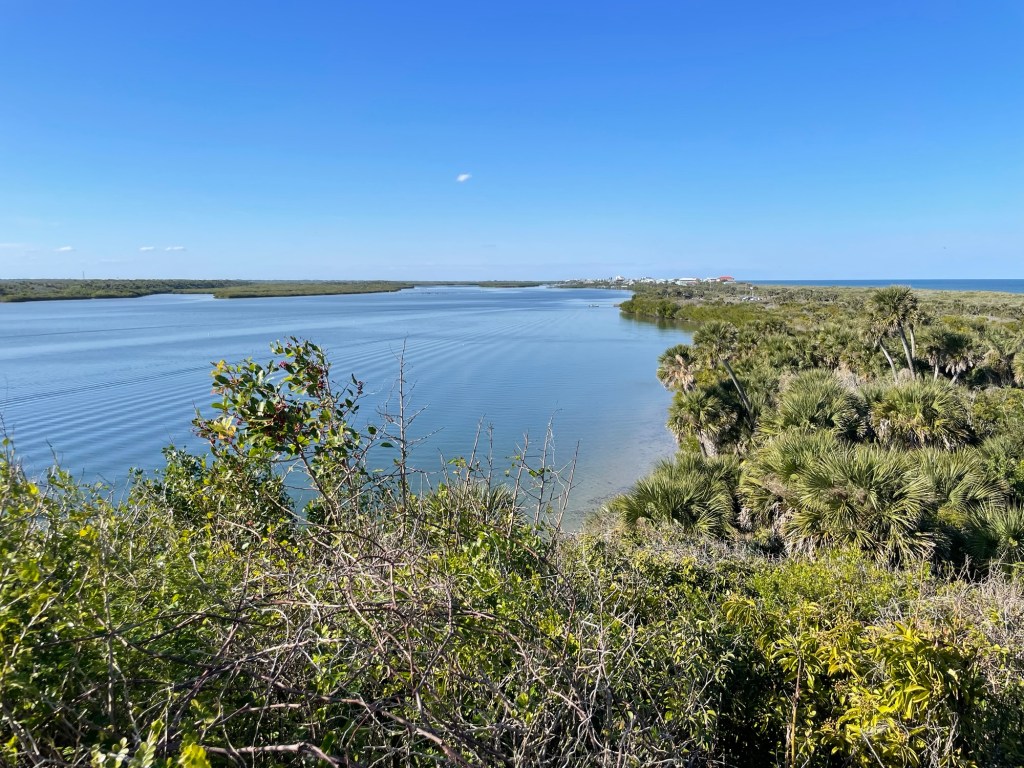
The intertidal waterway
Throughout central-north Florida and south-east Georgia a group of indigenous tribes known as the Timucuan (also written Timucua) made large shell mounds called middens. (These are some of the same people that Hernando de Soto and his gang of ne’er do wells met, abused, and killed as they searched for gold.)
Midden, if you’re unfamiliar with it, is a fancy archeological term for trash heap. We never really throw anything away. There is no away. Maybe we burn it. Maybe we dump it in a lake, river, or the ocean. But throughout time, we humans have usually dumped our unwanted items in a hole or made of pile of refuse and moved on. Our hermetically sealed landfills — even when they become Midwestern ski hills — are really nothing but modern day middens.
Research trenches show that Turtle Mound is comprised of oyster shells, trash, and soil in uneven layers, over the course of about 600 years, from roughly 800 CE through 1400 CE. It reaches more than 50 feet (15.5 meters) high. That’s a lot of oyster shells.
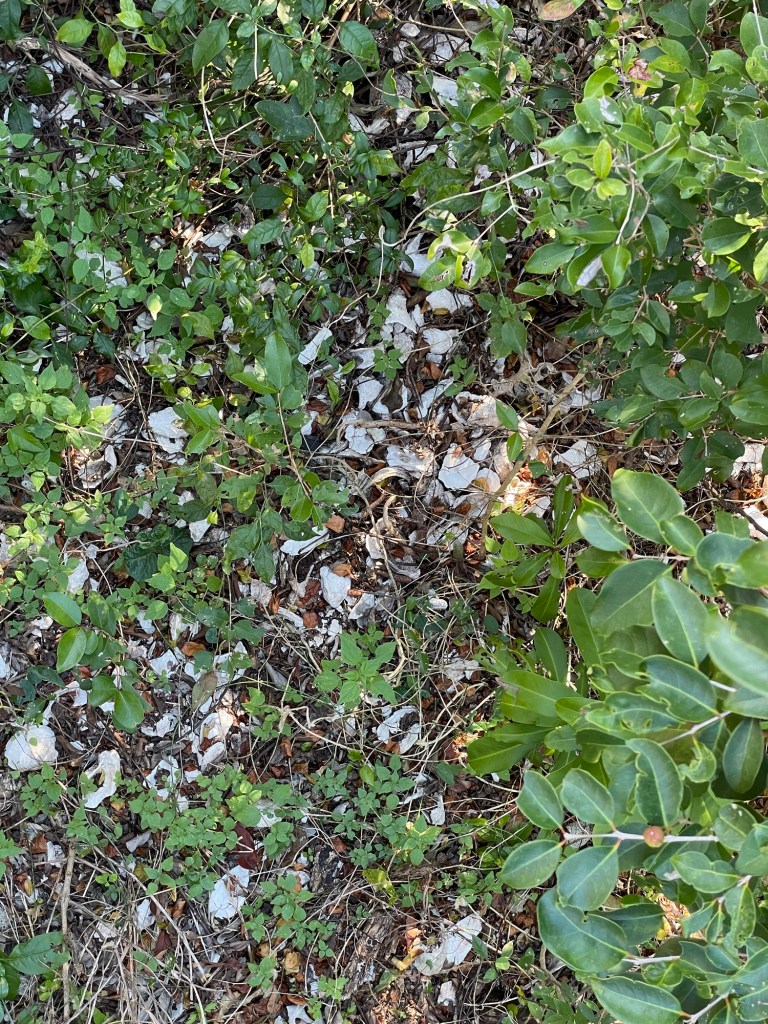
Turtle mound’s upper most layer
Now the question you might be asking is why there are so few oyster shell middens left. The answer is beneath our tires. Timucuan oyster shell middens all across the region were sliced into, scooped out, and the shells crushed down as a raw material during Florida’s road building boom days. The few middens that remain were saved by individuals who refused the lucrative offers of road construction firms, somehow understanding what was at risk.
Are these middens exciting? For you and me and The Average Joe, no, not really. But they’re all that’s left to tell us a bit about the day to day lives of an indigenous group of approximately 200,000 individuals in 1513 when Juan Ponce de Leon claimed Florida for the Spanish. By 1595 their population had dwindled to around 50,000, by 1700 that was a mere 1,000. The Timucuan were extinct as a society by 1800. And frankly, for that reason alone, I think the little bit that we have left of them is worth saving.
Day Two found us back on the grand tour path with a tighter focus: finish the driving tour, see the sights. We failed. We knew we would fail the minute we saw a wild momma boar and piglet cross the road in front of us while passing into the Merritt Island National Wildlife Refuge.
With the temps dropping quickly, we stopped at a manatee viewing area and saw a little one warming itself in the murky water. Shivering, I dug into the winter stuff bin in the back of the truck and pulled out my gate agent parka, insulated hat, and gloves. It might have looked ridiculous in Florida, but I was toasty warm.
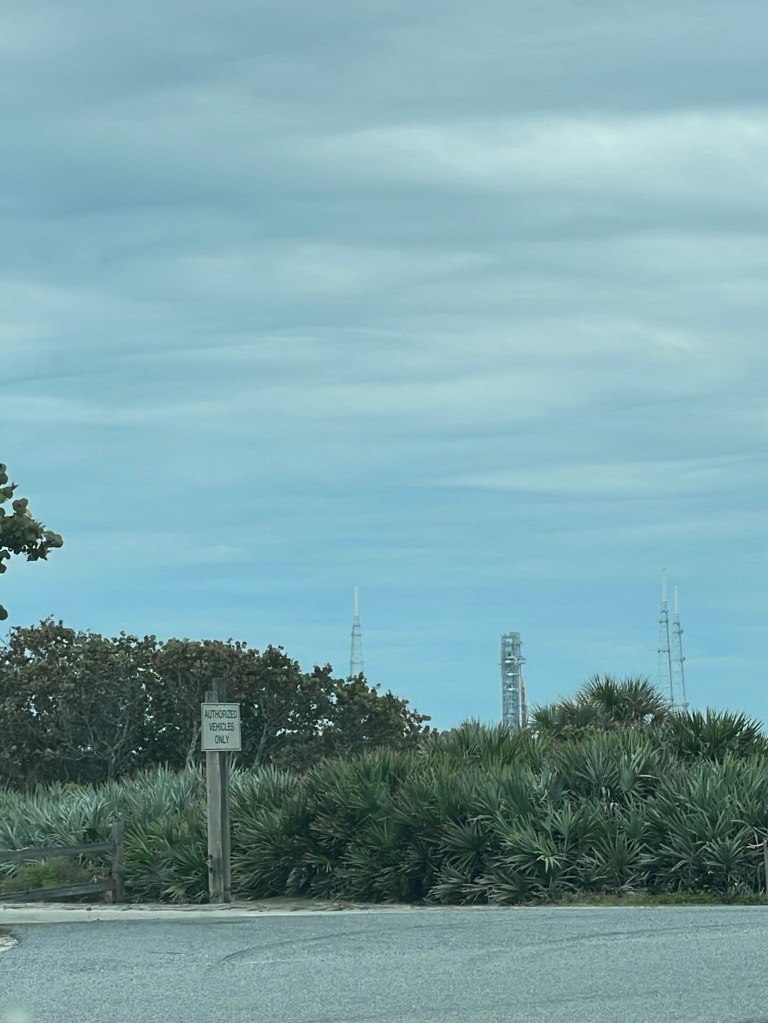
We slid into the southern-most edge of Canaveral National Seashore, just to do it, and saw the Artemis II rocket up on its launchpad. Police were blocking every viewing platform, so you could only catch quick glances of it as you drove. Luckily one corner is a head on view, so I grabbed a terrible photo heading into the 90° turn. The launch ended up being delayed due to “hydrogen leaks and communication issues during the final ‘wet dress rehearsal.’” That sounds bad.
Artemis II at Kennedy Space Center
Having experienced a small satellite launch two nights before, from many miles away, with the roar and ground shaking, I can only imagine what that monster will be like going up. We mentioned the sound and shaking to our hosts and they said, “By the time that gets to us, the rocket is long gone.” I find that simply amazing.
Leaving the shoreline, we drove past the Kennedy Space Center’s staff entrance with its quite unfriendly looking security patrol and into Merritt Island National Wildlife Refuge, stopping at their quite informative Visitor Center. It’s a small space, but it does a very good job of highlighting the history and importance of this wetland area.
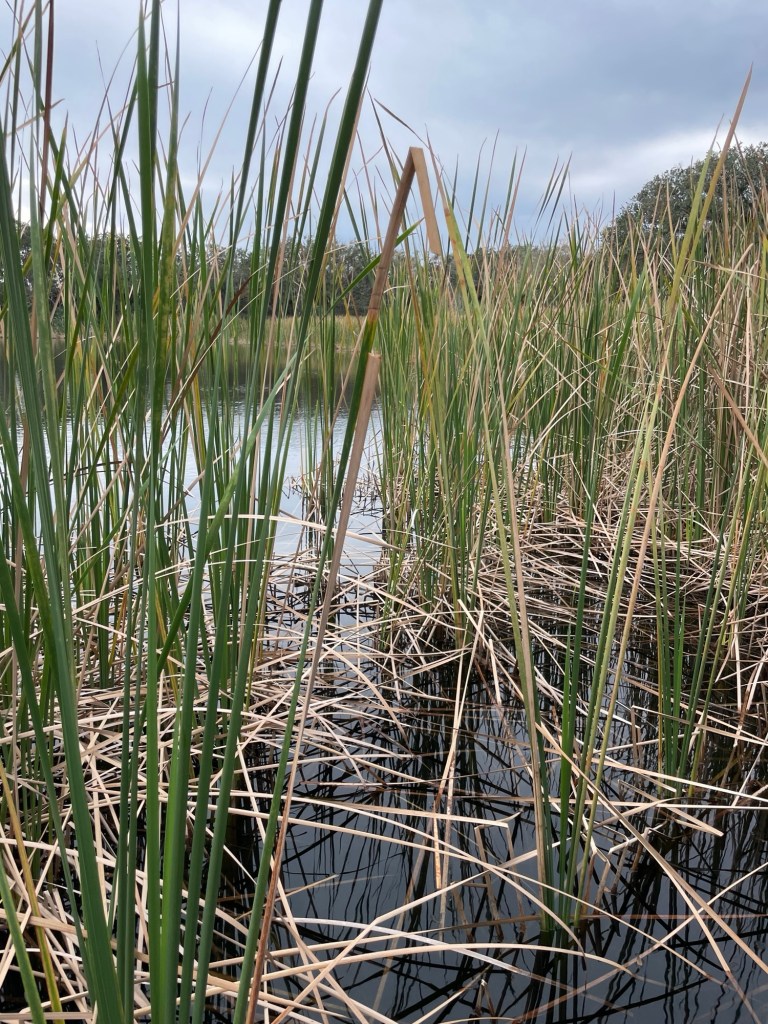
Swamp grasses
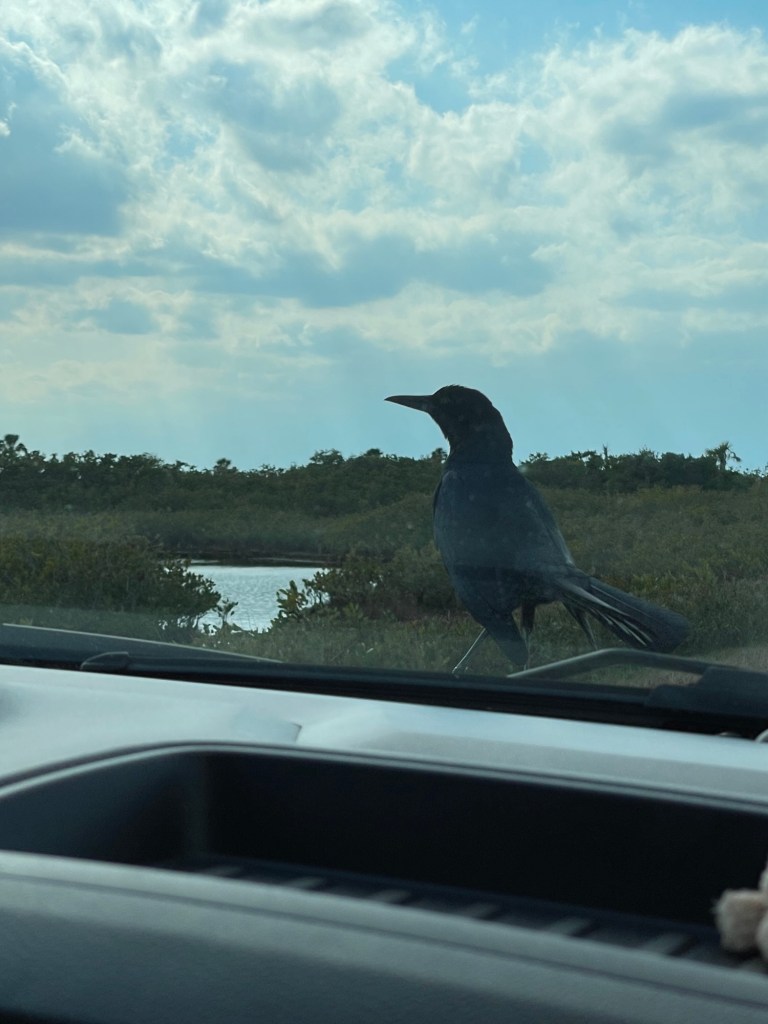
Jeff saw all kinds of birds in and around the visitor center and out on the driving/viewing loop. Sometimes I wish I could teleport some of our bird watching friends and family onto the truck with us, because below is as close as I get to spotting birds. Jeff tends to glaze over when I get excited about new-to-me plants and trees; I give him the awkward smile when he rambles on about the colorations on a non-breeding, female, southern whirdee doo.
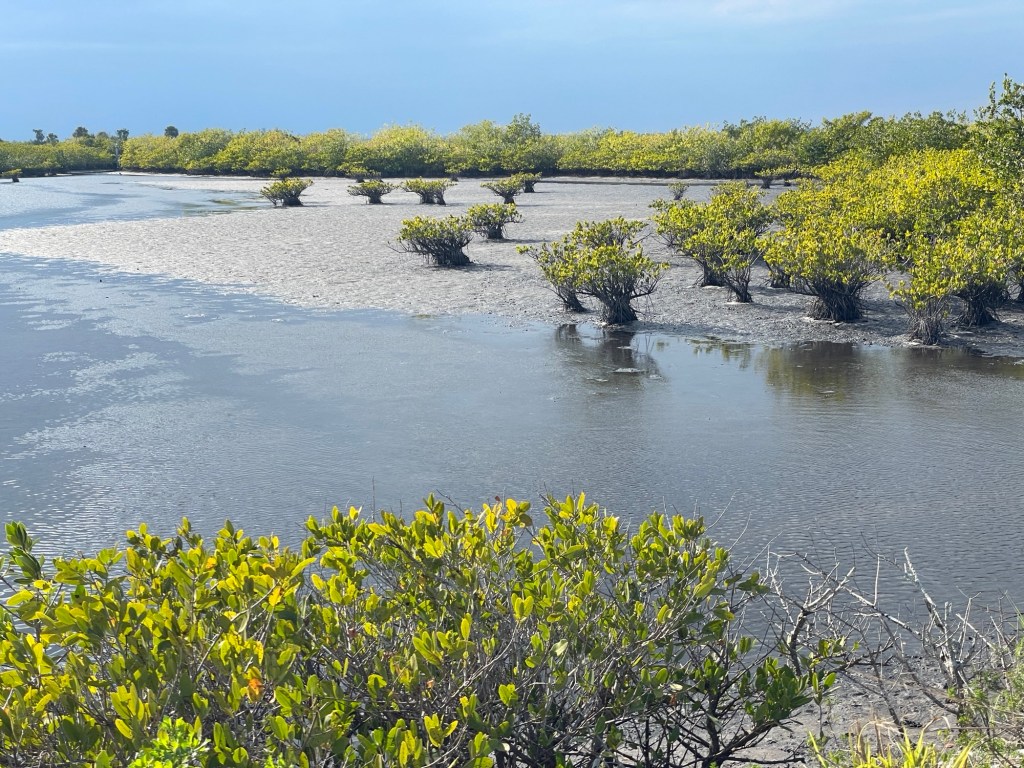
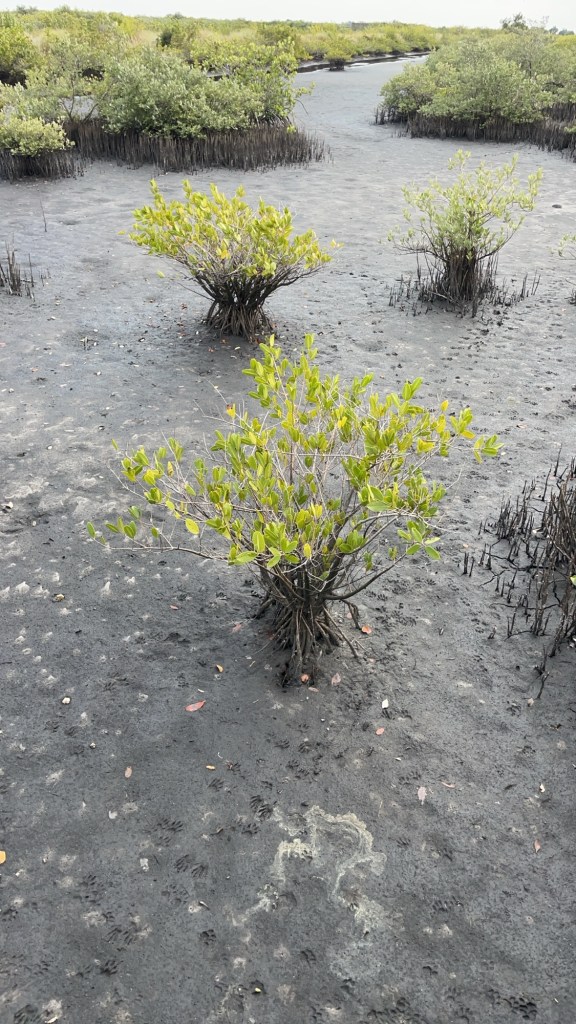
Look, a bird! It’s black!Young white mangrove treesCheck out those raccoon and bobcat tracks
For the record I don’t know much about plants and trees, but I like them and I’m learning.
I guess if you can spend nearly all your free time with someone for 30+ years, pick up and move hundreds of miles with that person multiple times, and endure the worst pain of your existence together, you can tolerate differing obsessions with equanimity.
The irony of writing about the warmest week we’ve spent in Florida while wearing parkas, gloves, and stocking caps is not lost upon me. It’s cold here in north-central Florida at the moment. Cold cold cold. My hope is we’ll soon see the back side of anything below 40°F for a while. I fear we have not seen the last of them.
Now, back to some remembered warmth.
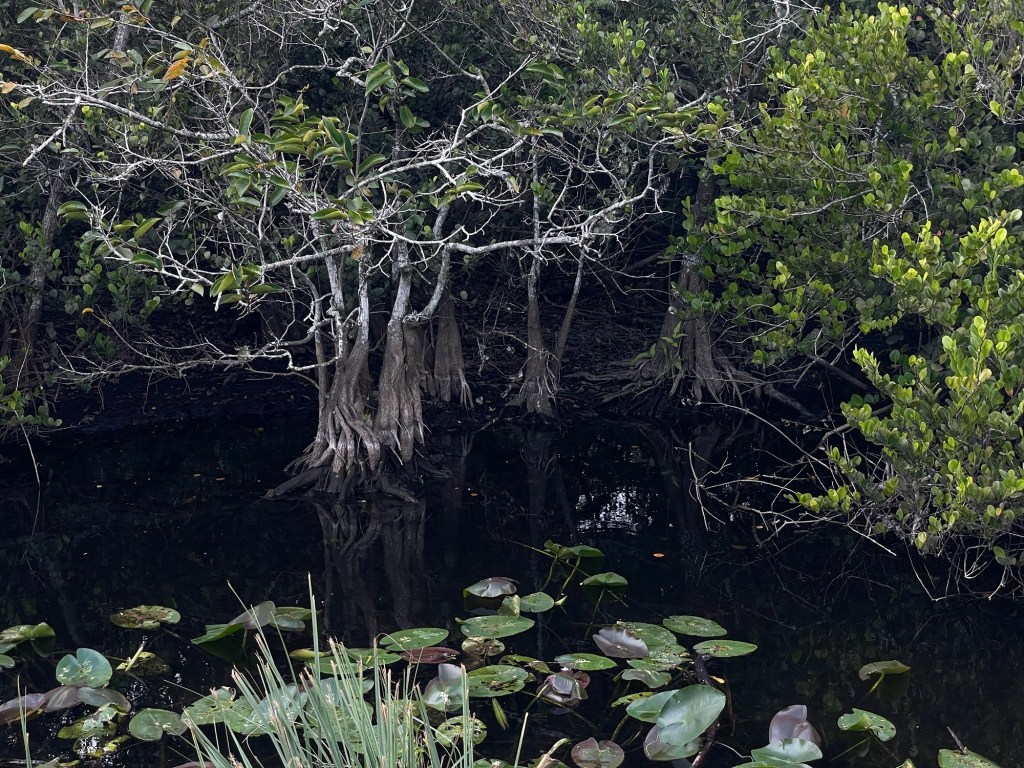
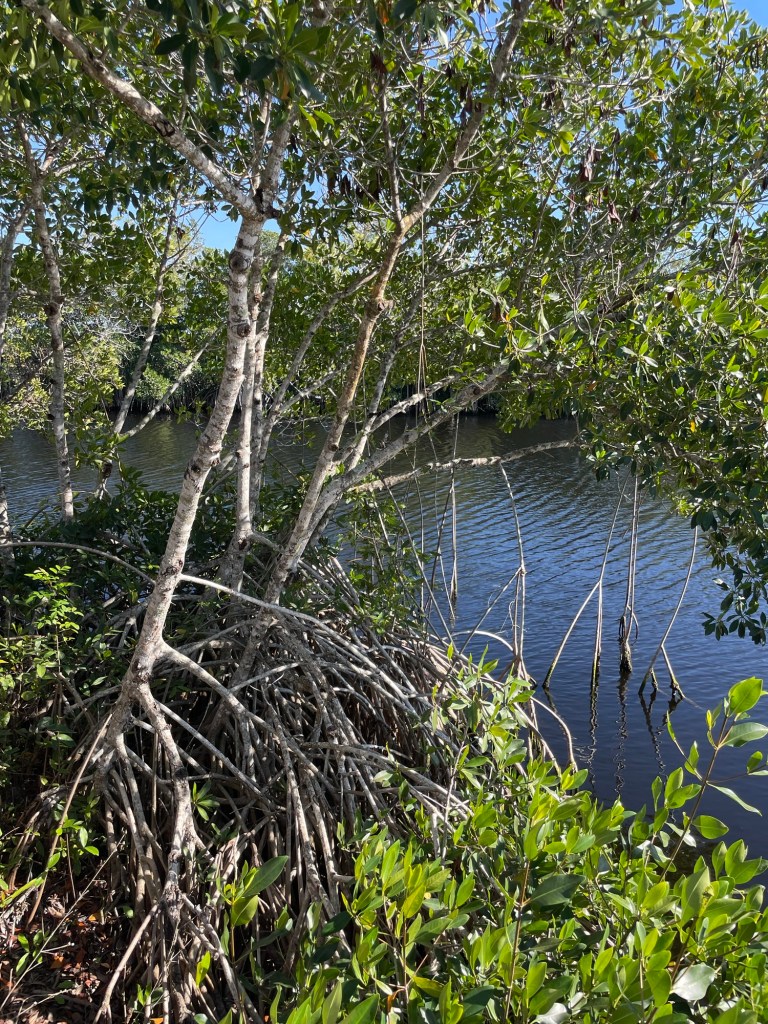
Mangrove roots are far thinner than I expected. We saw three types of mangrove trees in southern Florida: red, black and white.
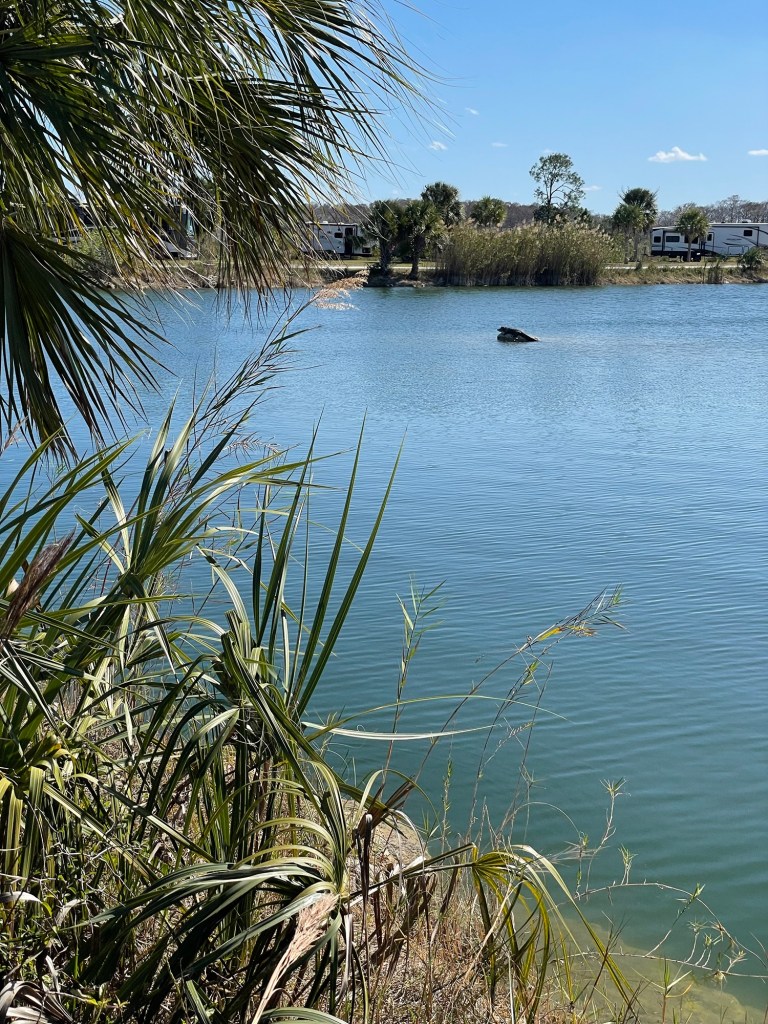
Upon entering the Big Cypress and Everglades National Parks region, I had one goal: I wanted to see alligators in a way that didn’t require binoculars or a zoom lens. The camp host at Monument Lake Campground assured me that no less than FOUR alligators lived in the campground’s lake. Four. We were off to a good start. As you can see below, a smallish one, Rocky, likes to warm itself on an outcropping right in front of the campsites.
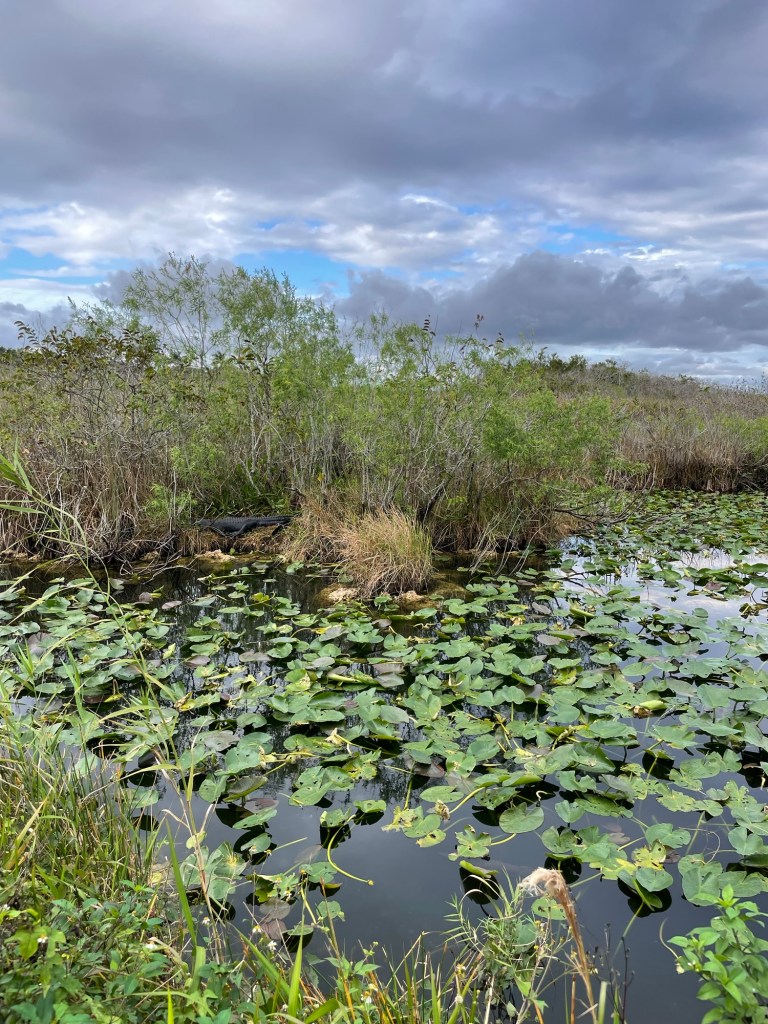
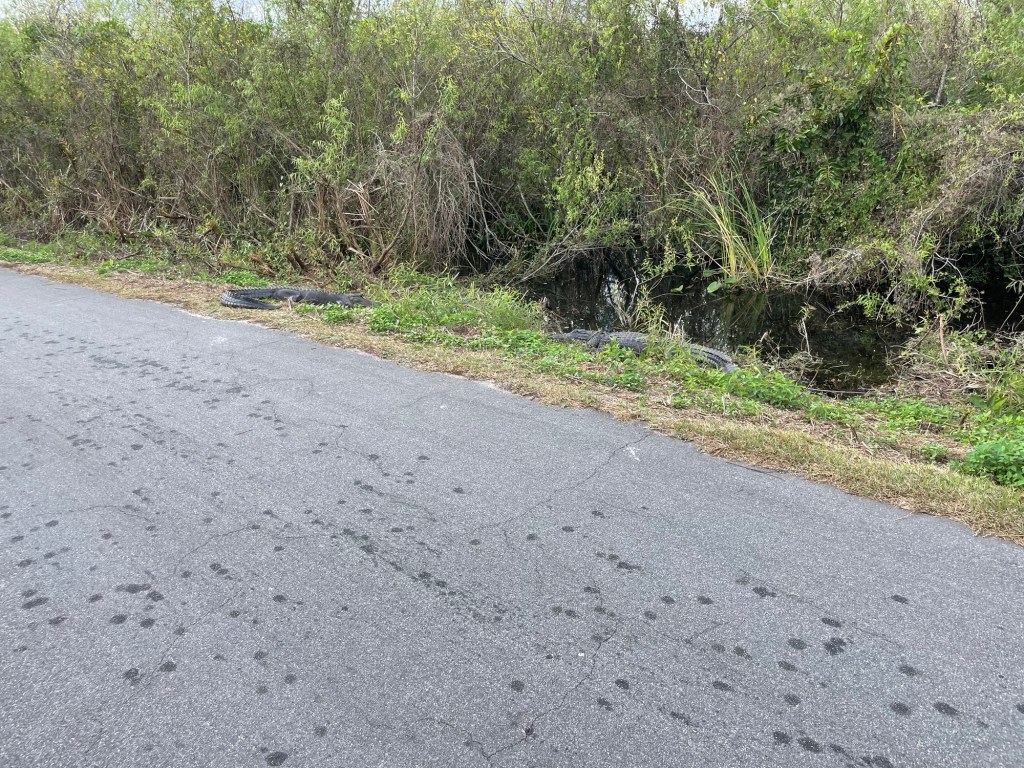
Quickly, we did see all four alligators, but with the exception of one, they didn’t often come close to the shore or even raise themselves too far up in the water. Eyes and snouts would follow you around the circular drive, but the gators themselves were elusive.
As we were parking the trailer, the host commented, “Please use a flashlight at night when walking to the bathroom as rattlesnakes and copperheads have been seen recently.” Gulp. Oh great. As if I needed another reason not to drink anything past 6pm.
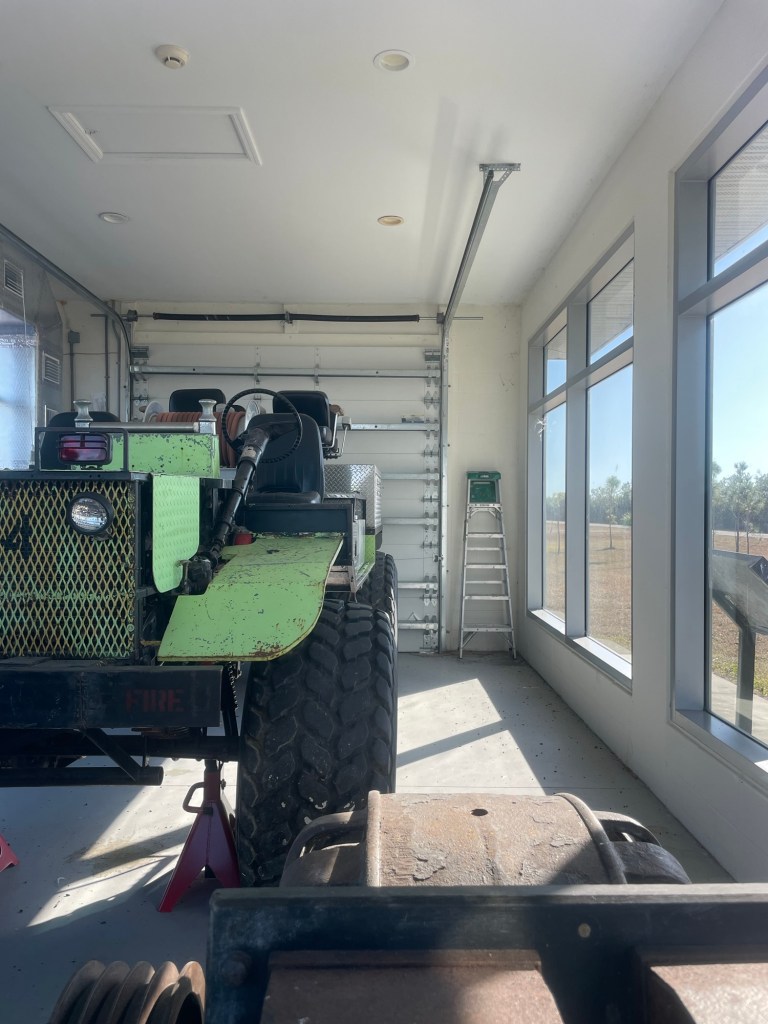
Our first tourist stop was at the Big Cypress Visitor Center, an excellent intro to the region. We watched a video about the watershed and read all the informational boards inside and out and walked the boardwalks. I checked out this huge swamp buggy on display while Jeff was occupied elsewhere.
This big green machine is older, but locals still make them from scratch out of spare parts and determination. Just for a sense of how big they are, I’m 5’0” and my eyes were level with the bottom of this thing’s seat. Made to navigate the swamps during the wet and dry seasons, they go anywhere and everywhere, carry all their own supplies, and must be repairable in the back country – because no one is coming to save you if it breaks down.
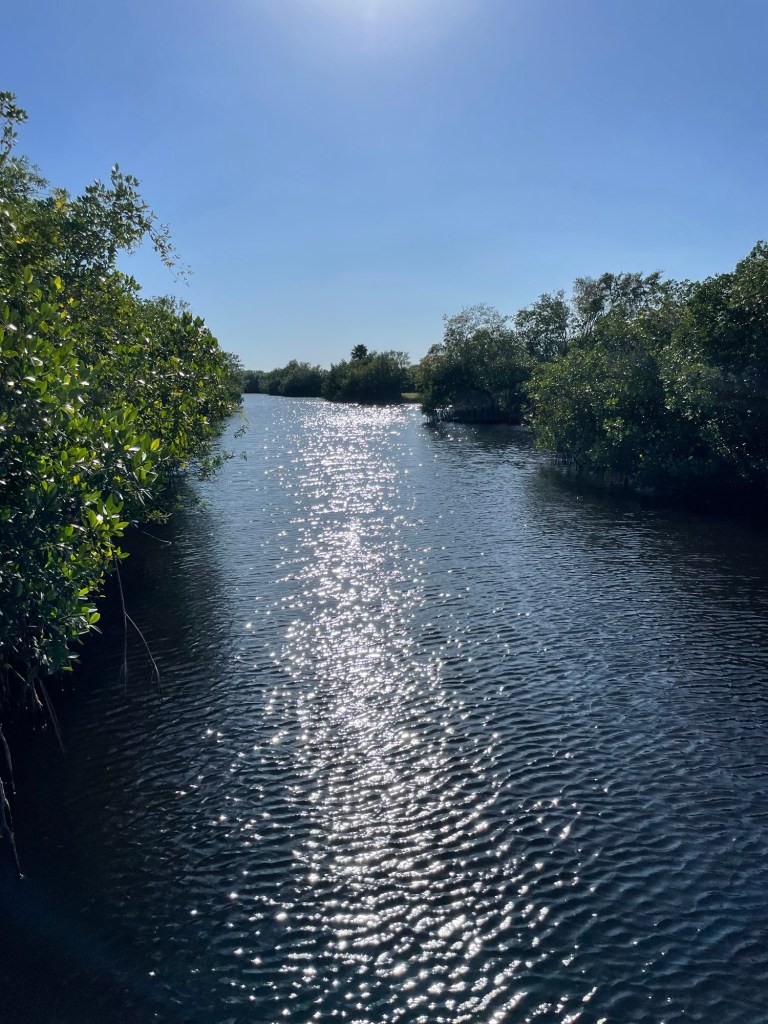
Florida is criss-crossed by channels. No swimming allowed there either.
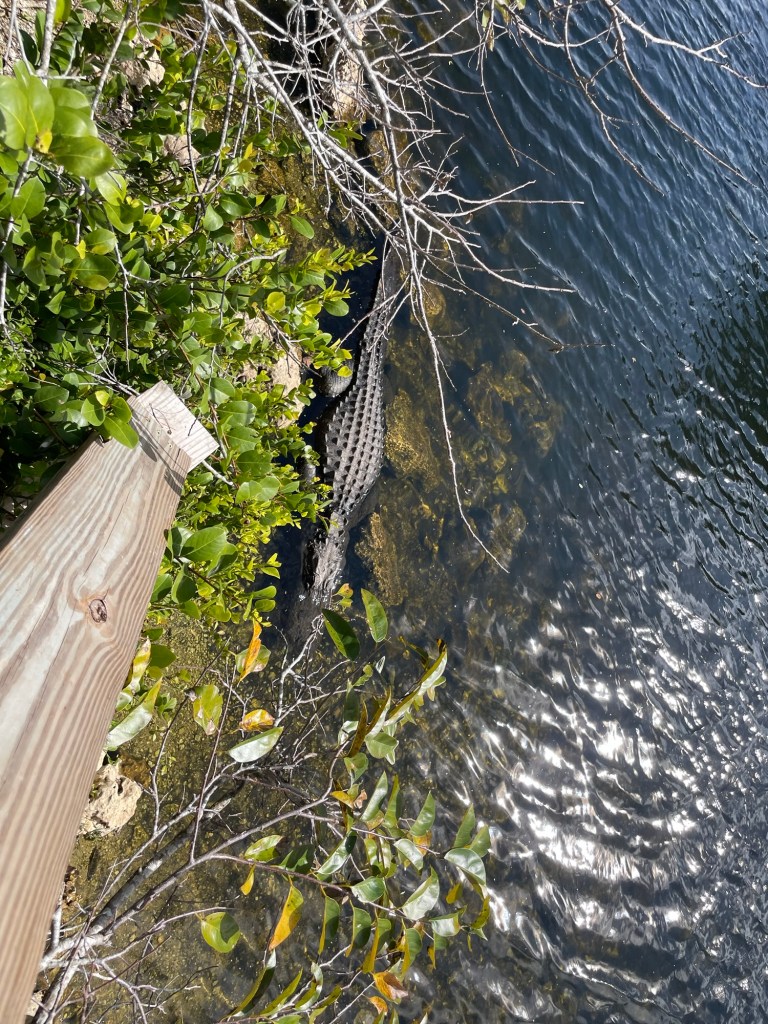
Florida’s state motto (In God We Trust) should actually be No Swimming or wading: Alligators. Those signs are everywhere. If there’s three tablespoons of water, an alligator has probably claimed it. Lakes and ponds, check. Canals and rivers, check. Swimming pools, check. Muddy banks along trails, check. One estimate we heard at Everglades National Park, was that there are at least a million alligators in the Everglades alone.
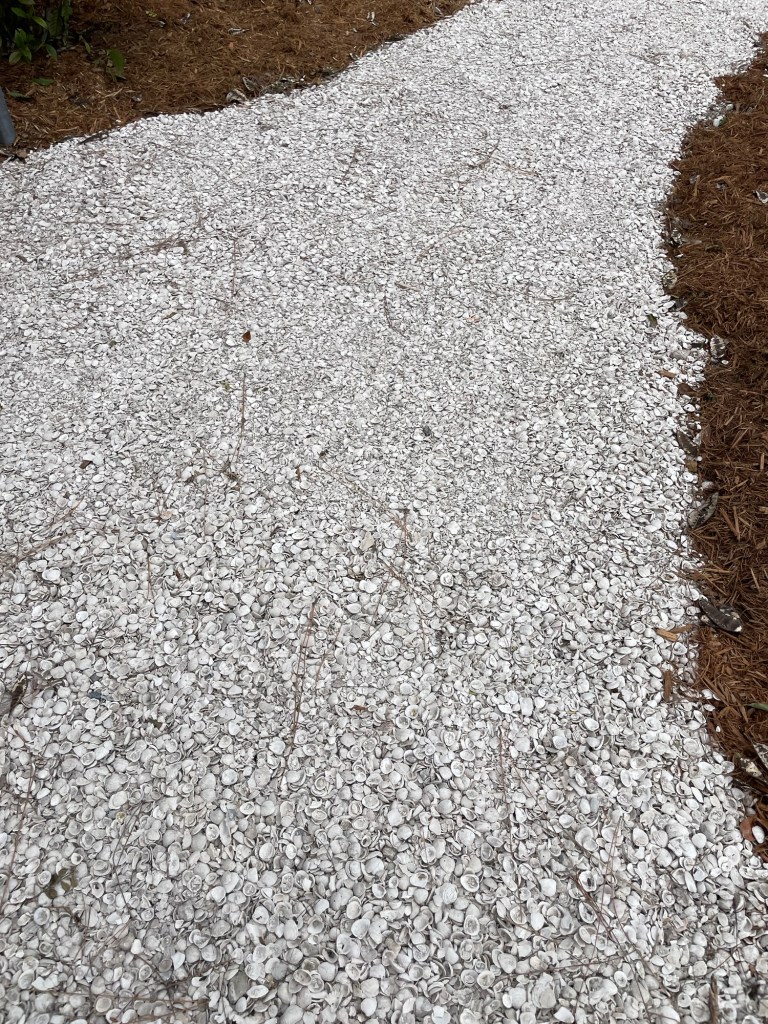
noun: co·qui·na | \ kō-ˈkē-nə \ Definition 1: a soft whiteish limestone formed of broken shells and corals cemented together and used for building 2: a small wedge-shaped clam (Donaxvariabilis) used for broth or chowder and occurring in the intertidal zone of sandy Atlantic beaches from Delaware to the Gulf of Mexico
Little white coquina shells have been used for millennia. (It’s a Latin word that means kitchen, btw) We see them all the time in the form of crushed shell paths. You see them everywhere down here, both inland and along the Florida coastline.
Ok, that’s closer.
I recommend going to all the ranger talks you can. Even if they seem basic at first, I always find them to be informative after the fact. During one at the Shark Valley Visitor Center, for instance, the ranger explained that an alligator’s knobby back and tail is due to hundreds of small, square, pointed pieces of bone under its hide and attached to its skeleton, together acting as protective armor. We even got to touch a few of these bone tiles during the talk. An alligator’s belly, by contrast, is smooth and relatively unprotected.
We spent a lot of time walking on boardwalks and appreciated them so much. I don’t think we’d have felt comfortable going into the swamps and hammocks otherwise. There was a lot of talk about how great it is to get out into the swamp on the north-south Florida hiking trail, but I just don’t see us doing that. Maybe if we’d grown up here and had experience doing that with family, school, or scouts and just being more comfortable with the biome overall. Maybe we’re just cowards. How about you? Would you feel comfortable hiking through a Florida wetland — alligators, snakes, and all?
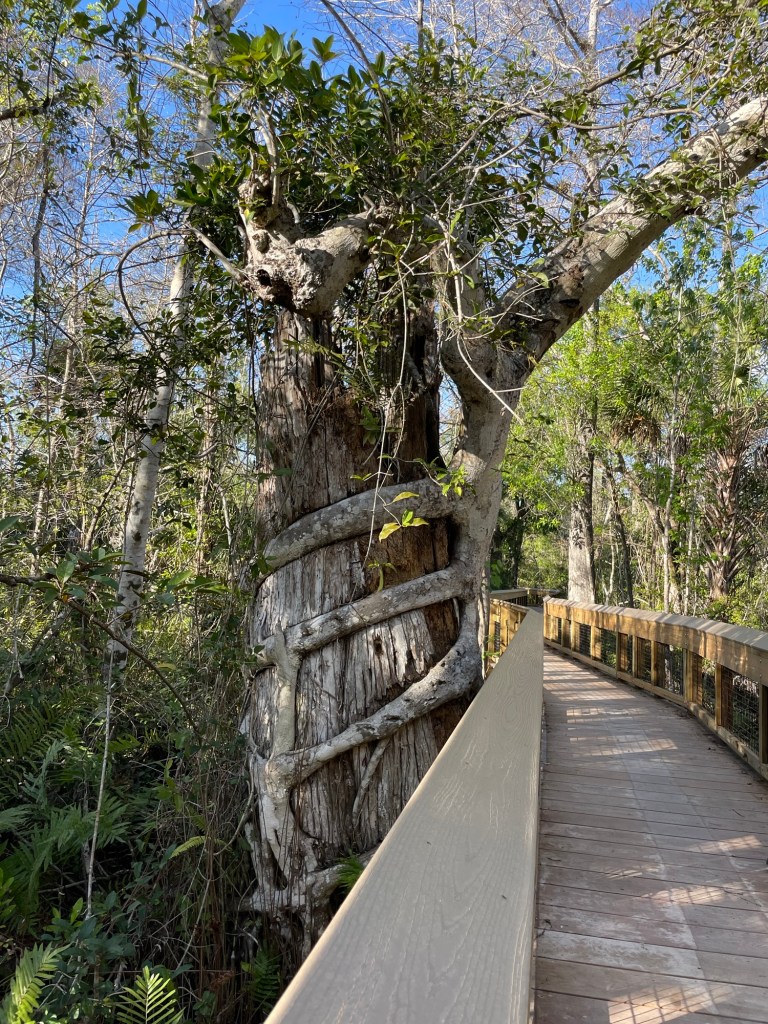
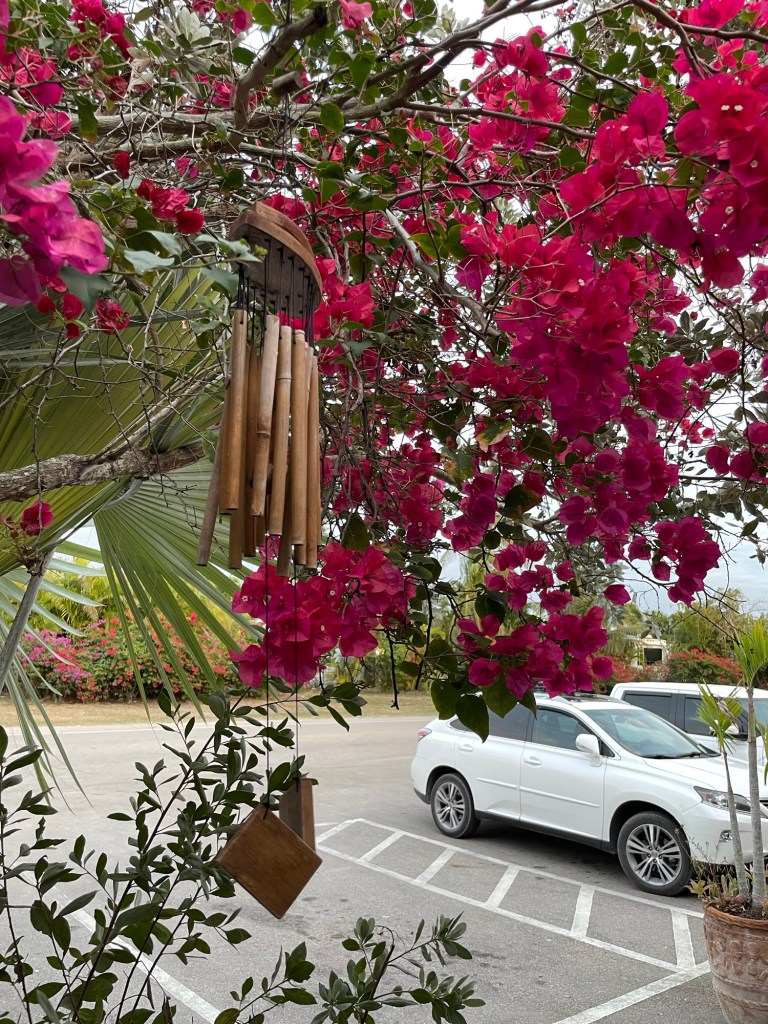
The Florida Strangler Fig (Ficus aurea) lives in a tree’s canopy as an epiphyte (nondestructive, symbiotic relationship with a living host) until its dangling roots reach the ground. Then it lives up to its name, drops its friendly symbiotic ruse, and wraps around and strangles the host tree, eventually becoming a free-standing tree where its host once stood. Rude.Lesser Bougainvillea (Bougainvillea glabra)The Everglades: River of Grass is Marjory Stoneman Douglas’ famous book that rewrote how Florida and the world thinks of The Everglades
The Everglades surprised us at every turn. The landscape is far more varied than we expected. The source is also much farther away and was once much more extensive than we realized. The wildlife is more elusive, too. I don’t know why, but I guess I half expected to be tripping over black bears, storks, and panthers at every turn. The makers of Mutual of Omaha’s Wild Kingdom and I need to talk.
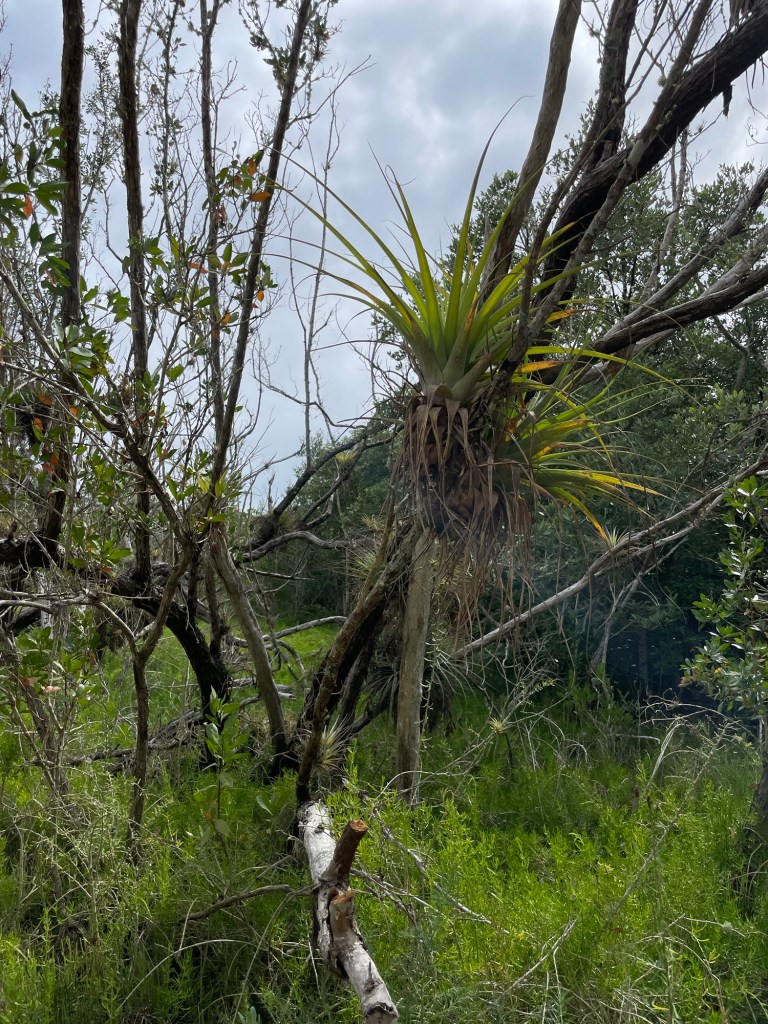
In the mixed pine forests, air plants are the size of your head
Jeff was adding birds to his life list at an unprecedented rate. Big birds, little birds, bright birds, camouflaged birds. He sees them everywhere. I nod and try to see where he’s pointing.
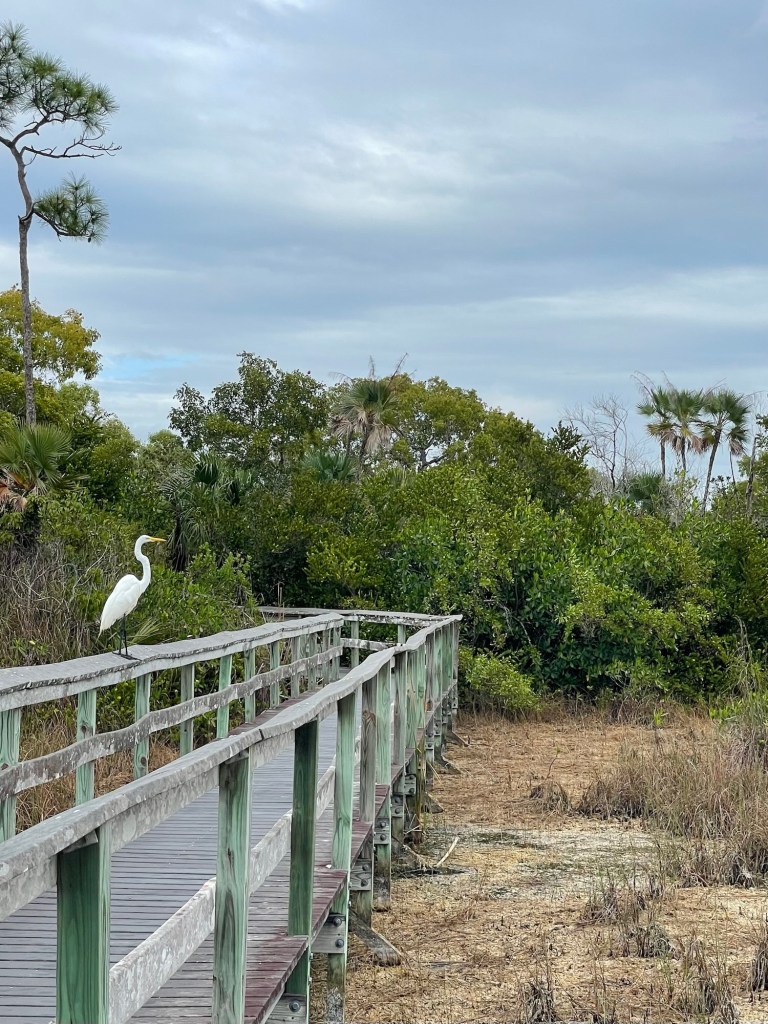
Great Egret – Copeland, FL – Fakahatchee Strand Preserve State Park
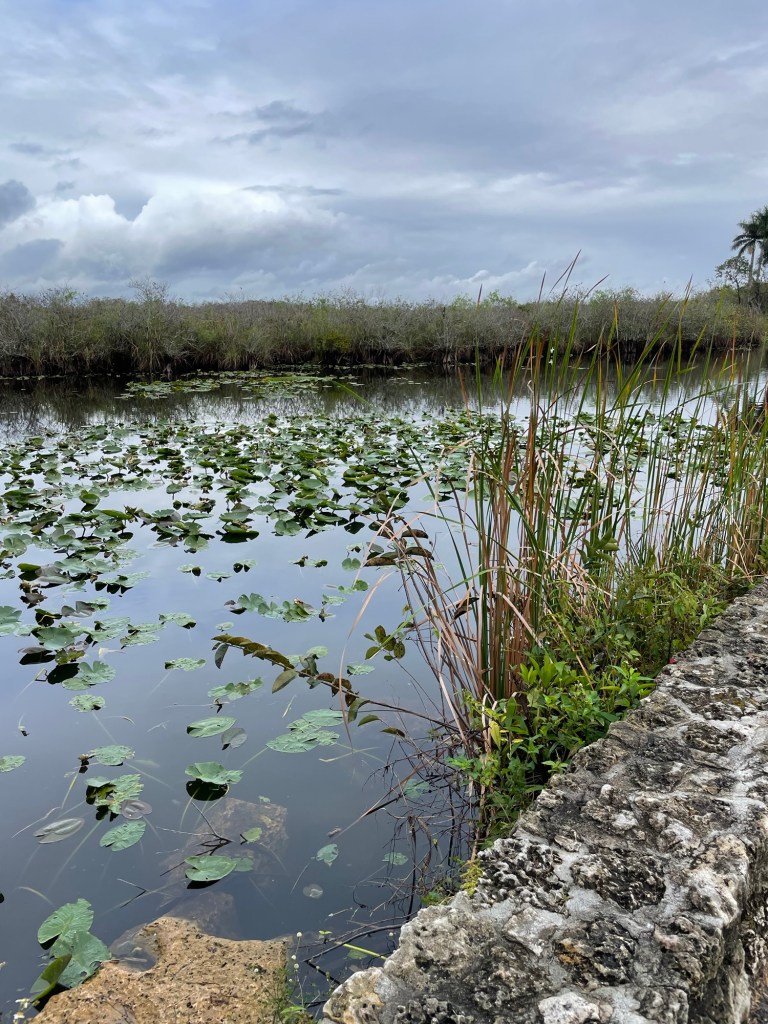
Above, you can see how dry the Everglades and Big Cypress regions are right now. At every visitor center, rangers were mentioning that it’s concerning how low the water levels are and how little rain the state has gotten. We passed a fire out on the plains as we drove in, so we didn’t need much convincing.
When the Tamiami Trail was built (Highway 41, that connects Tampa and Miami), it effectively cut the Everglades region in half. Any water that escaped being channelized east (in order to drain land for agriculture and to fill metro water towers) was now impeded between Lake Okeechobee and the southern tip of Florida’s peninsula, turning the natural wildlife corridors for panther, bear, tortoise, and etc into a deadly game of Frogger.
Although it’s a big pain to drive through right now, I was glad to see that raised bridges are getting built to allow both water and animals to move more naturally again.
Anhinga Trail- Everglades NP
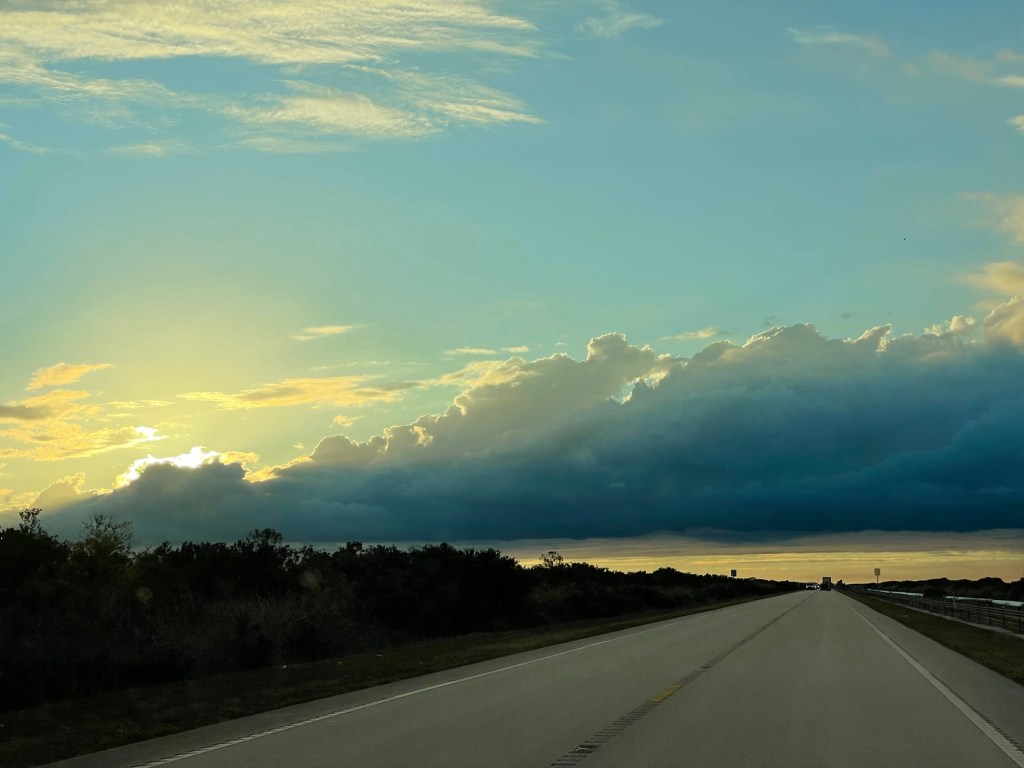
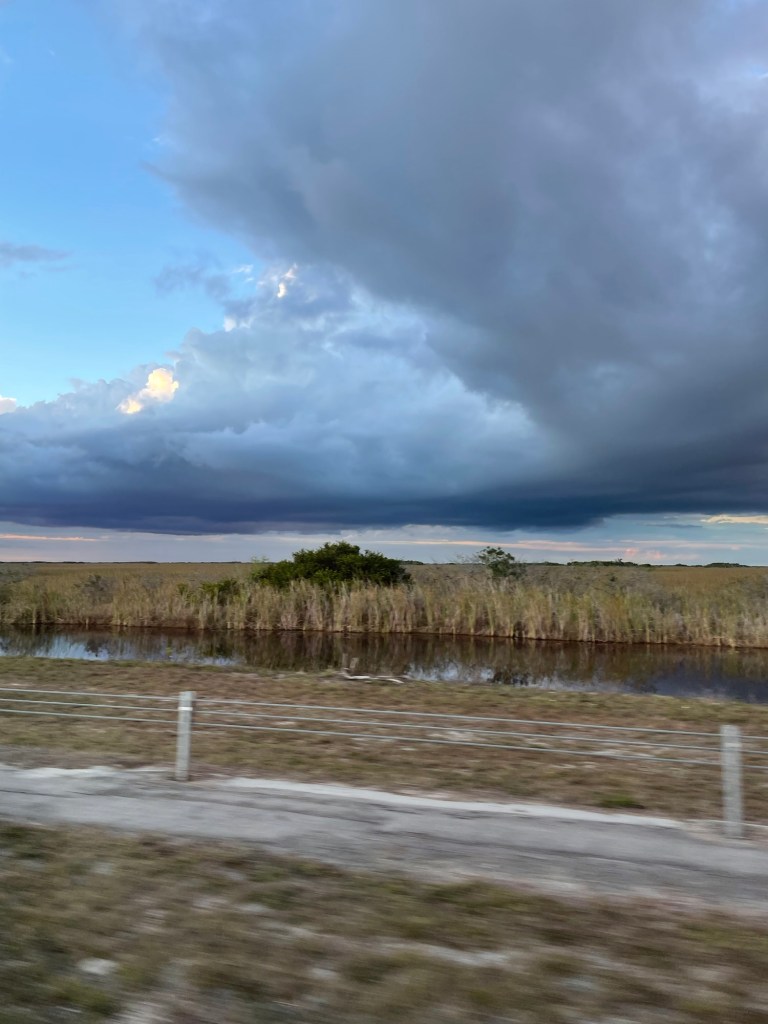
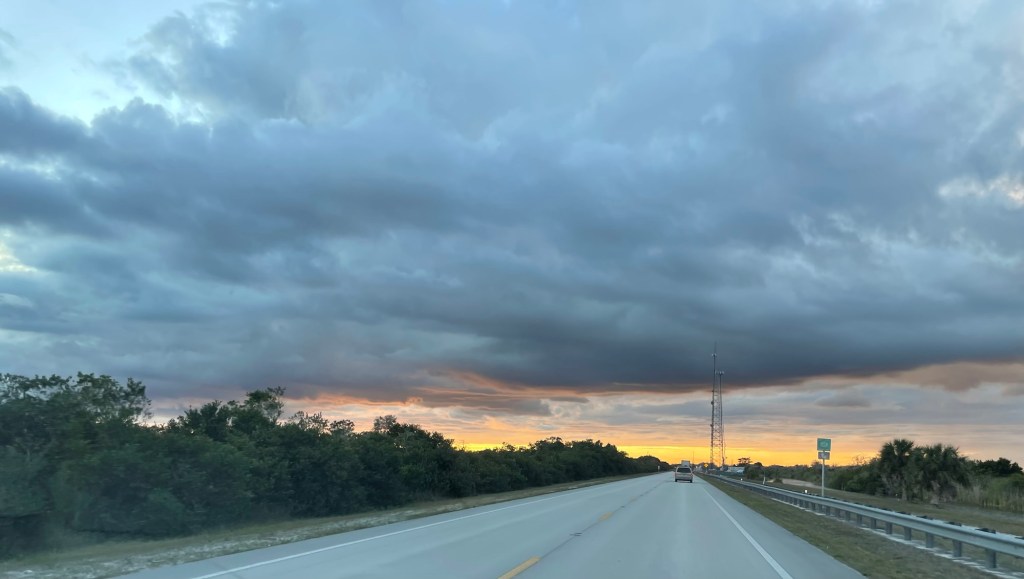
We got caught in a brief but intense rain storm while at the southern Everglades NP section and again while we drove back to the campground. Great clouds make for an excellent sunset.
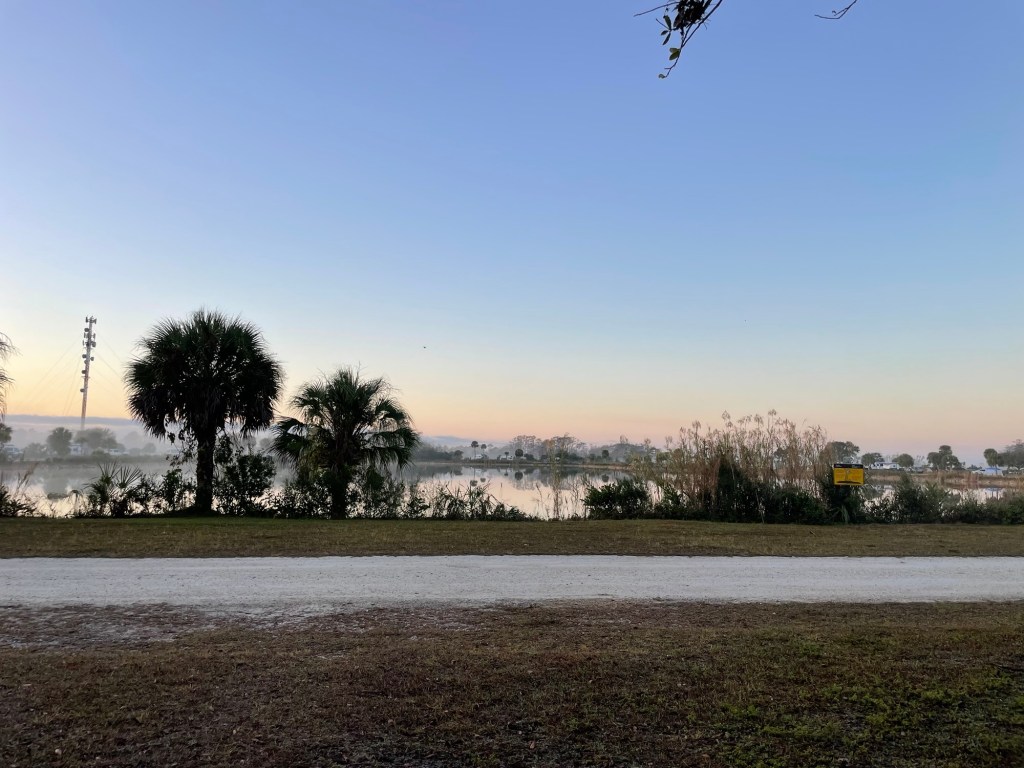
And the next morning, for a foggy sunrise.
Let’s take a momentary conversational left turn.
Campgrounds are interesting places. Unlike the long-term overwintering RV resorts, everyone in a state or national campground is only staying from 1-14 days. Being so fluid creates a unique community where people are instantly friendly and open, and where the old parlor room niceties are upheld — i.e., no politics and no religion talk.
Now yes, some campers do seem hell-bent on making sure everyone around them knows where they stand (bumper stickers, tee shirts, a sign in a window), but they tend to be exceptions more than the rule.
As a form of short-term community, I’m finding campgrounds to be rather pleasant. Strangers consistently wave to each other and stop to talk with people they’ve never met. Everyone feels ok walking to the bathroom at 2am and gets a compliment if breakfast smells good. You talk about each other’s camping setup and the pros and cons of different water filters. They leave their BlackStone mini grill out on a picnic table night after night. You just lean your bikes against a tree. Laundry areas do double duty as free book and gear exchange points.
In a world that seems increasingly determined to be nasty and tribalistic, it’s refreshing.
Forgetting to note the day of the week is a genuine problem these days. Not bothering to check the calendar, we drove 20 minutes to the northern, Shark Valley entrance of Everglades National Park on a Saturday. A Saturday. A beautiful, sunny Saturday. Not our brightest move. The line to get into the park was at least a dozen cars deep and the parking lot was at capacity. It took some time for enough cars to leave, but it was worth the wait.
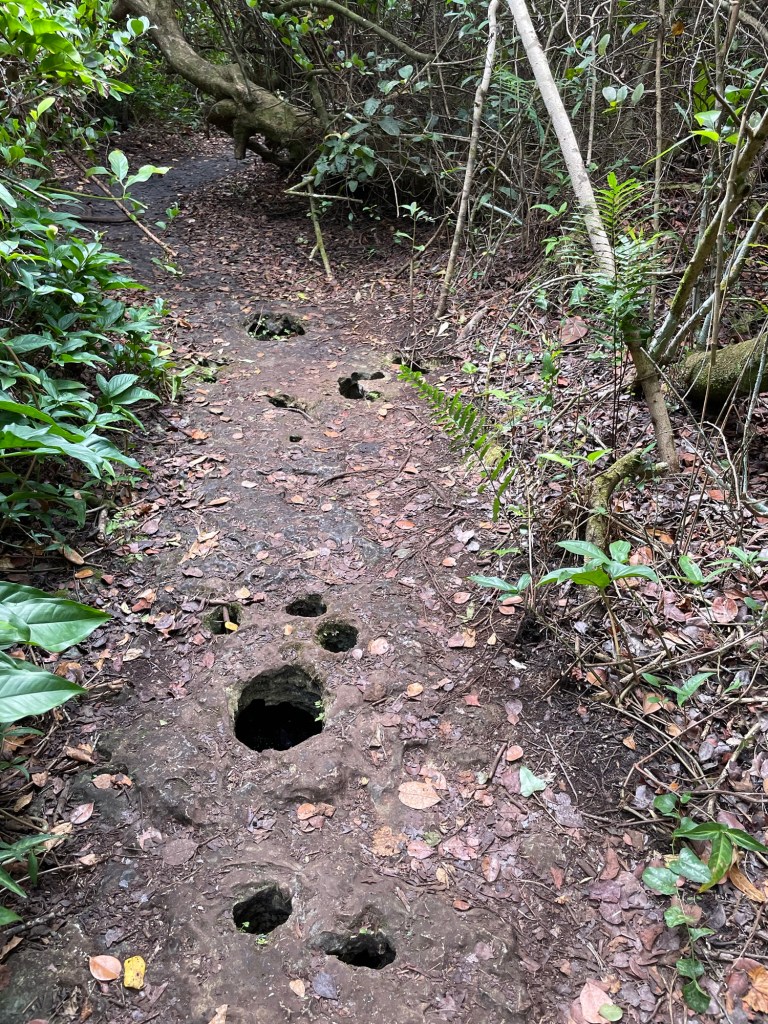
These holes on the walking path are where the limestone has dissolved over time. Not disconcerting at all.
Initially we were bummed to not have our bikes with us as the trail to the observation tower is 15 miles and we didn’t want to spend $70 on the tram tour. With a shrug, we decided to just walk a few miles and head back to the campground. Talk about blessings in disguise, we saw more wildlife in that hour and a half than we ever would have ever seen speeding past on our bikes. We definitely would have missed the turtles and baby alligators (with mom hunkering down nearby).
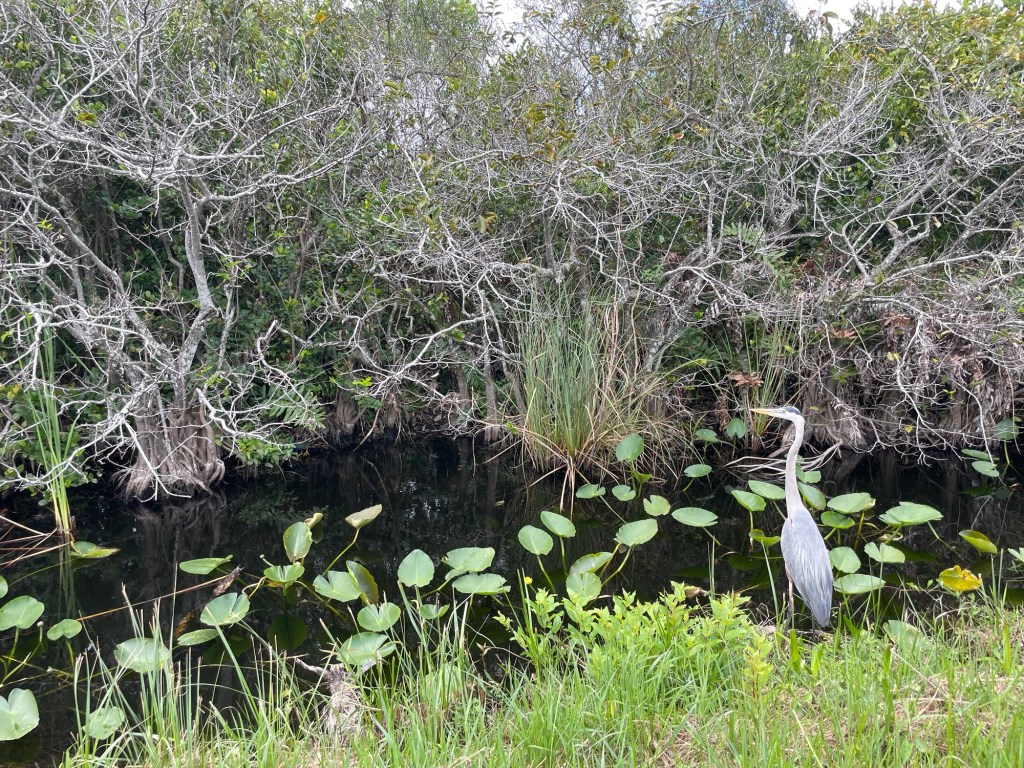
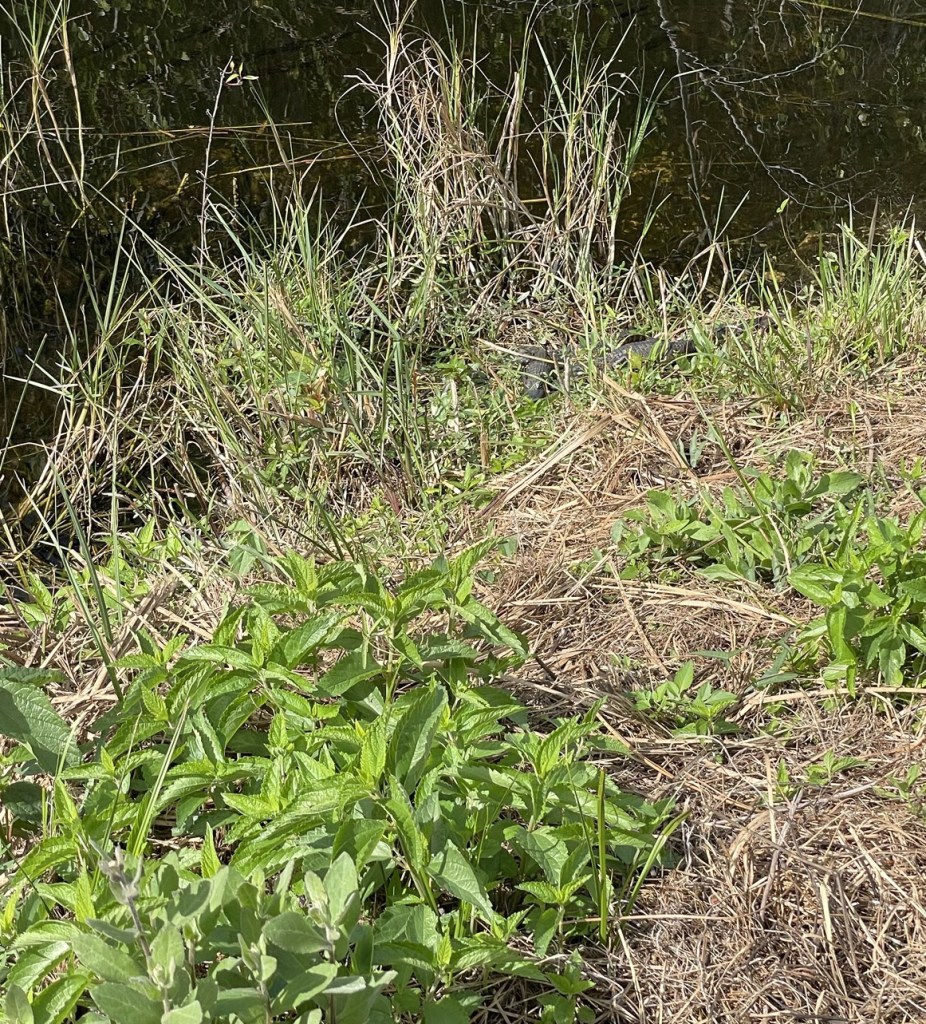
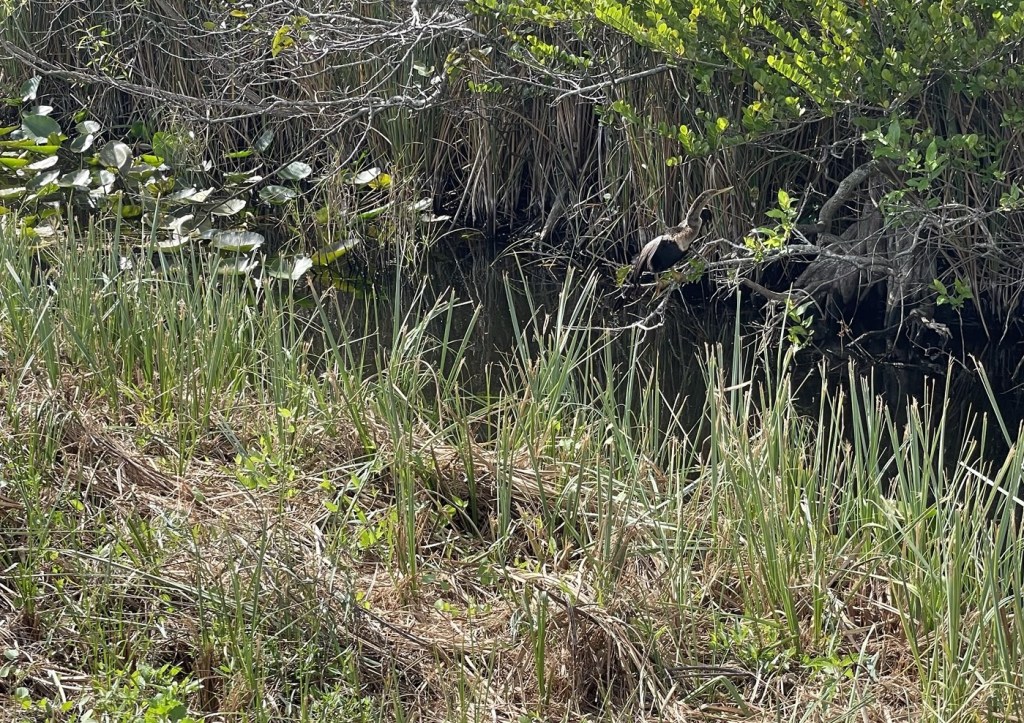
Great Blue HeronPinch in to see the baby gatorsAnhinga drying his feathers offYes, we and hundreds of other visitors walked/rode right past a pair of alligators sunning themselves near the pavement. It’s strange, but you get used to being around them after a while.
Gator goal more than reached! These two gators were a little too up close and personal. Check out the blog’s video page to see a different gator in motion.
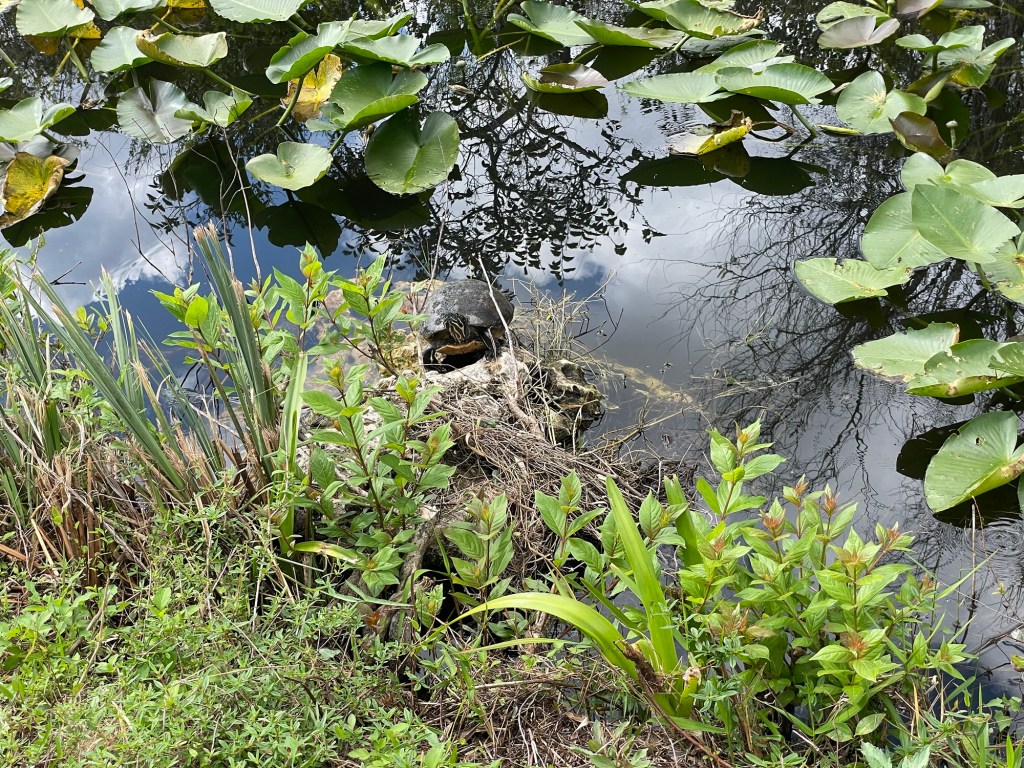
A turtle warming up in a rockWhite cypress trees rooted into the channel
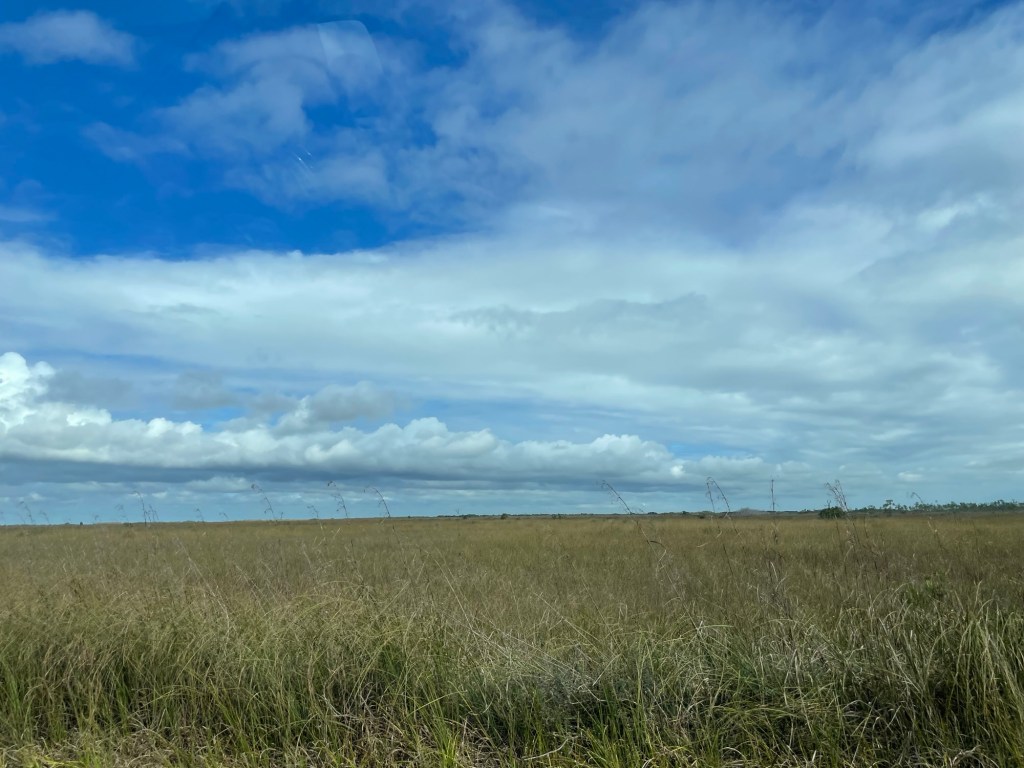
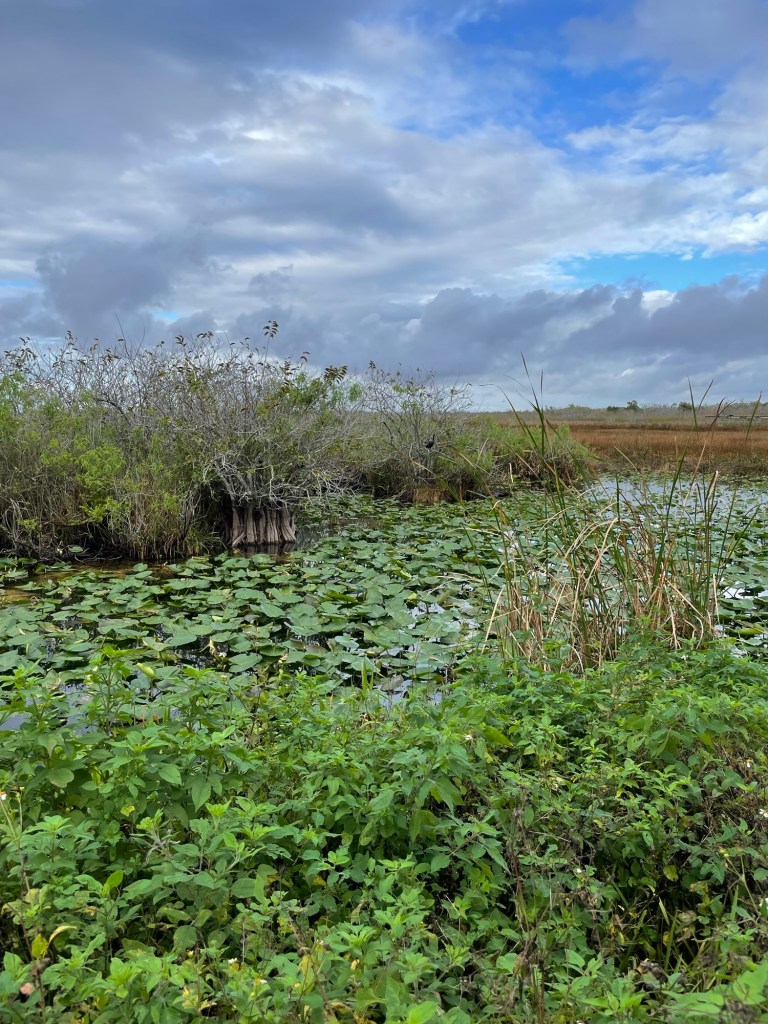
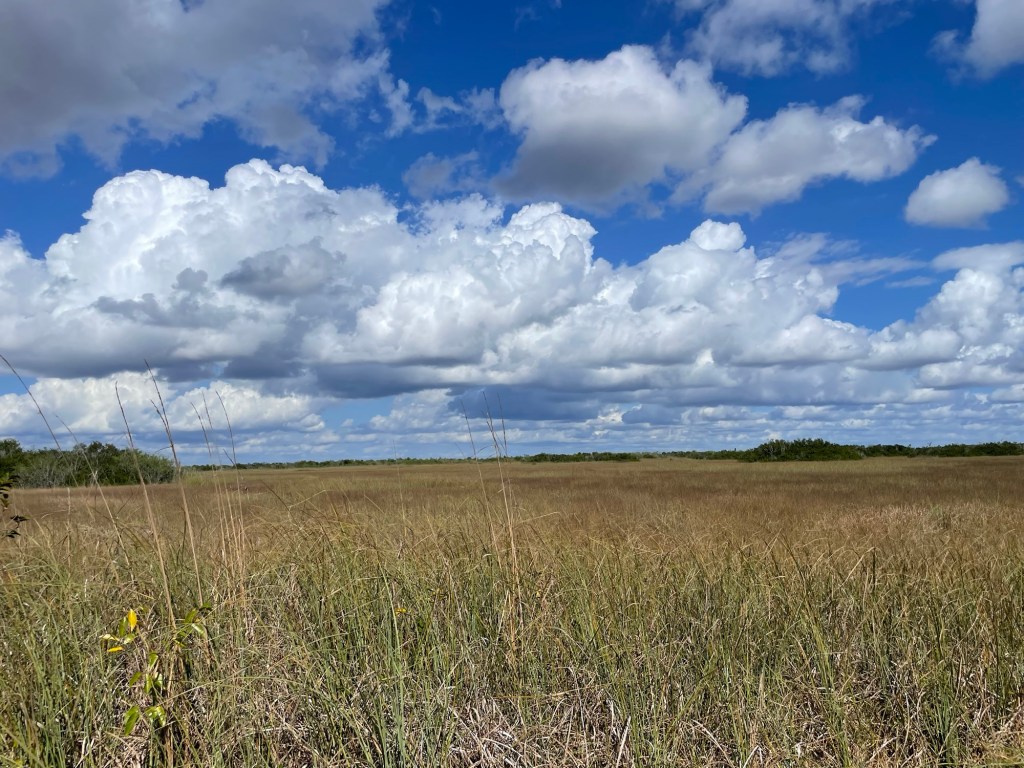
Ultimately that wide river of grass was my favorite part of the larger Everglades landscape. I enjoyed seeing the mahogany hammock, ponds full of lily pads and water birds, and mangrove stands in brackish water, of course, but somehow they didn’t compare to a seemingly endless swath of water grasses bending to the wind beneath low slung clouds.
Back at the campground, we stayed close to the trailer our last full day and rested up. Travel days are always a little stressful, so we try to keep things simple the day before.
Excuse me, what?!?
When we first arrived at Monument Lake Campground, the gentleman in the van next to us said that last year a snake hunter caught a 20ft Burmese python in the wetland behind our campsites. There was much fast blinking. What might look like a boring field behind a few trees is actually part of the Big Cypress wetland/swamp with all its usual critters living within it. You can be sure I spent a fair bit of time peering into those grasses.
After a few days at a rather lackluster north Florida RV park that had weekend availability, our free and easy lack of reservations travel style was beginning to become an issue. Heading down the western coast, we were very lucky to grab two nights at Little Manatee River State Park outside of Bradenton. Considering its proximity to the city, my mom suggested we text my aunt who lives there, and we ended up meeting her for drinks and dinner. (Ex-aunt? What do you call someone that used to be married to your uncle?) Despite not seeing my aunt for 45 years, she invited us to crash at her place for a few days. Hell yeah. In addition to getting to know her better and getting updated on all the bigger family news, taking her up on the offer gave us a chance to see the city in more detail, too.
We asked for a good seafood suggestion. Good plan because she knew a place. It had it all: excellent food, good drinks, and a great view.
She is a such whirlwind! And after living in Bradenton for 50 years, the city as a whole seems to know her. People would randomly call out to her, restaurant owners and waitstaff would stop to chat with her, and all she has to do is dial a guy she knows to get the freshest, straight off the boat fish and shellfish for a song. At almost 70, she’s still working part-time, thin as a rail because, talks a mile a minute, knows her mind, and has a heart of gold. I can see why she and my mom became friends all those decades ago.
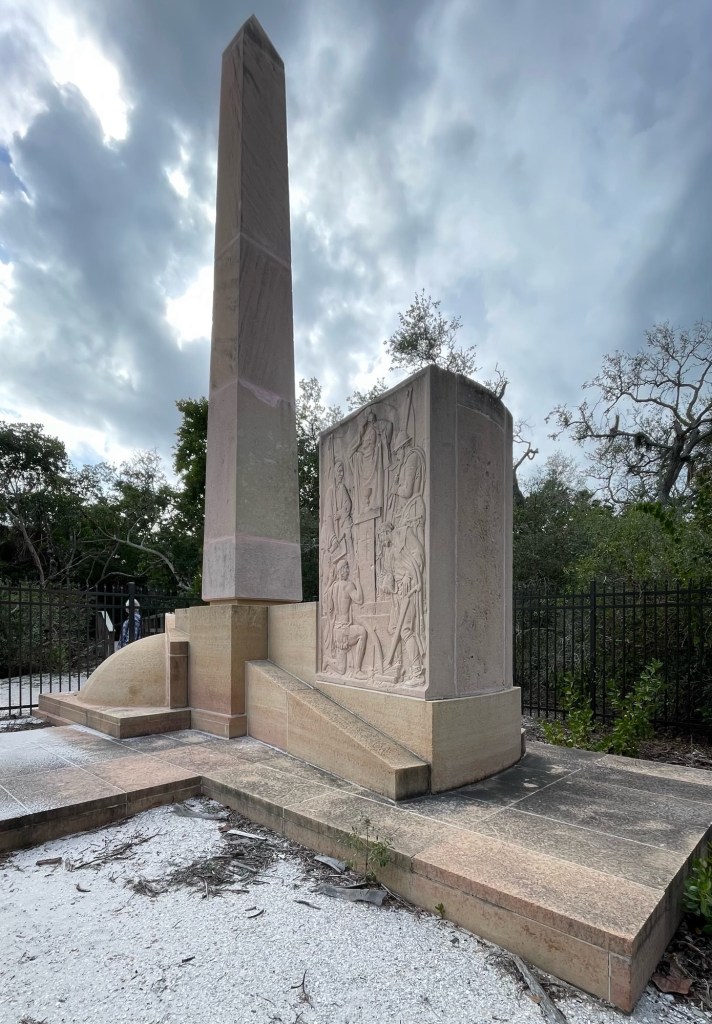
Just a few miles down the road from her house, the De Soto National Monument sits at the mouth of the Manatee River, right where it meets Tampa Bay, commemorating the 1539 landing of De Soto and his soldiers on Florida’s shores. If you’re unfamiliar with Hernando de Soto, he was a right awful piece of humanity. In his quest for gold and glory, De Soto and his 620 soldiers, servants, and priests captured, tortured, killed, and enslaved the native population, confiscated their homes and resources, and basically raped and pillaged their way across the lower half of what would become the United States — all while calling the indigenous population savages. Hypocrite, table for 621 please.
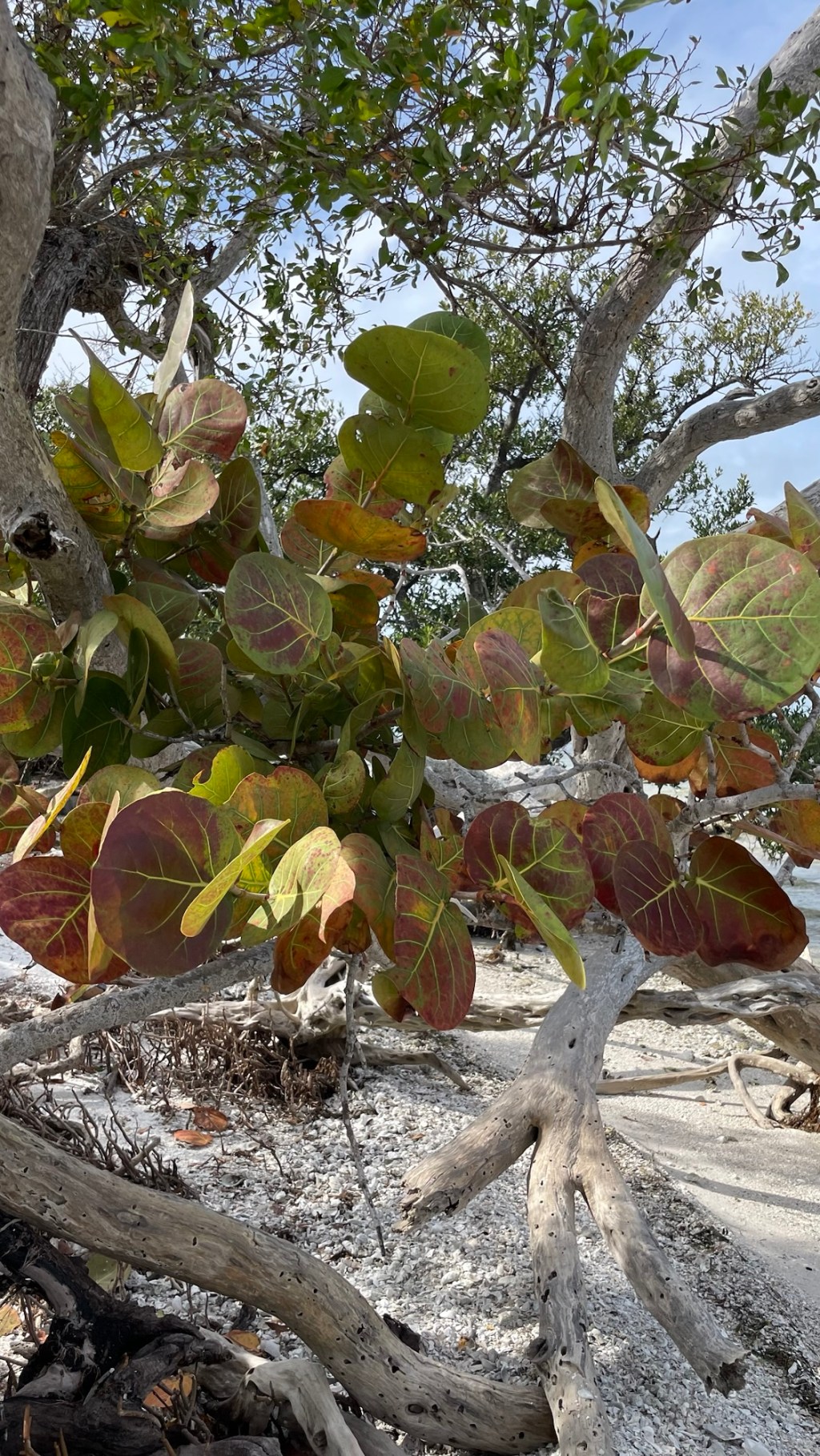
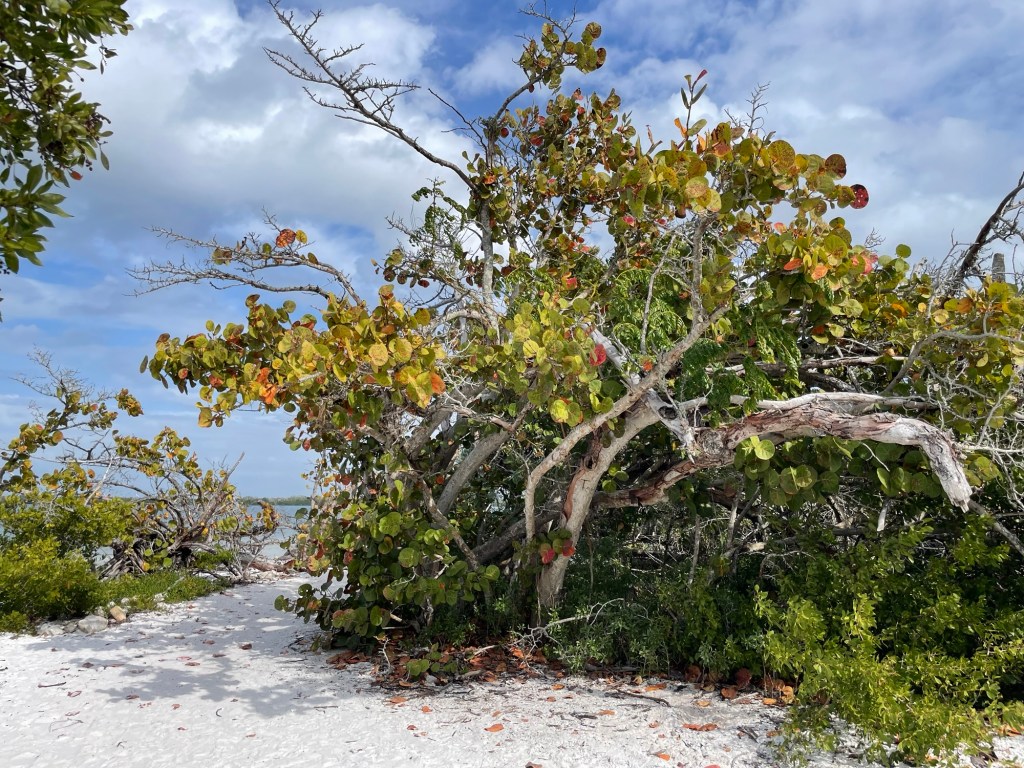
We first saw Sea Grape, my current favorite tree/bush/ornamental planting, on the De Soto coastal trail
The De Soto National Monument’s official visitor center is closed while undergoing hurricane storm damage repairs, but a very friendly NPS volunteer in MSU Spartan gear (Go Green!) was under the reception tent to tell us a bit about the NPS site and walking trail, De Soto’s journey across the country, and how the local native populations sent the exploration party on a 4,000 mile long series of wild goose chases, culminating with De Soto’s death of fever (malaria?) and secret water burial in the Mississippi River. Because De Soto had told the native tribes that he was a god, his men were afraid that if the locals found out De Soto the Fake Deity had died, the locals would ambush them in retaliation. That seems a fair assumption.
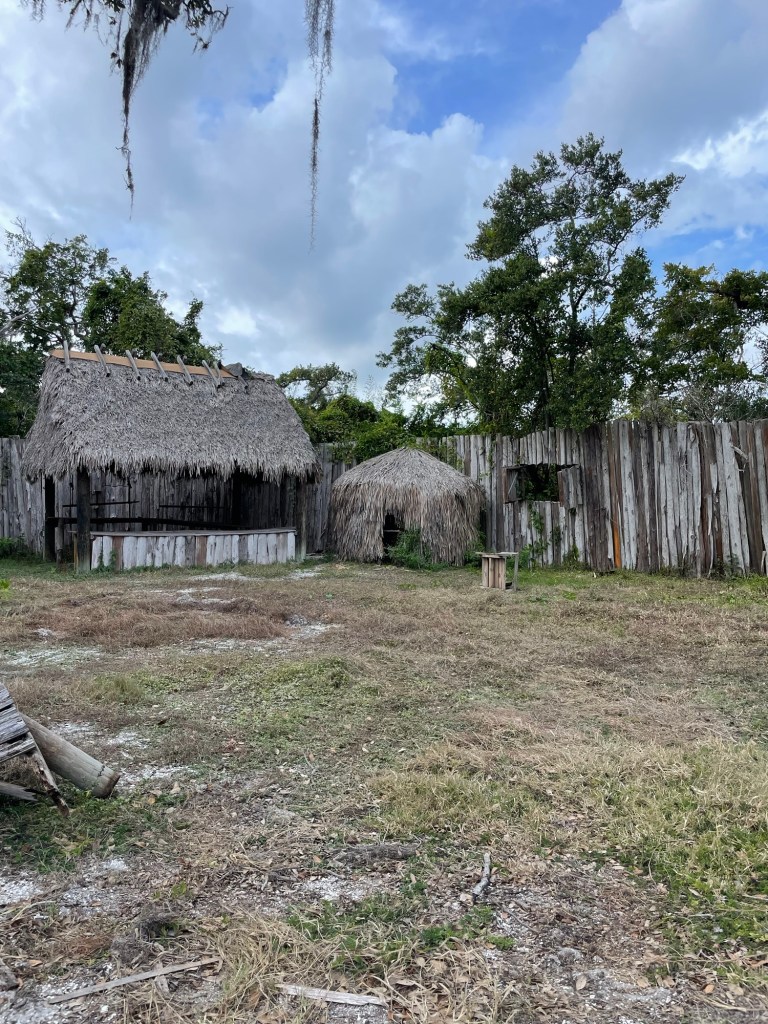
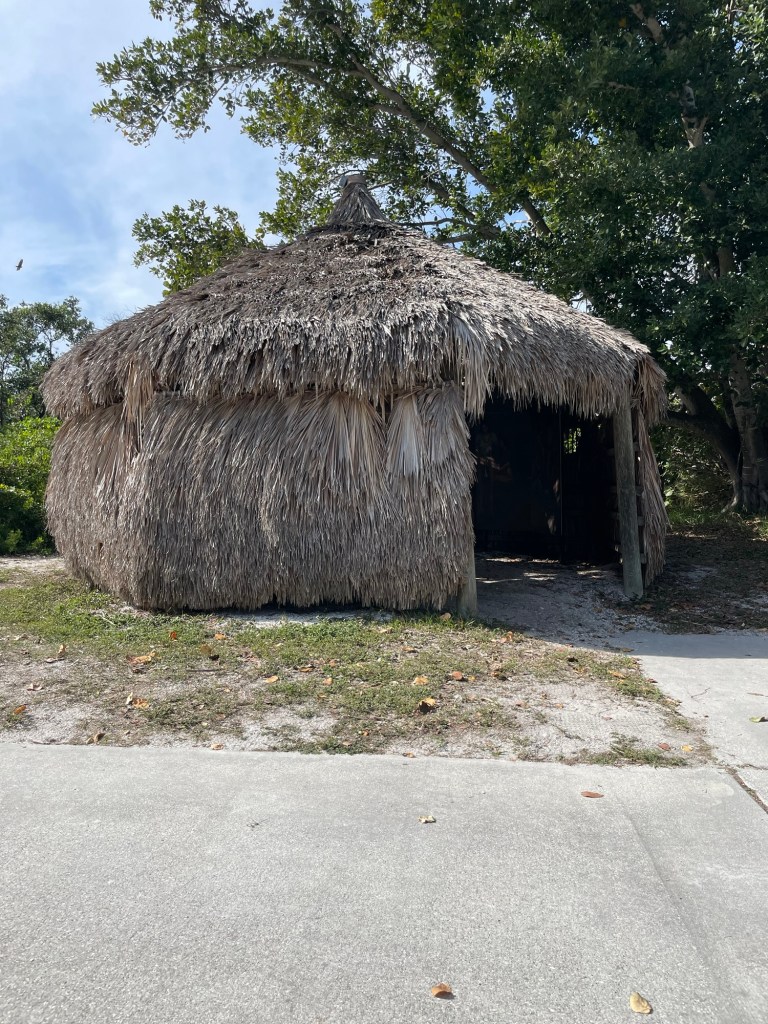
Onsite, there’s a recreated native village, but a few of the buildings were also damaged by hurricanes so those are off limits for the time being. The one below is the only one you can enter these days. I think the indigenous use of spent palm branches and palm leaves is brilliant. They repel water well, are plentiful and renewable, and make a nice rustling sound in the wind. Some local bars and restaurants still use them for outdoor patio roofs.
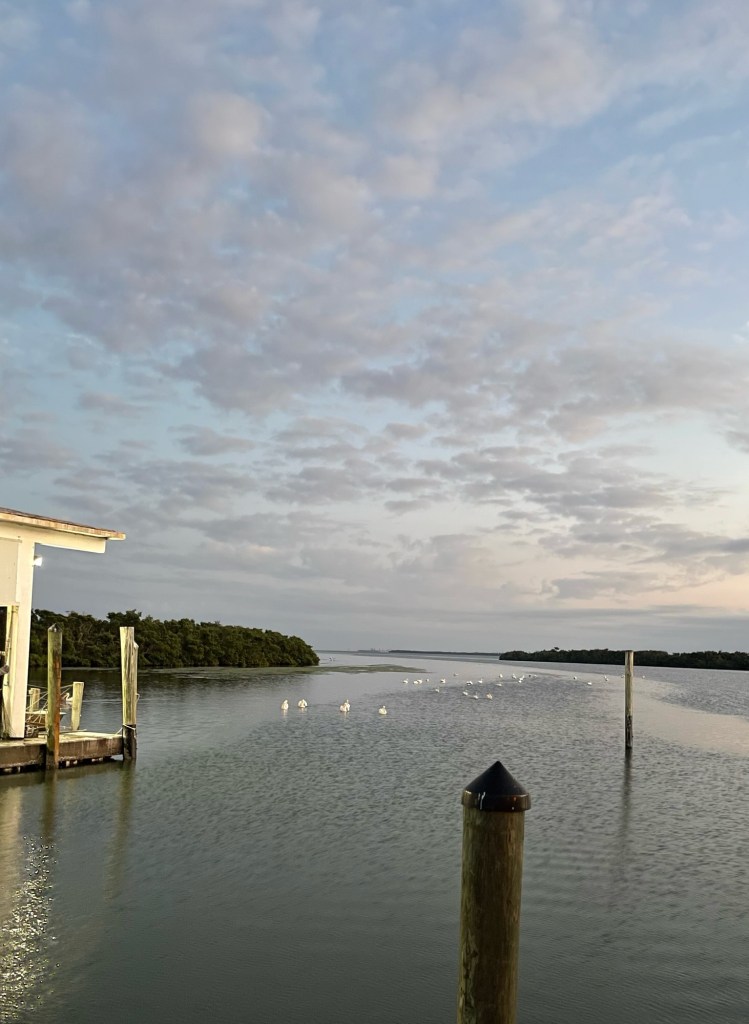
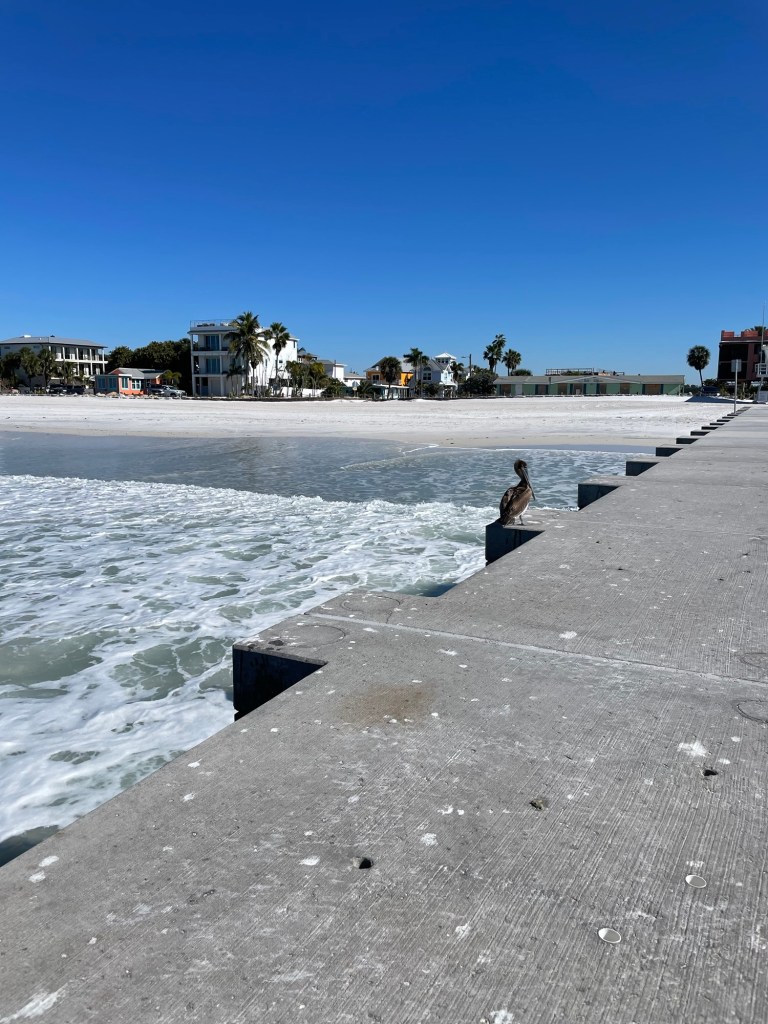
During some of our extra Bradenton time, we drove over to Longboat Key and met a couple feathered locals, had a coffee, and took a walk on the pier where we saw some kids surfing on the crazy waves. The brown pelican below walked right up to us and appeared to be looking for some kind of fish tax to be paid. We run into a lot of tourist taxes on the road, but this bird’s approach was the most brazen.
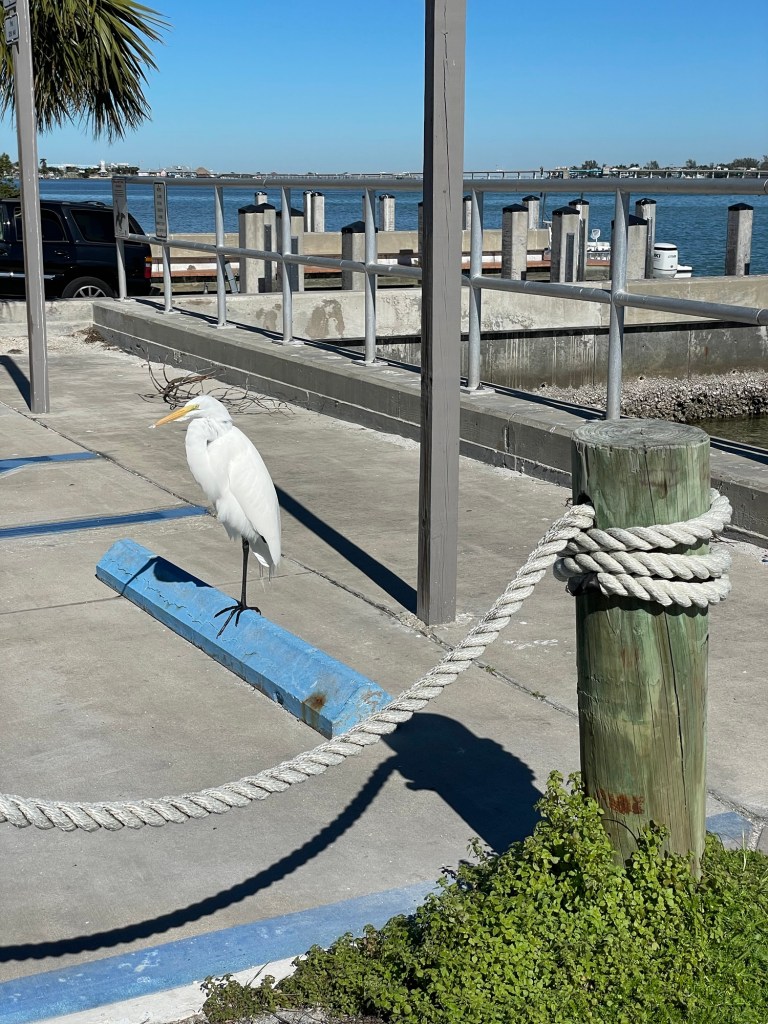
Great egret resting on one leg
Let’s talk Pizza Money.
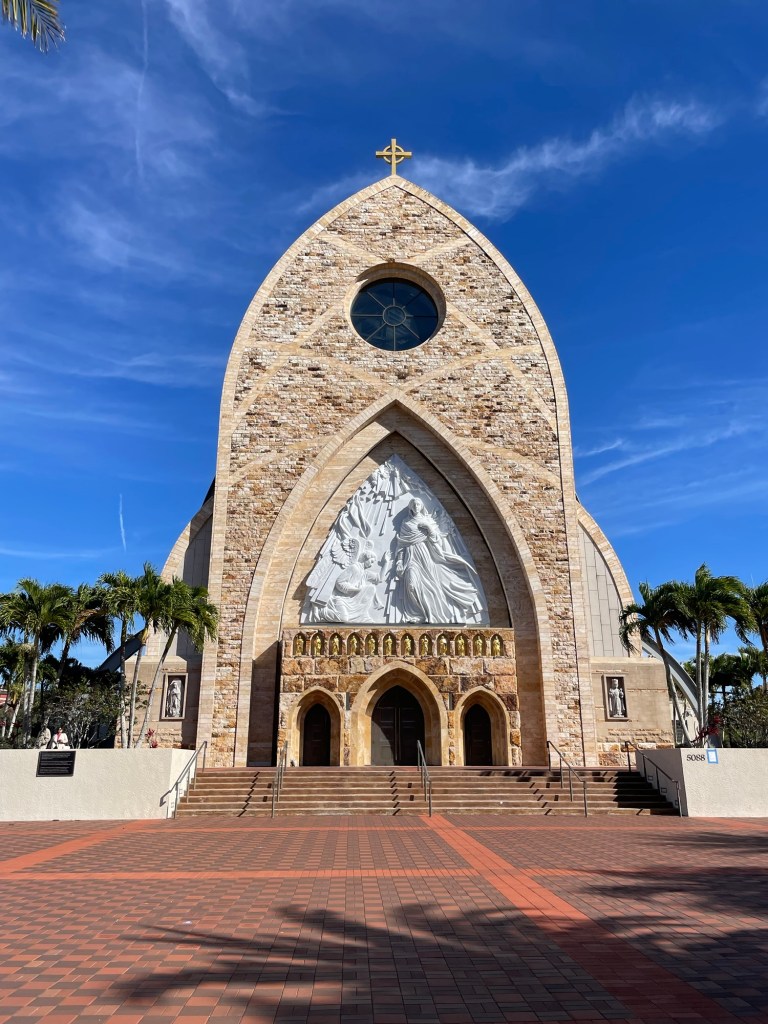
Apparently Tom Monaghan, the founder of Domino’s Pizza is Catholic. Big Catholic. Now what does one do when one is Big Catholic and up to one’s neck in dough? You go to Florida, and lead the charge in having an entire town, a modern cathedral, and a private college built from the ground up and call it Ave Maria.
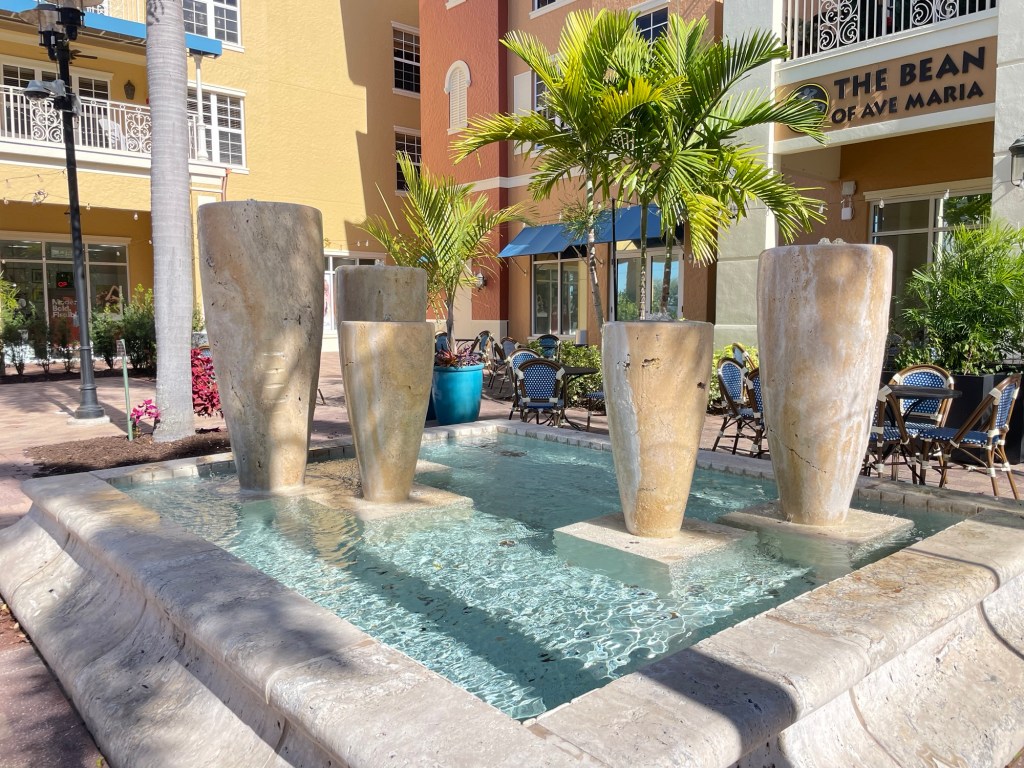
The designers did a good job. The town has a quaint, unified, sun-drenched look about it. Everything is neat, clean, and color-coordinated. Golf carts as secondary transport vehicles abound. There isn’t a lot of variety in the village, but there’s everything you need: a few good restaurants, some shops to browse, an ice cream parlor, a coffee shop, a smaller Publix grocery store, a massive church should you need one, and etc. No Domino’s pizza though! Not high-end enough? Maybe the smell didn’t fit the design scheme? Hard to tell.
Sun drenched Ave Maria
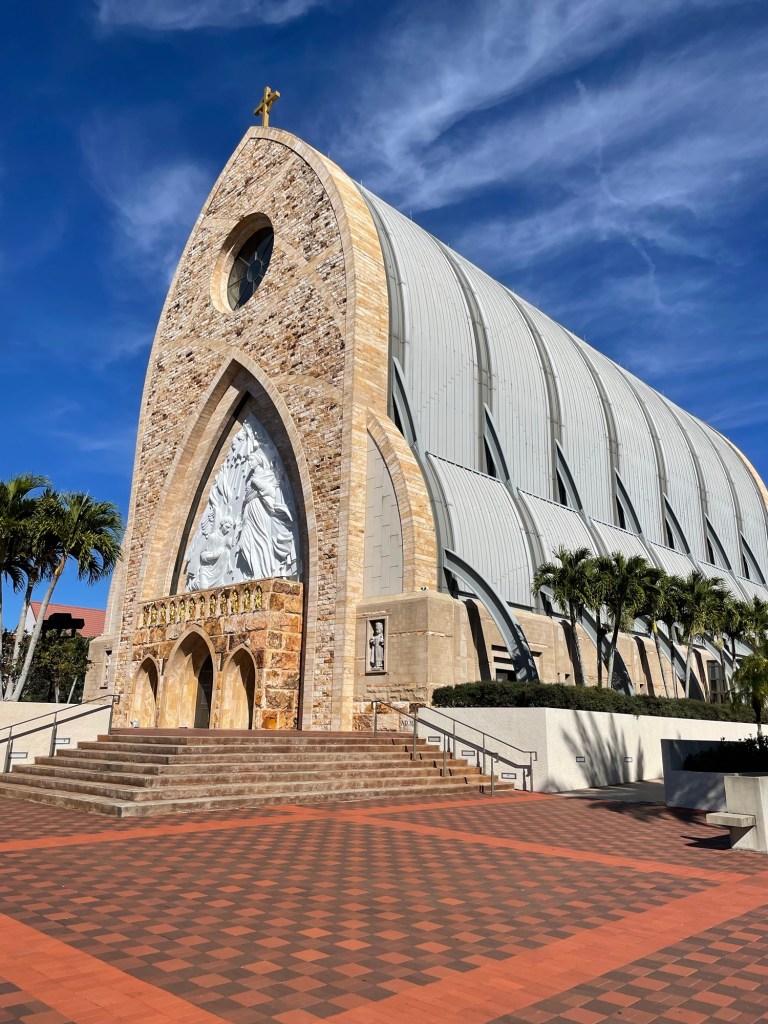
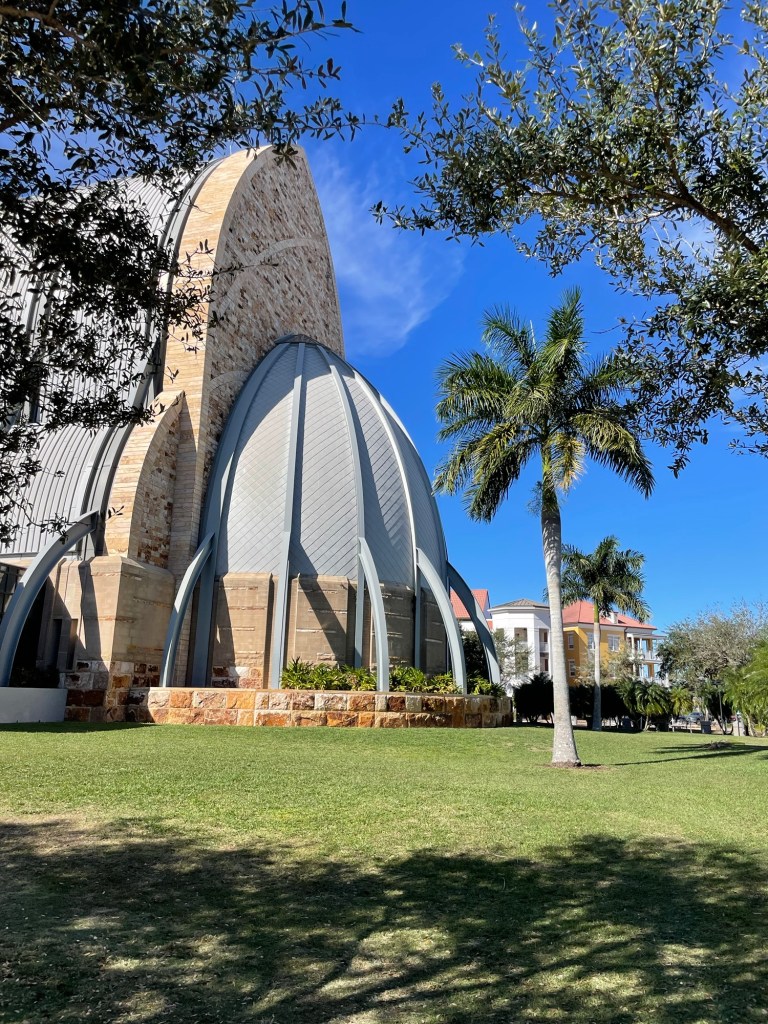
The Cathedral is the literal center of the Ave Maria village and its modern lines really make it stand out. The back is my favorite as it resembles a rocket ship ready to blast off. Inside it’s all elegant steel girders and muted tones. The exterior masonry highlights the front’s sculptural piece. The university is across the street.
We learned about Ave Maria because Jeff’s sister and partner are renting a place there for to avoid the snow, so we got to stay overnight with them and live a normal life for a couple hours. Jeff went golfing. I pushed a button for coffee. It was fifteen steps to a bathroom with a washer/dryer combo. There was a huge TV for watching movies. (Watch the 2007 version of Death at a Funeral, by the way. It’s fantastic.) We had such a lovely time seeing them.
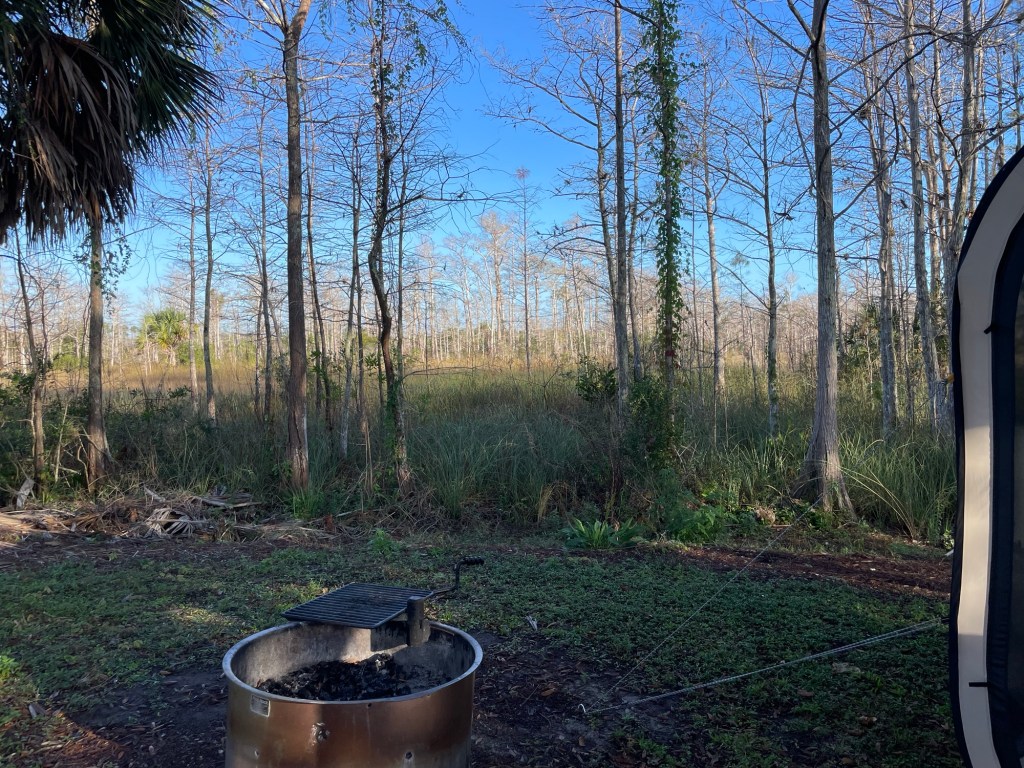
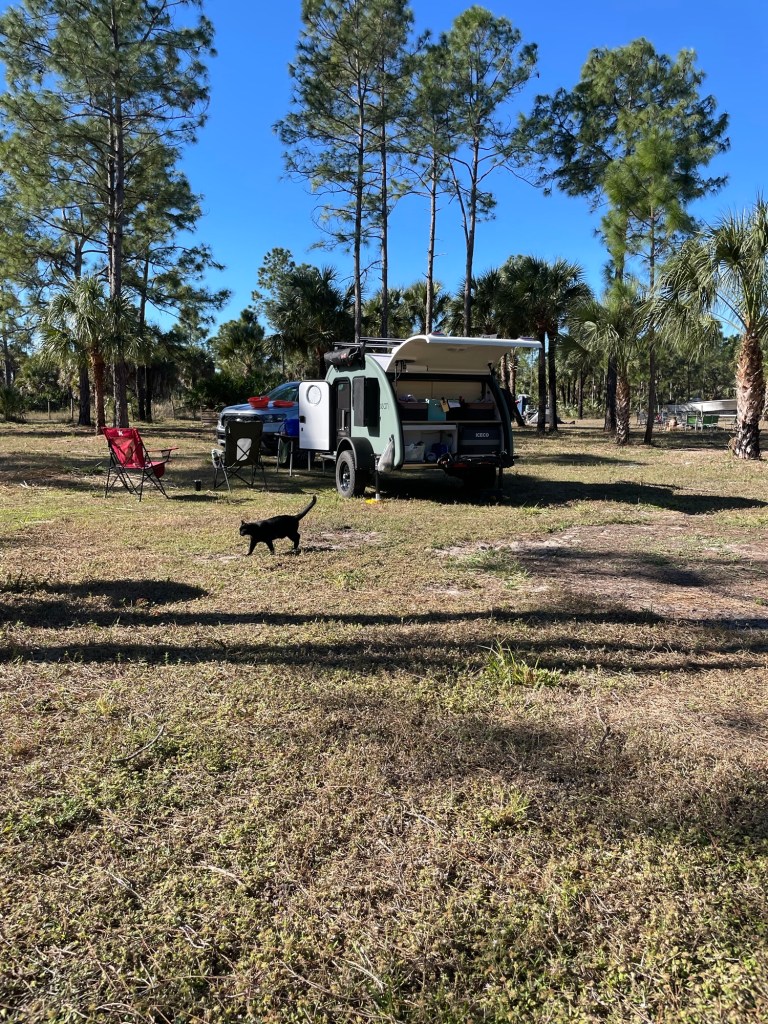
We joked upon arriving at the security-guard in a booth gates of Ave Maria that we were getting to experience two very different sides of life during our Naples-area stay. The campgrounds for miles around had zero availability for the long holiday weekend. So we dug a bit deeper and found something off-grid. It was very very rustic and on private land in a wildlife preserve (including Florida panthers!): no water, no electricity, not a single frill. Nothing but a porta-potty, a chain link fence, and a massive fire pit in a big o’ field. “Park anywhere in the back half.”
Not Ave Maria
Driving the last two miles there, we went from your average two lane road, to a narrow unstriped road, to a dirt road, to a barely wide enough for one vehicle sandy two-track. We knew we were there when we saw a (broken down) boat and (ratty) American flag at the entrance. Those were the indicators in our emailed directions: boat and flag. We were alone the first night and not gonna lie it was kinda creepy, but after we got back from Ave Maria we saw that a motorcycle tent-camper had arrived while we were gone. He seemed to really dig the place. To each his own. While it wouldn’t have been our first choice, it was a welcome port in a No Vacancy storm when we needed one. The owners were incredibly friendly, laid back, and have big plans for the space. I wish them well.
It was a good reminder that not everything needs to be what you’re hoping for. Sometimes it just needs to be good enough for now.
Salem the world’s softest cat enjoyed checking out the trailer from all angles and probably would have happily become an adventure cat if we’d let him. I really wanted to let him.
Florida is living up to its tourist posters: bright, warm, and beautiful. And as I watch the northeast and Midwest descend into ice, snow, and wind chill chaos, Florida’s reputation as a winter refuge is solidified. Now that we’re near the southern end, it’s become hot and humid. The mosquitoes were apparently late coming back from the holidays, but some rain yesterday has them punching the clock again. We bought an anti-bug house to hide out in just in time!
To be honest, we haven’t done a lot so far this month, and that’s been lovely. Until two days ago, we hadn’t even done a lot of driving in Florida. Drive to get where we needed to be, sure, but not much beyond that.
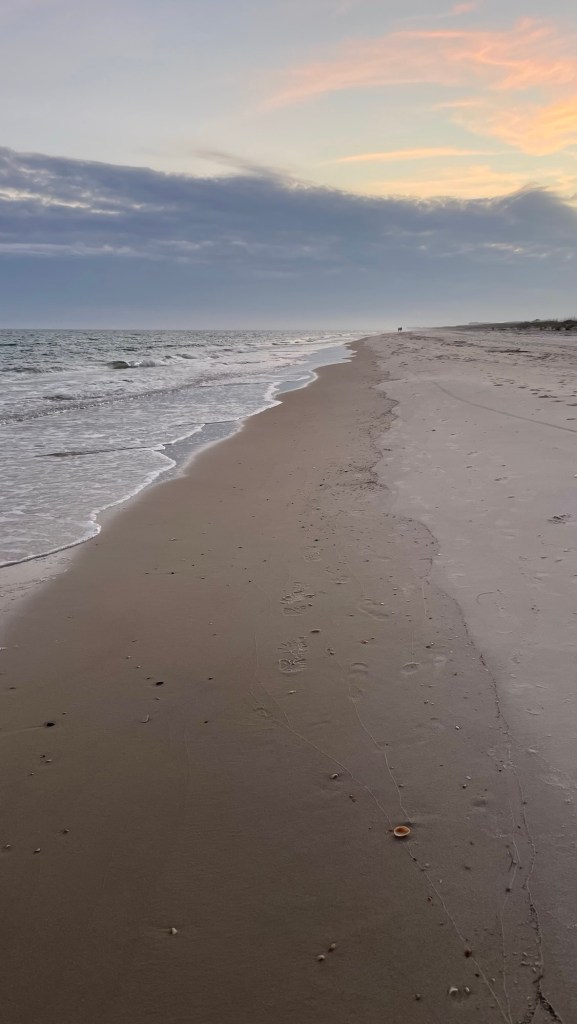
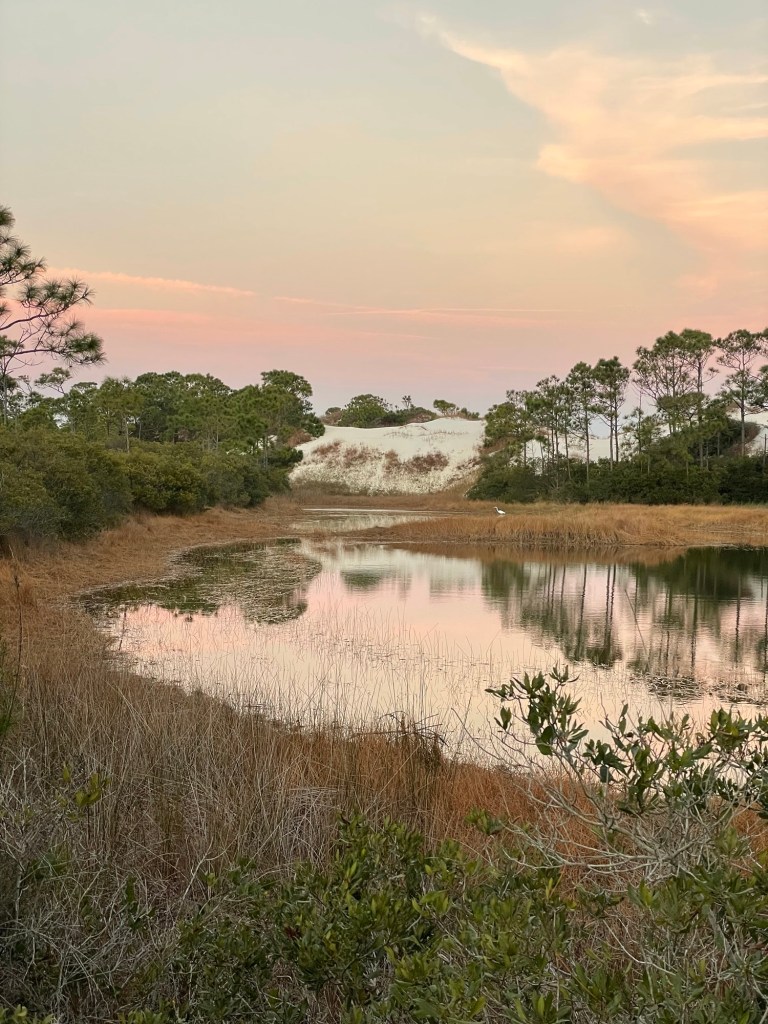
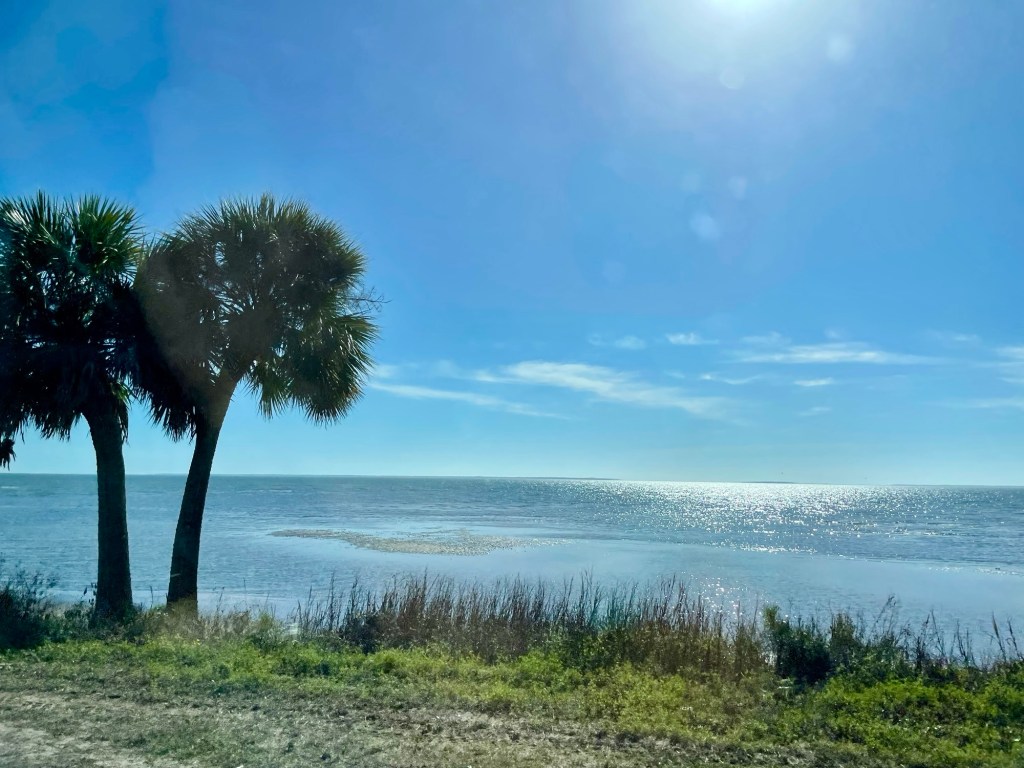
St. George Island, a barrier island along the Panhandle’s gulf coast, was the perfect first stop after so much time in Georgia. Crossing the long bridge to the island felt like the rest of the world had suddenly disappeared. Highly recommended.
We rode our bikes down the single state park road, spun our wheels when a cycling trail turned to sugar sand, and walked several miles through the wetland interpretive area.
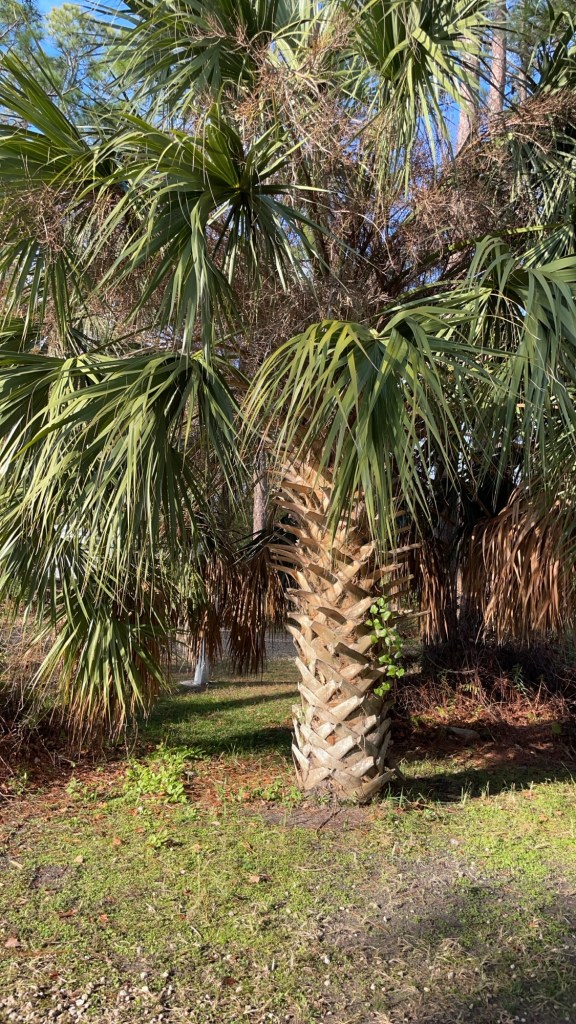
I started to appreciate the different palms
We kept our eyes peeled for alligators (no luck). I pulled my FujiFilm camera out and started to get a feel for its dials and settings again. On a deeply foggy morning when the propane grill didn’t want to light (our own fault), we had a delicious breakfast at The Beach Pit.
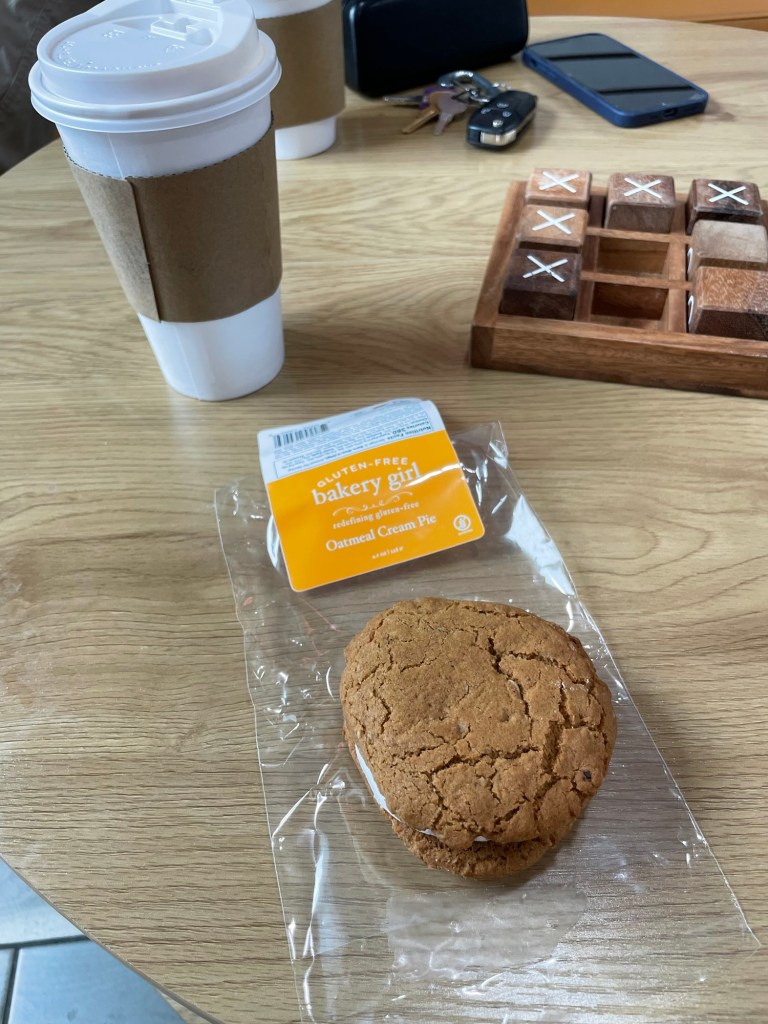
Afterward, we had a cozy cup of coffee at Island Espresso while we waited for the dense fog to lift. While ordering I saw that they carry a brand of gluten free snacks, Gluten Free Bakery Girl, that is easily the best I’ve ever eaten. I tried an Oatmeal Cream Pie as it’s also also dairy-free and I legit cried out with joy biting into it. It tasted just like the ones I remember from growing up. It’s a small thing, but it had a big impact.
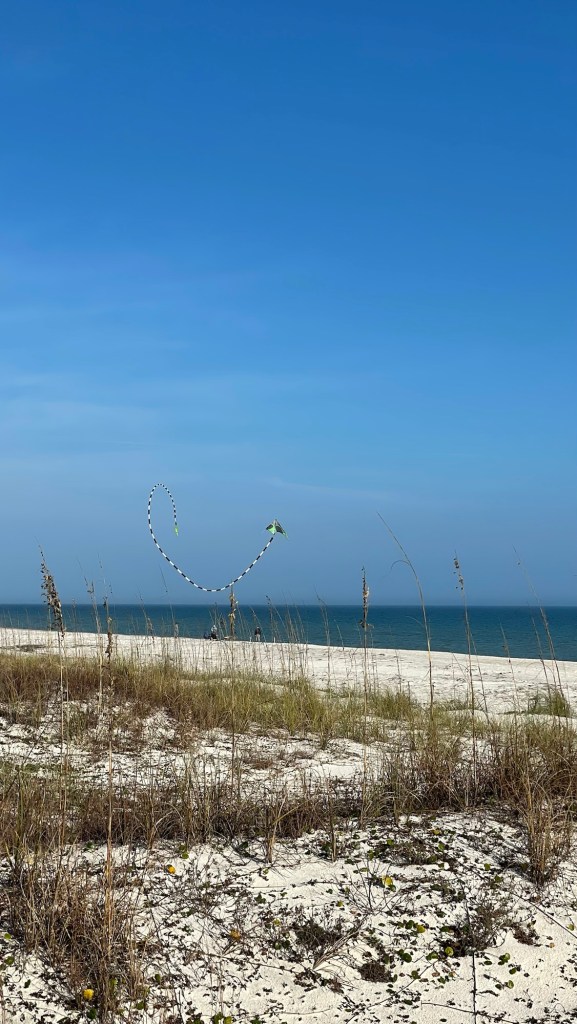
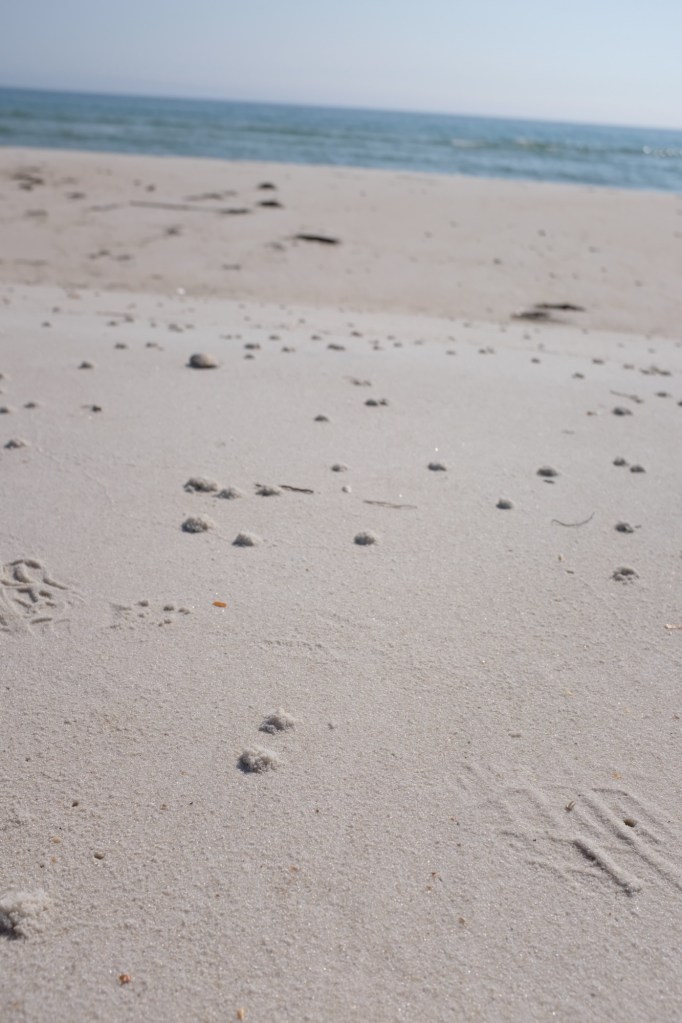
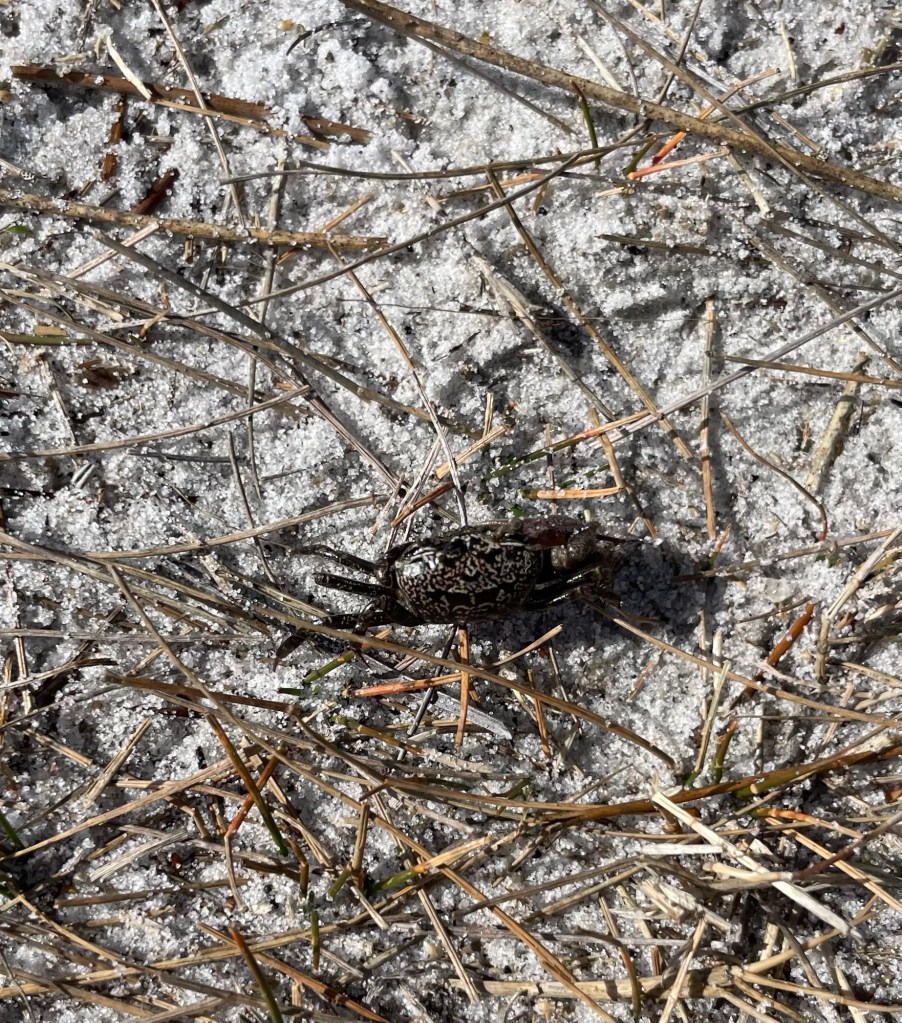
Later we watched a man taking a kite through leaps, curls, and dives. It made a zzz zzzz zzzzz sound as it cut its way through the air. I could have watched it for hours.We wondered what was making tiny little holes in all the sandy areas. Turns out, they’re little crabs of some sort. I never figured out which kind.Jeff learned about Great White Egrets while heading to the beach for sunset. (Zoom in to get a better look.)
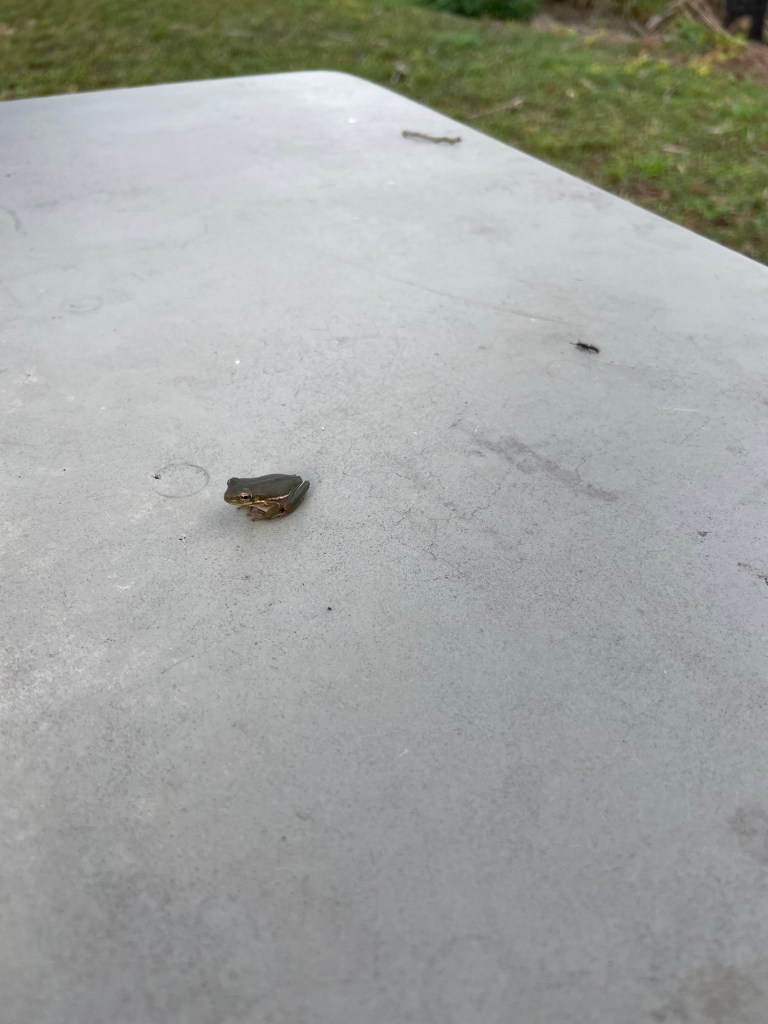
I had several conversations with a tiny green tree frog that lives in one of the women’s shower houses. Jeff found a small cottonmouth snake near our truck. Thankfully the camp host moved it for us. That ticked it off and we got the whole curl and show your fangs show. Cool, but a little terrifying.
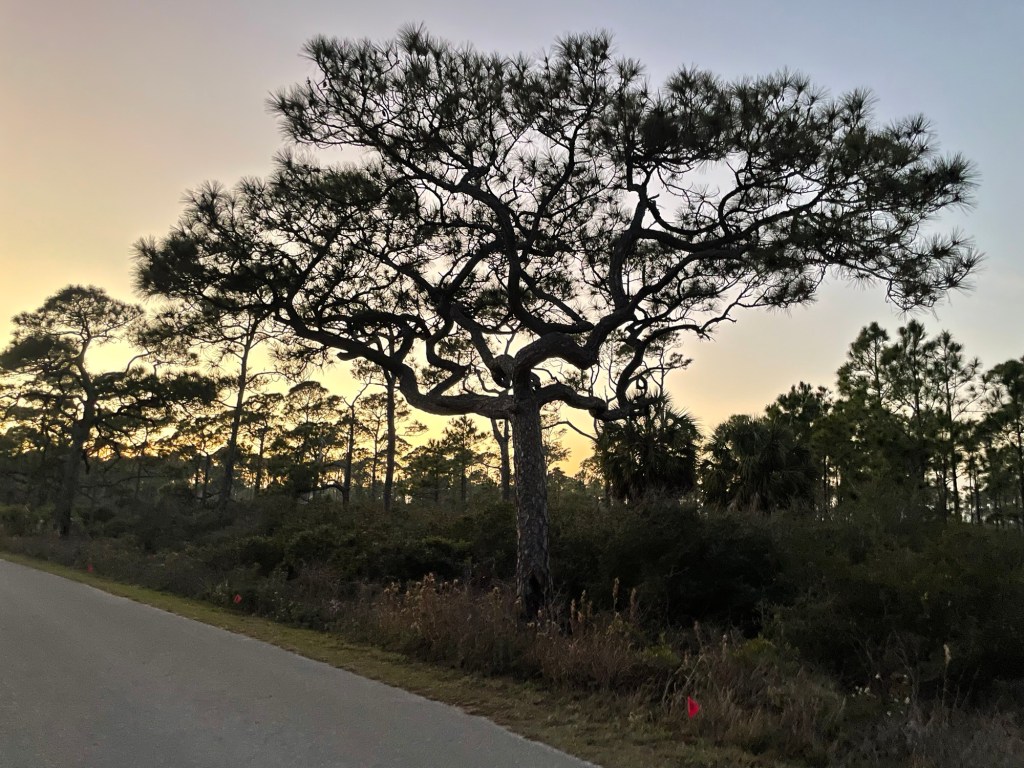
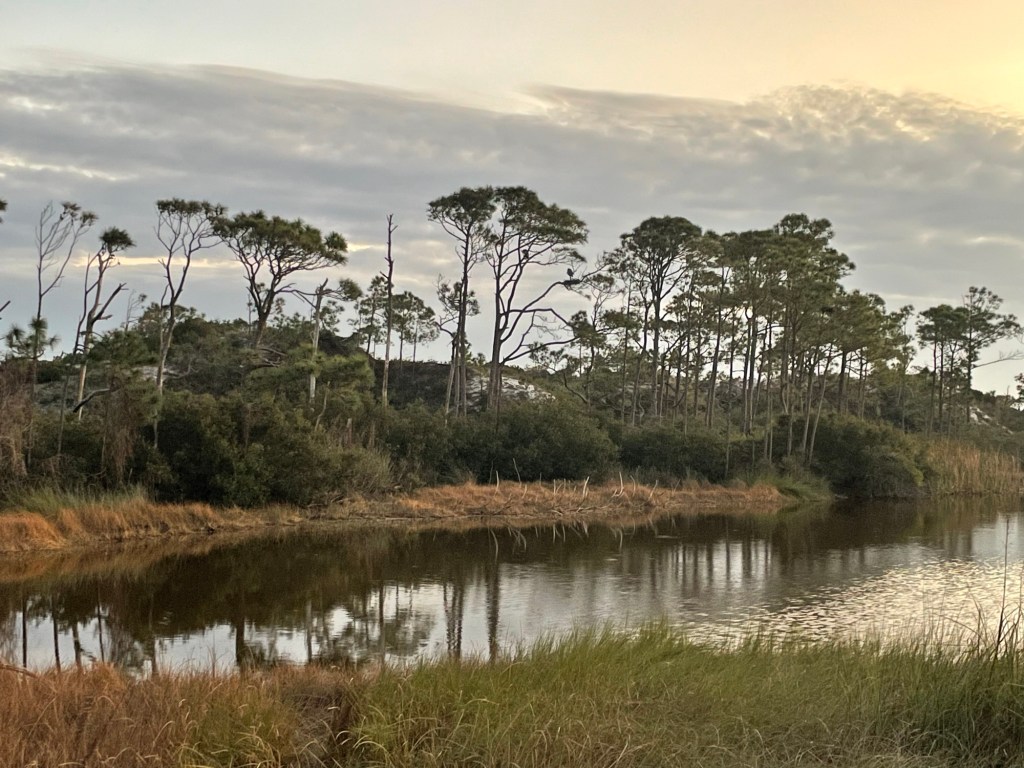
I fell in love with the silhouette of twisting pines against an orange sky.
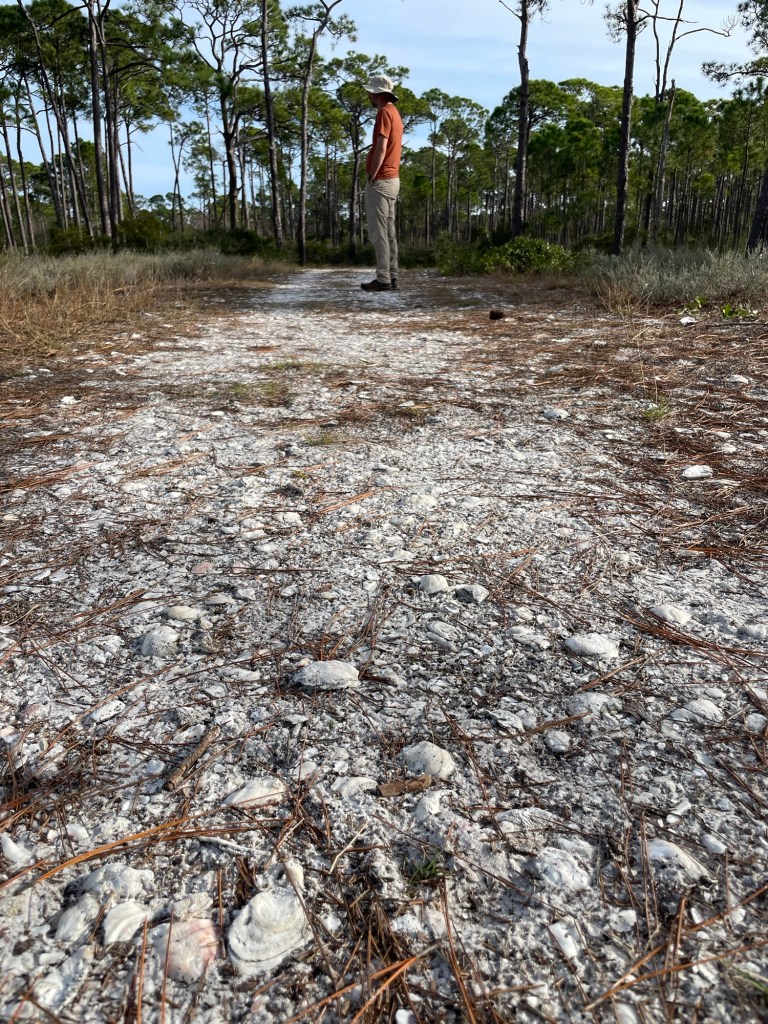
The island introduced us to the concept of using oyster shells as construction materials. It makes perfect sense as there are literally tons of them to be had, free for the taking, since local, raw oysters are a top menu item everywhere in these parts. (Thank you, no.)
Oyster shell path
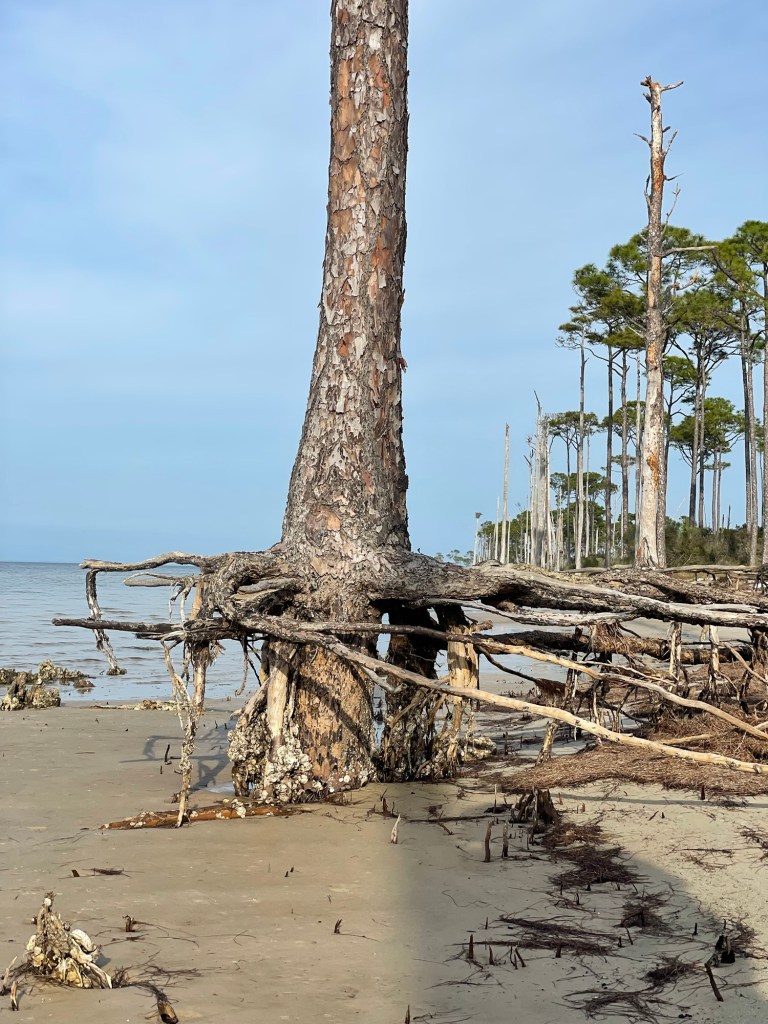
Tides are still something that I’m getting used to. The concept of water levels vastly changing from hour to hour is starting to make space in my brain, but the reality of what it does to the landscape is sometimes still beyond me. Toss in a few hurricanes scouring out the sand and it’s a whole different world.
I mean, seriously, this is wild.
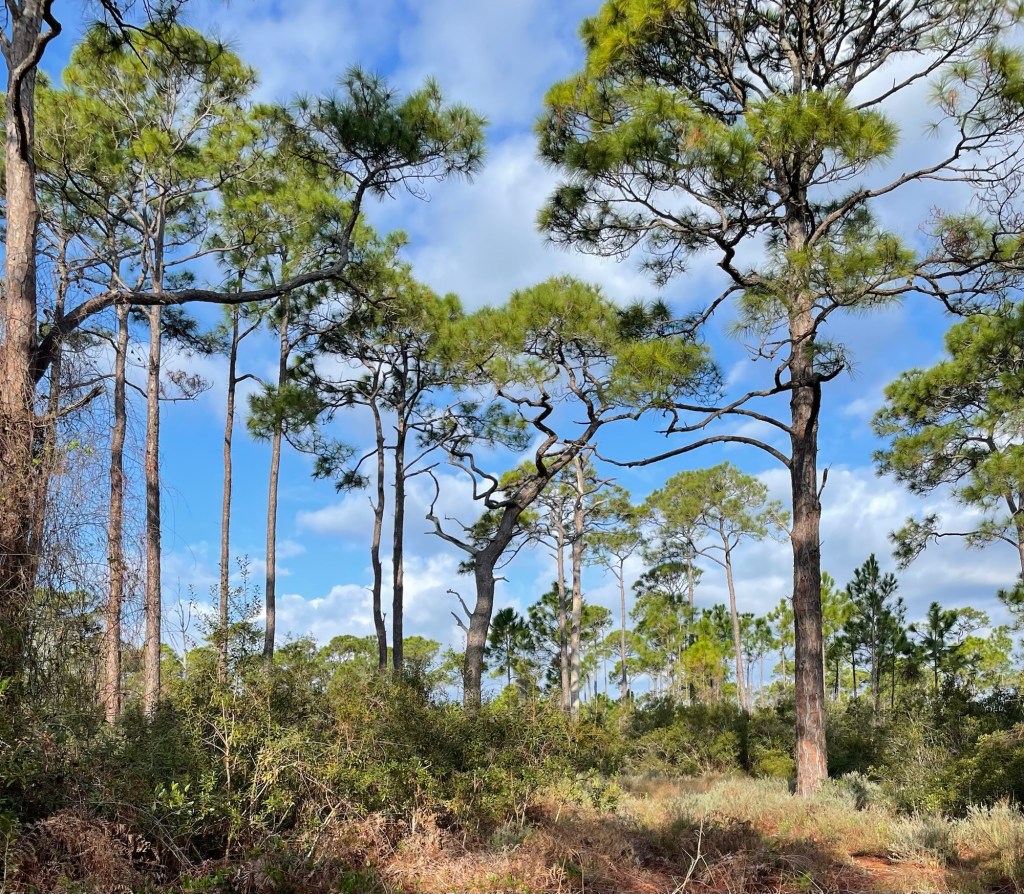
This poor long leaf pine has been through some rough days. The wind-twisted angles of the one below reminds me of trees out on the African savanna.
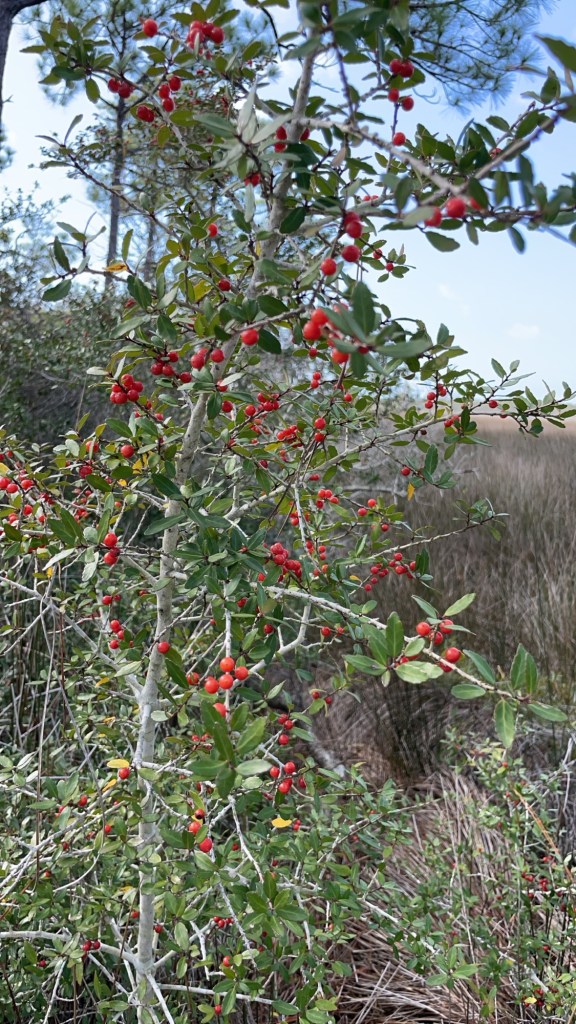
Ilex vomitoria (Yaupon Holly) is common across the park’s wilderness areas. Despite its name, tea made from this plant does not induce vomiting. It’s popular with many birds and mammals.The Panhandle is said to be what Old Florida was like. I can see the appeal. It was hard to leave. “The Forgotten Coast” (Don’t feel too bad, the locals like it that way.)
Florida drivers, we find, are at least as aggressive as Georgians and overly fond of playing on their phones while they drive. Jeff has had to lay on the horn to remind an oncoming car to stay on their own side of the road more than once. Despite all the proof to the contrary, a lot of people still seem to think that texting while driving isn’t a big deal. And there appears to be an inordinate amount of smarter than the average bear drivers down here. Locals love to complain about all the idiot snowbirds on the road, but it’s the Florida plates that terrify us!
We finally made it out of Georgia on Monday the 5th and are now sitting on a very lovely, very sandy barrier island on the Florida panhandle. It’s quiet and peaceful and the local cafe has delicious gluten-free & dairy-free goodies. The Oatmeal Cream Pie made me close my eyes in awe. Gluten-Free Bakery Girl (in Maryland) deserves all the good things in life.
Now, back to Georgia for a few minutes.
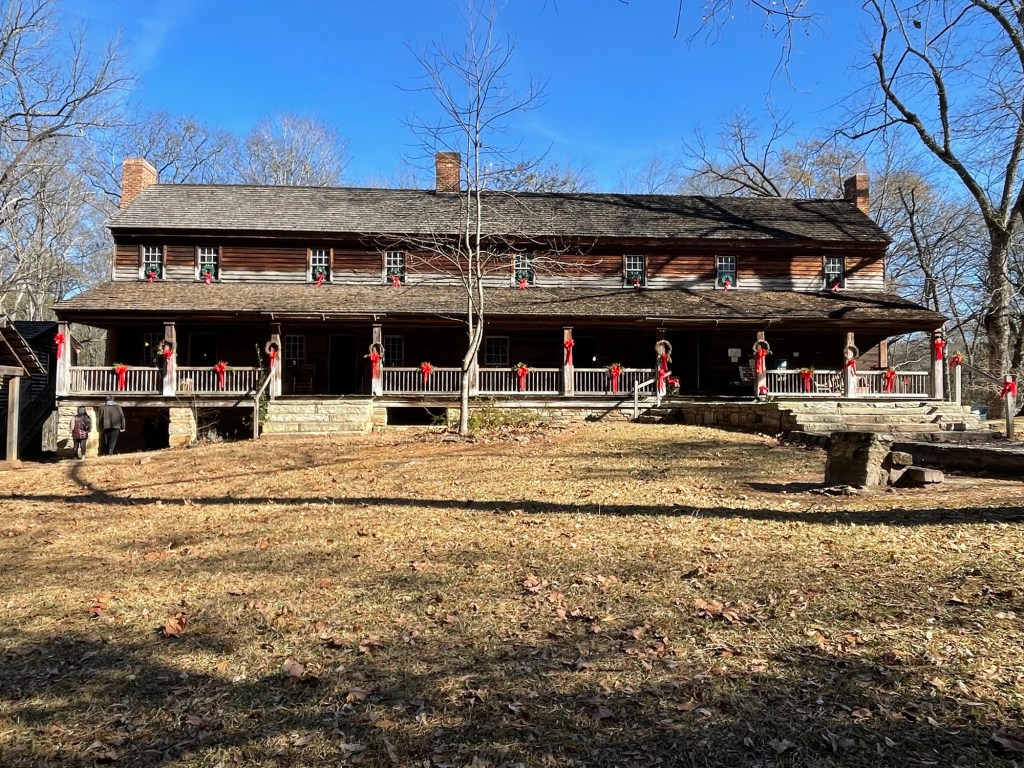
While Ashtabula (last post) started out as a coaching inn and then became a single family’s plantation home, Traveler’s Rest only ever operated as a stagecoach inn. Devereaux Jarrett built it near the intersection of Old King’s Highway and the Unicoi Turnpike. In business from 1815 until 1877, it was granted to the State of Georgia in 1955 by a descendant of his for use as a historical and educational site. The inn now acts as a time capsule and includes a surprising number of pieces of the original handcrafted furniture. According to the video we saw, coaching inns were found about every 20 miles on these long distance highways, as that was about as far as someone could reasonable expect to travel in the days of poorly maintained roads and literal horsepower.
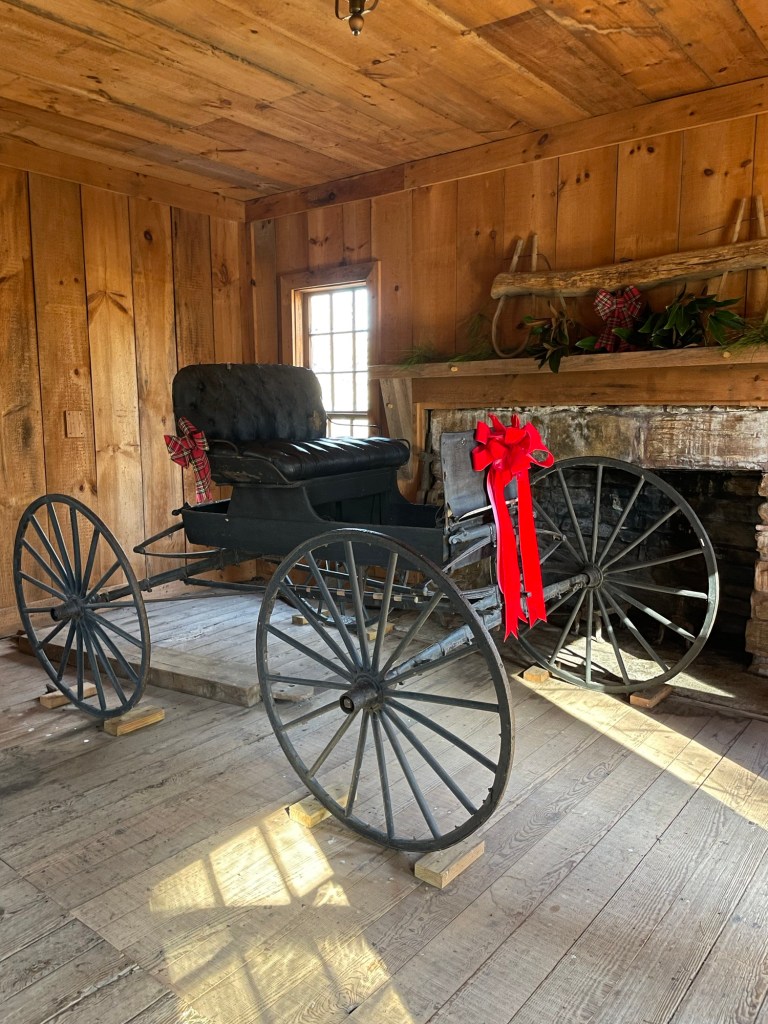
The Jarrett family buggy. One horse power.
A few days before Christmas, the day after we found out that we were not getting the truck back as planned, we drove up to Toccoa and went to a little unassuming spot on the map that I’d been hoping to visit. But since it’s only open a few hours each week, we hadn’t gotten up there.
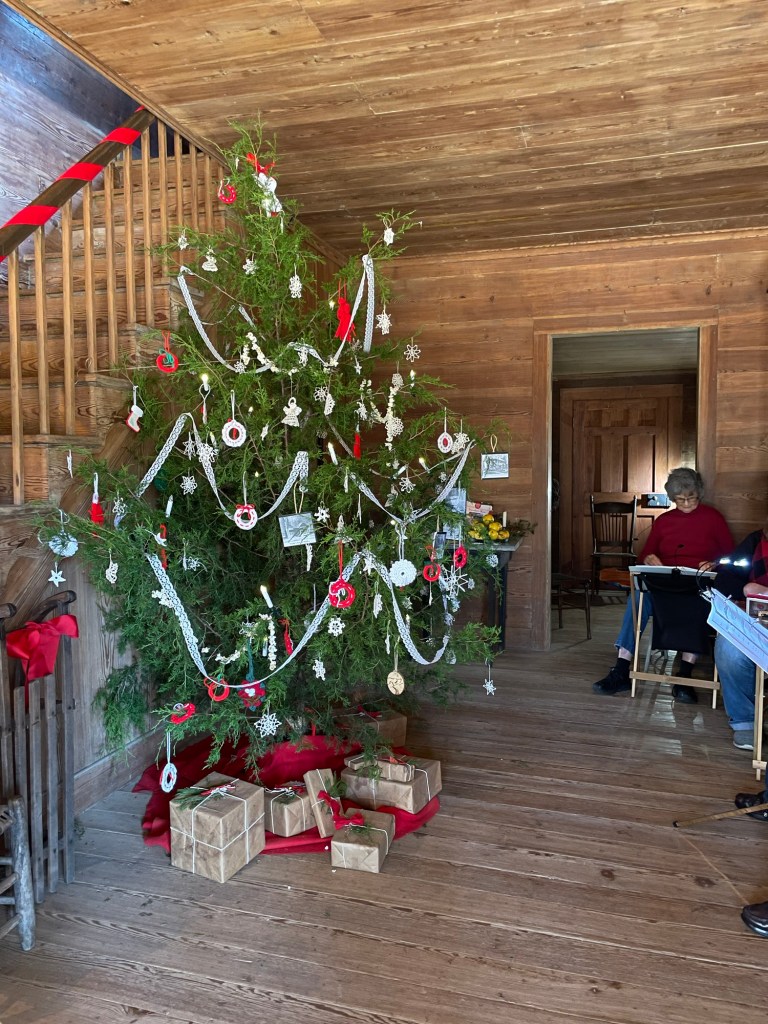
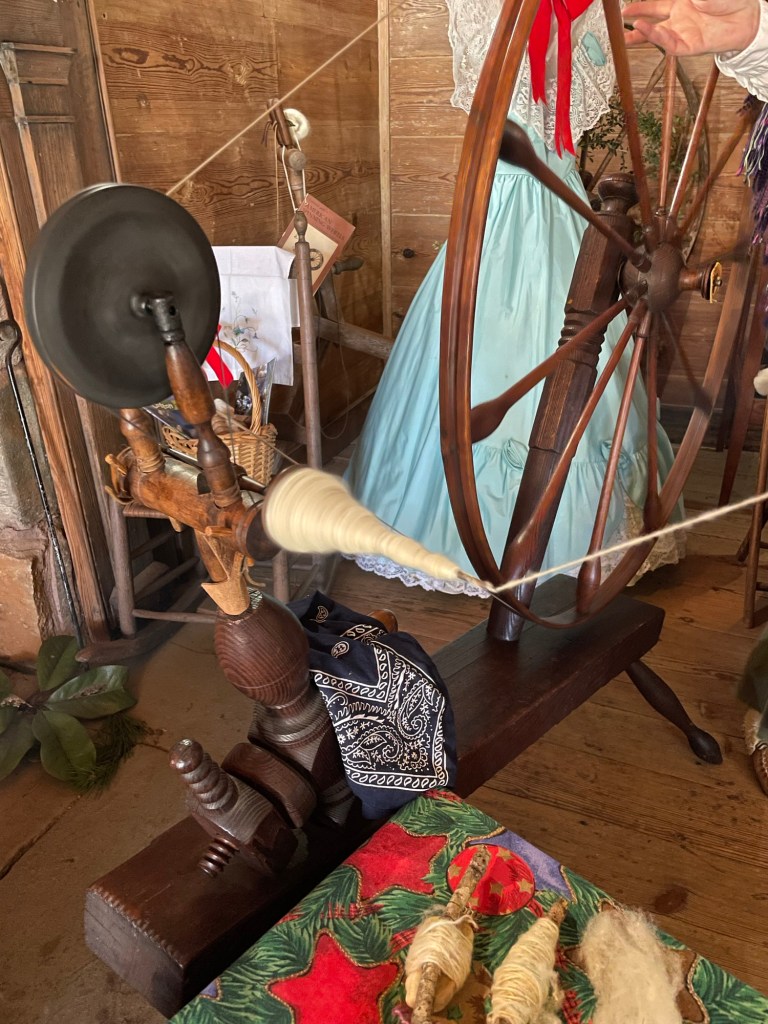
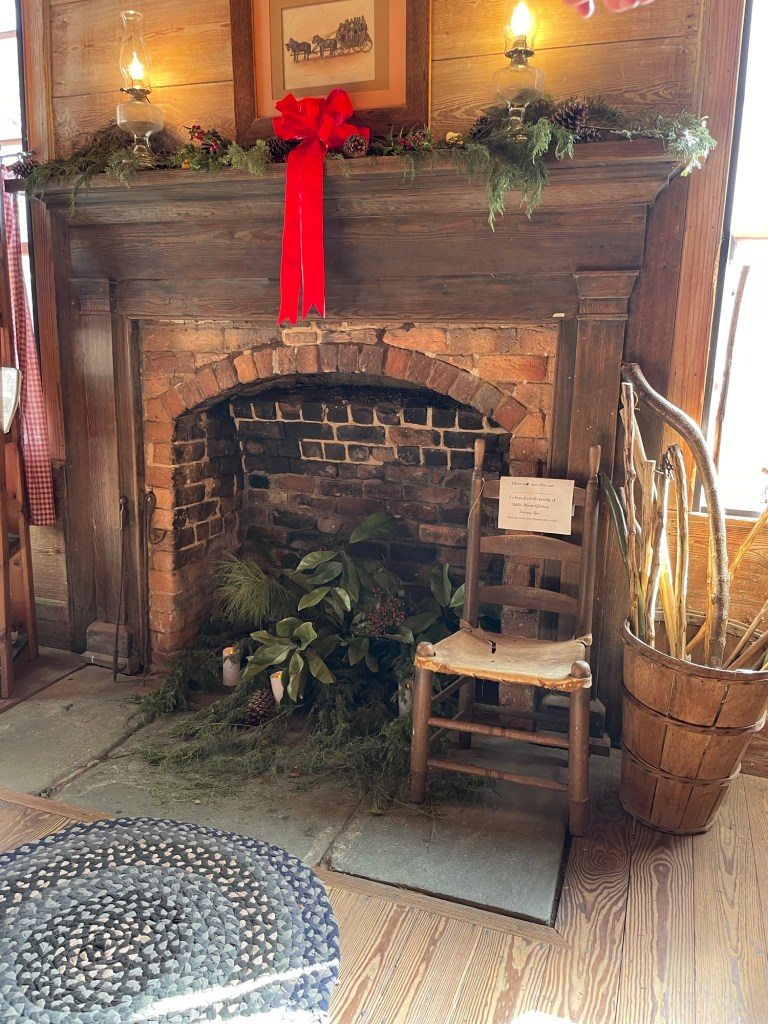
We sure got lucky with our timing. This coaching inn historical site was decked out in holiday decorations, a local dulcimer group was playing carols, volunteers were serving homemade refreshments in the cellar kitchen and in the upstairs pantry, and I got to learn about spinning wool and cotton thread from the most patient and enthusiastic spinner I could have asked for. I ask a lot of questions.
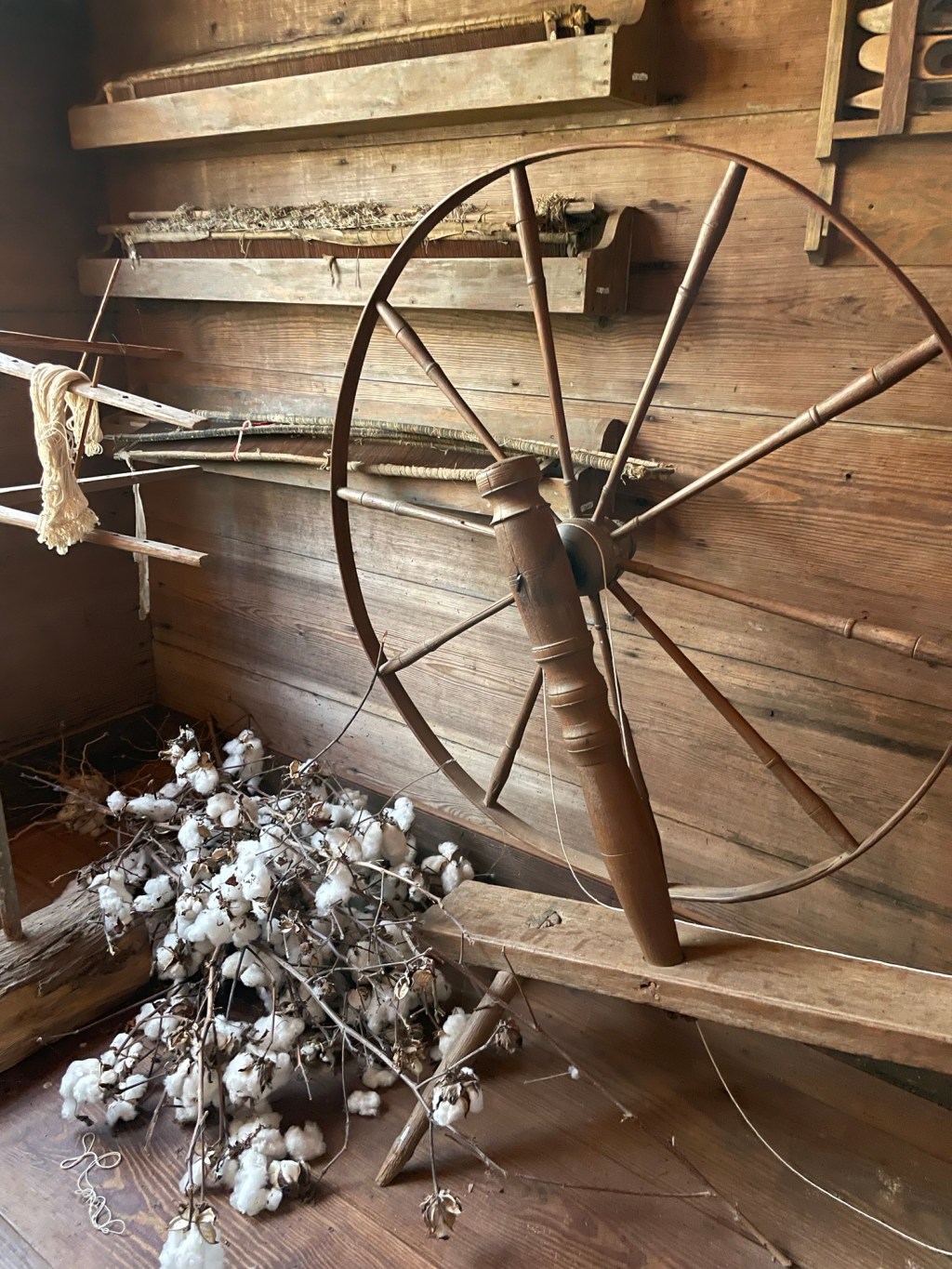
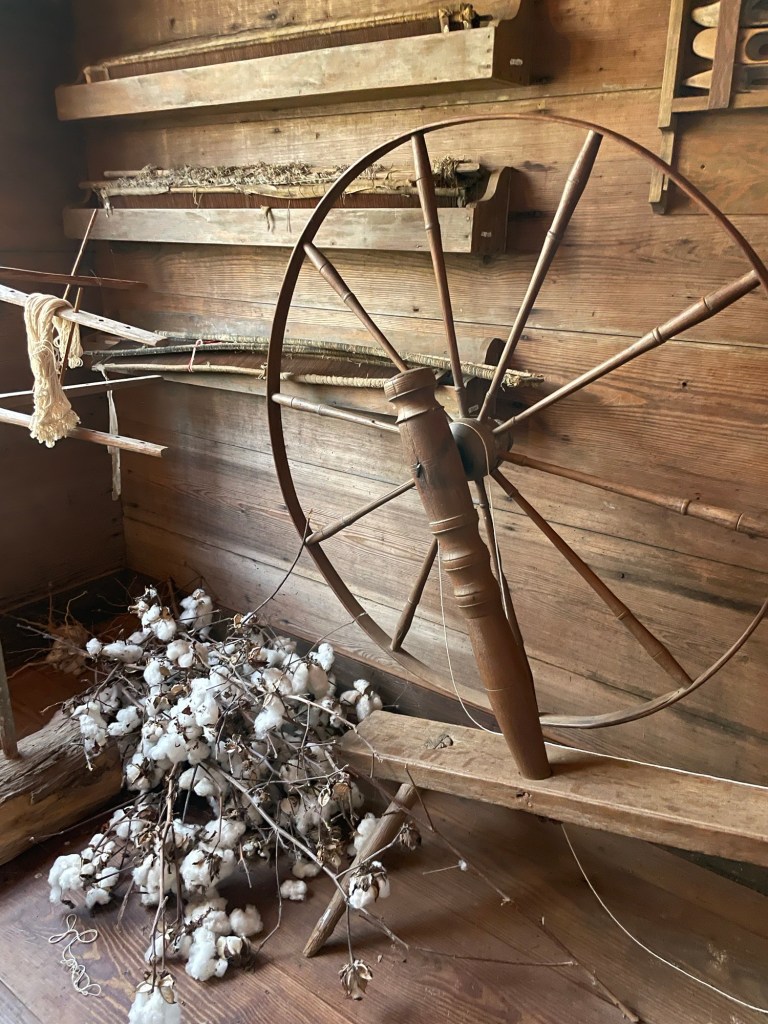
Spinning wheel and cotton on the stem
We lucked out on the weather, too. It was unseasonably warm and a soft breeze was blowing. They had all the doors thrown open which allowed guests to easily move in and out of the inn and around the property. No bunching up in hallways or following someone else’s pace while walking the same route.
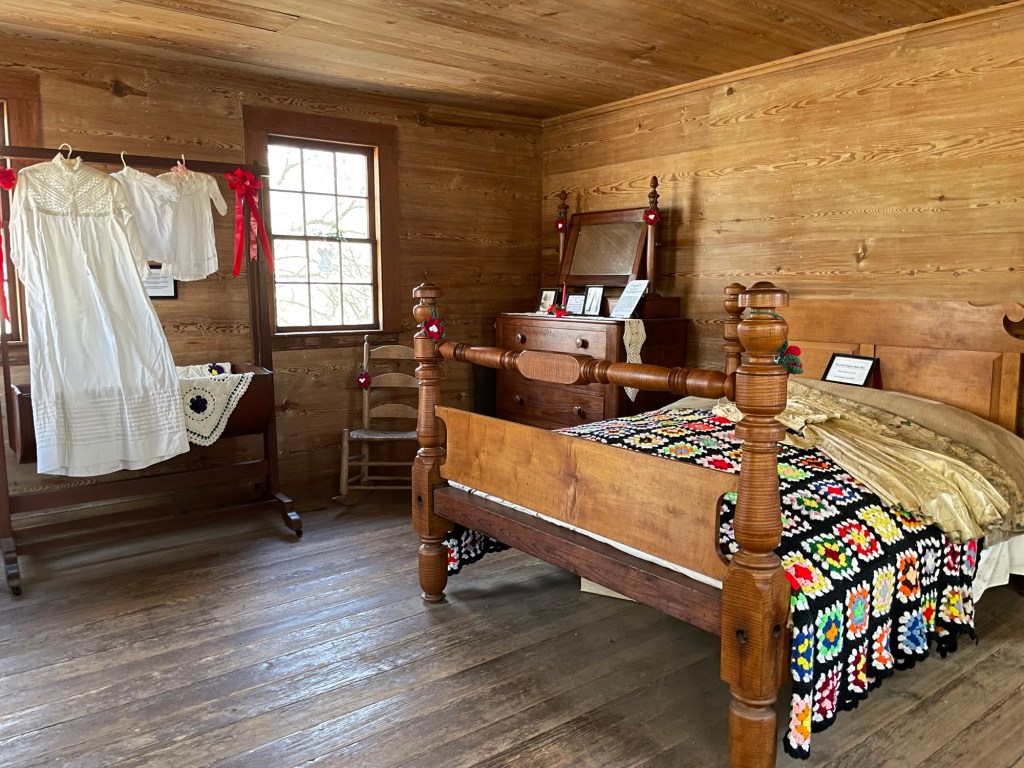
Antique bed frame, bassinet, and dresser. Not the modern crocheted squares coverlet, obviously.
You see that rail at the end of the bed? A quilt was rolled around it, storing it out of the way, and then, when you got cold in the middle of the night, you just pulled it towards you. Instant presto! Nice and toasty. It’s so practical; why don’t we have that on beds anymore?
Unheated bedroom with double bed
Travelers could pick from a private room and bed, heated $$$, a single room with two or more to the bed, unheated $$, or a group room with multiple beds of multiple people, unheated $ (to use the modern travel guide rating system). In this uninsulated hotel made of unfinished pine boards, a fireplace of your own would have made a big difference on a cold day.
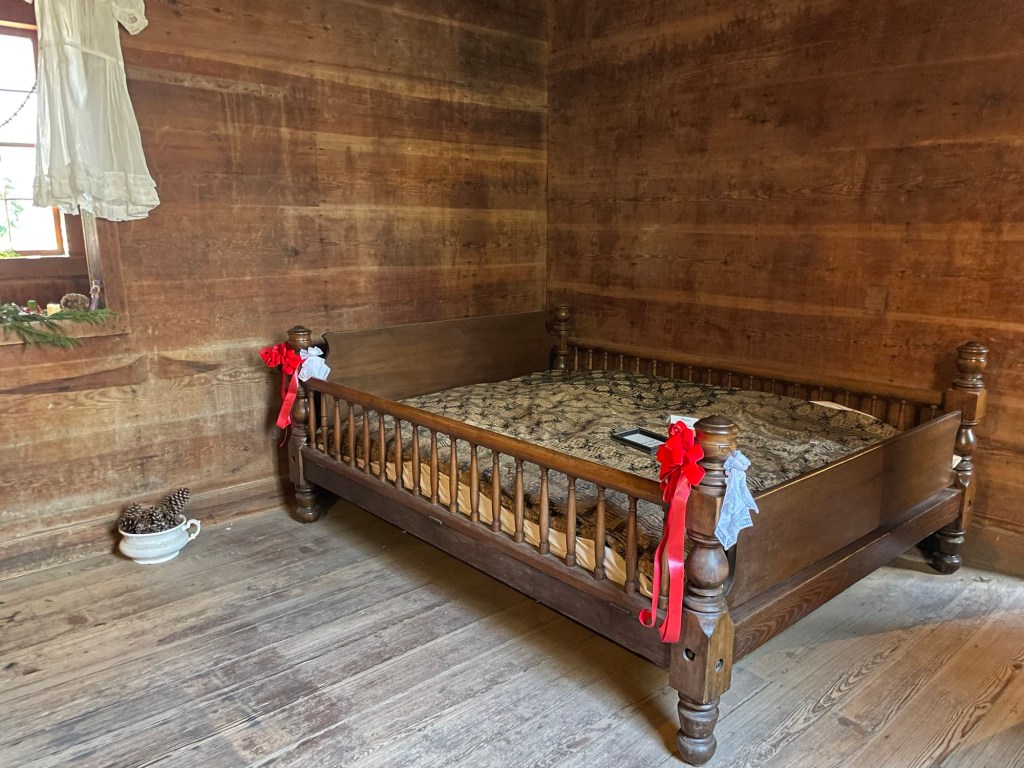
Bed with removable side rails
Can you guess why this bed looks so funny? If you imagine a long pillow going from one solid end to another, it makes more sense. This is where the children slept. Imagine just dumping your kid into the unheated communal kids’ bed and then heading off to sleep in another room. Modern parents would never.
I wonder how well our ideas of decorating for Christmas line up with the actuality of homes from this time period. Not that I think it matters, and I liked seeing everything so cheerful and bright during this rather brown time of year. It’s just a random thing I thought here and at Ashtabula.
Sherri’s wheel, working loose wool into yarn
Now spinning. This, I found fascinating. First, let me say that Sherri has the patience of a saint. Second, she refers to her wheel as ‘she’ and talks about it having preferences, as in, ‘She doesn’t like too much humidity,’ and ‘She doesn’t appreciate being moved.’ Third, the end of that spindle will snag your fingertip something good if you’re not paying attention. Poor Sleeping Beauty.
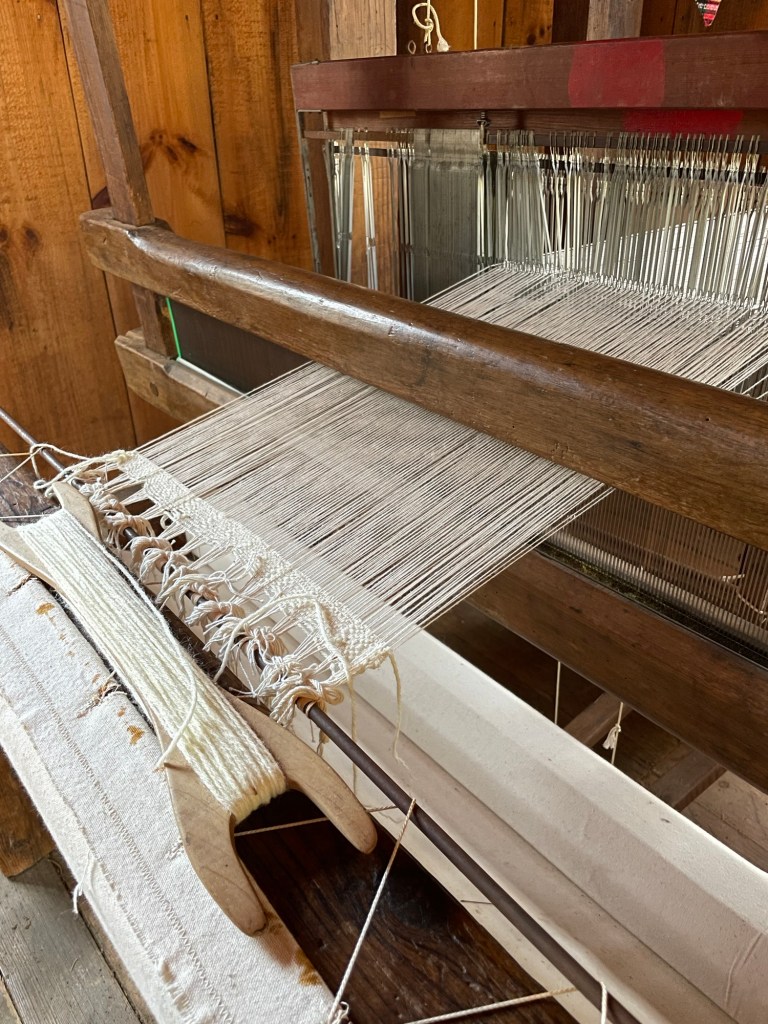
Since nearly all of a household’s day to day textiles were made in house, spinning was an essential part of nearly every woman and child’s life. Sherri said it took between eight to twelve spinners to keep one weaver at a loom. That’s a lot of thread/yarn! I recently read that all children were taught to spin as soon as they were coordinated enough. Women spun whenever they weren’t occupied with other tasks, and people who couldn’t contribute to heavier tasks (such as the elderly, injured, or disabled) spun to assist in the support of the household. Even the men spun in their free time when there was a dire need or if finances were especially tight.
Since spun fiber (wool and cotton) was always in high demand, it was also a way for women who did not marry or were suddenly widowed to financially maintain themselves and any children. Although spinster eventually became a derogatory term meaning a never married women of a certain age, it wasn’t used that way originally. Rather, being a good spinner/spinster was seen as having a highly valued skill and was treated as such.
The family’s loom
Think about the number of cloth goods a typical house would have used. Think about how many things are in your home right now that wouldn’t be out of place in the 1800s. Napkins and shirts, blankets and upholstery. Sheets and aprons, towels and socks. Now imagine making each one by hand. Thread by thread. Stitch by stitch. We didn’t replace things so quickly when we had to make them by hand.
Screw trends and keeping up with the Jones, we repaired things until they were beyond repair and used their scraps after that. Rag rugs, quilts, and saddle blankets, to name a few. We lost something important to the human race, I argue, when that type of thinking stopped being the norm.
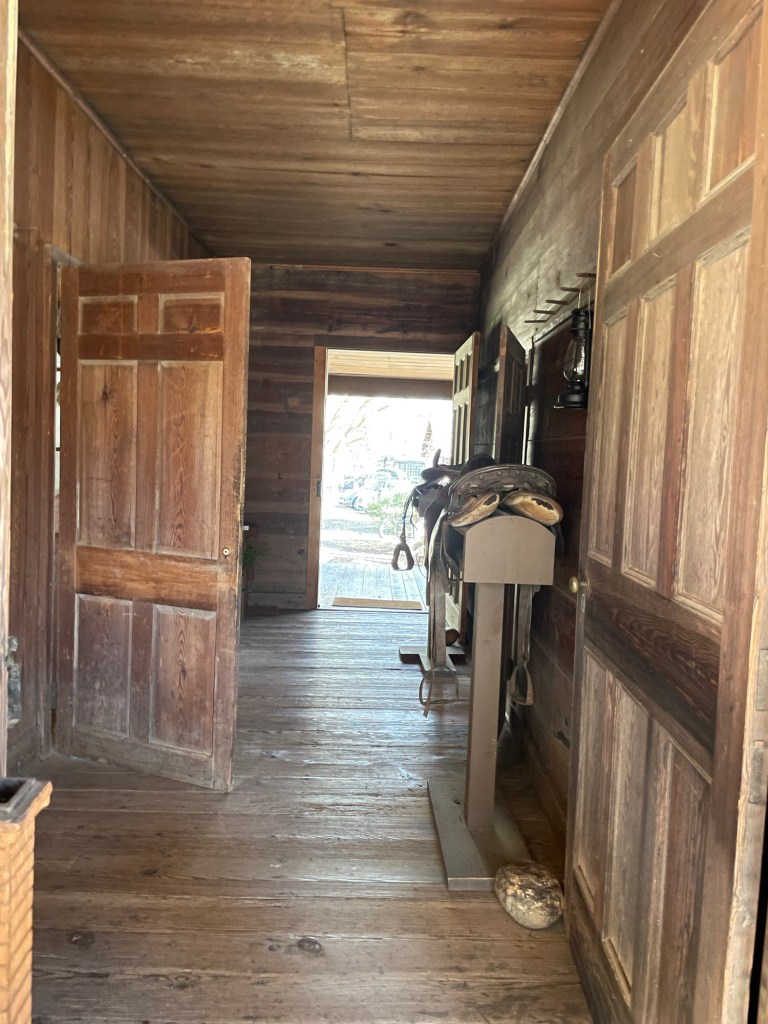
I imagine saddles were not actually kept in the breezeway, but the stable is long gone
I imagine these big breezeways would have felt like the lap of luxury on a gorgeous warm day when a light wind was blowing. The cross breeze from the attached, covered porches would turn the air over quickly and freshen the house, whisking away cooking and other unpleasant smells, and probably drop the interior temps by at least 10°F.
From here you can see how wide the building was when it stopped being an inn. The guest bedrooms are all upstairs, and the cellar kitchen is on the lower left, beneath the dining room. A small staircase connects the two, and the pantry is behind the dining room. The main staircase is sandwiched between the dining room and the left cross-hallway.
Office and reception area
The reception hall is on the far right, with the right cross-hallway behind it. Between the two cross-hallways, the guests’ parlor (front left) and the family’s parlor (front right) sandwich the center fireplace. The lower rooms at the rear were for storage and the family’s use. The loom was housed in its own building, a short distance from the pantry.
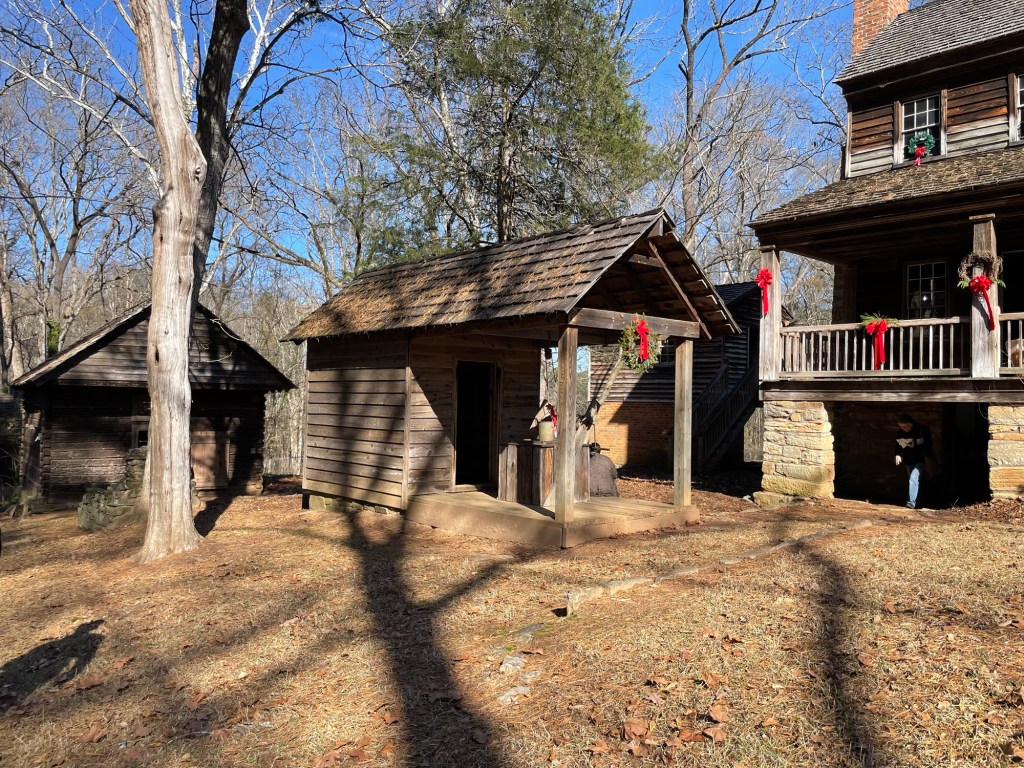
Ice house and covered well, meat house in rear
Outbuildings were all over the property. A well and ice house were must-haves. As were tool sheds, a simple forge with blacksmithing tools for repairs, a carriage house and stable, the necessities (aka outhouses), and cabins for enslaved labor.
Cast iron vat, probably 2 ft (0.6 m) edge to edge
The big vat above rocks back and forth and was used for boiling laundry and making lye soap. I’m not sure where the fire would have been built, maybe around it? Or perhaps under it, if the large slab isn’t original? Maybe in the brickwork behind it? I didn’t think about that until after we left.
The meat house, reproduction
If you zoom in, you can see the tool marks on the logs used to build this shed. It’s not original, but these tool marks are still impressive in my book.
On our way out of Georgia, we stopped at General Coffee State Park to break up the journey. It’s a nice campground with several different hiking trails, super friendly staff, and a cute demonstration farm. I spent some quality time getting to know this handsome bay.
Union troops robbed the home on their way north FROM the March to the Sea, not TO it. It was after his army had bypassed Charleston and went instead to Columbia (where ironically Charlestonians had moved their families, money, and household goods for safekeeping), on his way to North Carolina that small raiding parties pillaged the Uplands’ homes and businesses.
The things that wake me up in the middle of the night.